
Mind map
MALAYSIA LEGAL SYSTEM
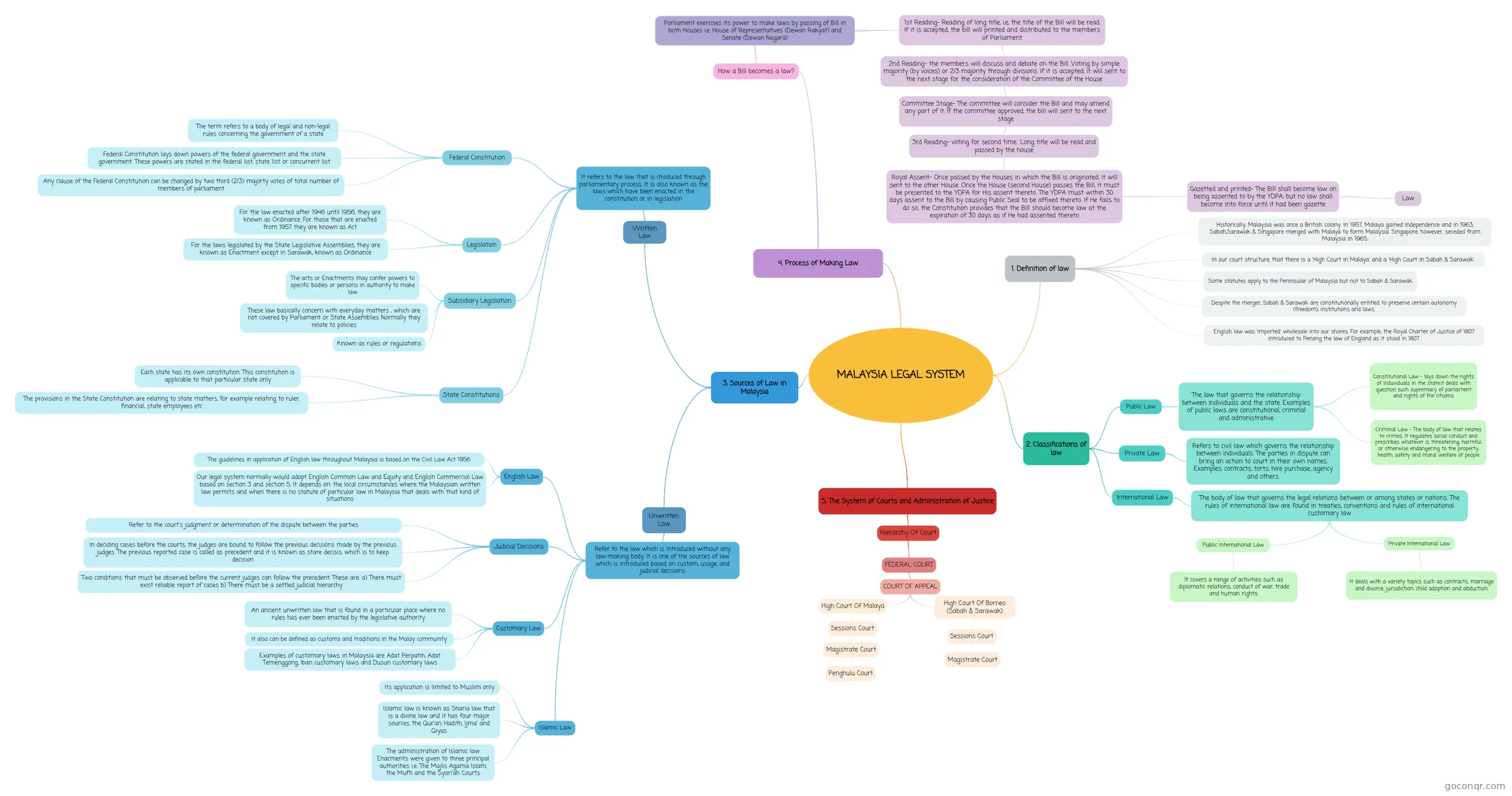
Mind map: Malaysia legal system
Map content
MALAYSIA LEGAL SYSTEM
1. Definition of law
- Historically, Malaysia was once a British colony. In 1957, Malaya gained independence and in 1963, Sabah,Sarawak & Singapore merged with Malaya to form Malaysia. Singapore, however, seceded from Malaysia in 1965.
- In our court structure, that there is a 'High Court in Malaya' and a 'High Court in Sabah & Sarawak'.
- Some statutes apply to the Peninsular of Malaysia but not to Sabah & Sarawak
- Despite the merger, Sabah & Sarawak are constitutionally entitled to preserve certain autonomy (freedom), institutions and laws.
- English law was 'imported' wholesale into our shores. For example, the Royal Charter of Justice of 1807 introduced to Penang the law of England as it stood in 1807.
2. Classifications of law
- Public Law
- The law that governs the relationship between individuals and the state. Examples of public laws are constitutional, criminal and administrative
- Constitutional Law - lays down the rights of induviduals in the state.it deals with question such supremacy of parliament and rights of the citizens
- Criminal Law - The body of law that relates to crimes. It regulates social conduct and prescribes whatever is threatening, harmful, or otherwise endangering to the property, health, safety and moral welfare of people
- The law that governs the relationship between individuals and the state. Examples of public laws are constitutional, criminal and administrative
- Private Law
- Refers to civil law which governs the relationship between individuals. The parties in dispute can bring an action to court in their own names. Examples, contracts, torts, hire purchase, agency and others.
- International Law
- The body of law that governs the legal relations between or among states or nations. The rules of international law are found in treaties, conventions and rules of international customary law
- Public International Law
- It covers a range of activities such as diplomatic relations, conduct of war, trade and human rights.
- Private International Law
- It deals with a variety topics such as contracts, marriage and divorce, jurisdiction, child adoption and abduction.
- Public International Law
- The body of law that governs the legal relations between or among states or nations. The rules of international law are found in treaties, conventions and rules of international customary law
- Public Law
3. Sources of Law in Malaysia
- Written Law
- It refers to the law that is itroduced through parliamentary process. It is also known as the laws which have been enacted in the constitution or in legislation
- Federal Constitution
- The term refers to a body of legal and non-legal rules concerning the government of a state
- Federal Constitution lays down powers of the federal government and the state government. These powers are stated in the federal list, state list or concurrent list
- Any clause of the Federal Constitution can be changed by two third (2/3) majorty votes of total number of members of parliament
- Subsidiary Legislation
- The acts or Enactments may confer powers to specific bodies or persons in authority to make law
- These law basically concern with everyday matters , which are not covered by Parliament or State Assemblies Normally they relate to policies
- Known as rules or regulations
- Legislation
- For the law enacted after 1946 until 1956, they are known as Ordinance. For those that are enacted from 1957 they are known as Act
- For the laws legislated by the State Legislative Assemblies, they are known as Enactment except in Sarawak, known as Ordinance
- State Constitutions
- Each state has its own constitution. This constitution is applicable to that particular state only
- The provisions in the State Constitution are relating to state matters, for example relating to ruler, financial, state employees etc
- Federal Constitution
- It refers to the law that is itroduced through parliamentary process. It is also known as the laws which have been enacted in the constitution or in legislation
- Unwritten Law
- Refer to the law which is introduced without any law-making body. It is one of the sources of law which is introduced based on custom, usage, and judicial decisions
- English Law
- The guidelines in application of English law throughout Malaysia is based on the Civil Law Act 1956
- Our legal system normally would adopt English Common Law and Equity and English Commercial Law based on section 3 and section 5. It depends on: the local circumstances where the Malaysian written law permits and when there is no statute of particular law in Malaysia that deals with that kind of situations
- Judicial Decisions
- Refer to the court's judgment or determination of the dispute between the parties
- In deciding cases before the courts, the judges are bound to follow the previous decisions made by the previous judges. The previous reported case is called as precedent and it is known as stare decisis, which is to keep decision
- Two conditions that must be observed before the current judges can follow the precedent. These are: a) There must exist reliable report of cases b) There must be a settled judicial hierarchy
- Customary Law
- An ancient unwritten law that is found in a particular place where no rules has ever been enacted by the legislative authority
- It also can be defined as customs and traditions in the Malay community
- Examples of customary laws in Malaysia are Adat Perpatih, Adat Temenggong, Iban customary laws and Dusun customary laws
- Islamic Law
- Its application is limited to Muslim only
- Islamic law is known as Sharia law that is a divine law and it has four major sources, the Qur'an, Hadith, Ijma' and Qiyas
- The administration of Islamic law Enacments were given to three principal authorities i.e. The Majlis Agama Islam, the Mufti and the Syari'ah Courts
- English Law
- Refer to the law which is introduced without any law-making body. It is one of the sources of law which is introduced based on custom, usage, and judicial decisions
- Written Law
4. Process of Making Law
- How a Bill becomes a law?
- Parliament exercises its power to make laws by passing of Bill in both Houses i.e. House of Representatives (Dewan Rakyat) and Senate (Dewan Negara)
- 1st Reading- Reading of long title, i.e, the title of the Bill will be read. If it is accepted, the bill will printed and distributed to the members of Parliament
- 2nd Reading- the members will discuss and debate on the Bill. Voting by simple majority (by voices) or 2/3 majority through divisions. If it is accepted, it will sent to the next stage for the consideration of the Committee of the House
- Committee Stage- The committee will consider the Bill and may amend any part of it. If the committee approved, the bill will sent to the next stage
- 3rd Reading- voting for second time.. Long title will be read and passed by the house
- Royal Assent- Once passed by the Houses in which the Bill is originated, it will sent to the other House. Once the House (second House) passes the Bill, it must be presented to the YDPA for His assent thereto. The YDPA must within 30 days assent to the Bill by causing Public Seal to be affixed thereto. If He fails to do so, the Constitution provides that the Bill should become law at the expiration of 30 days as if He had assented thereto
- Gazetted and printed- The Bill shall become law on being assented to by the YDPA, but no law shall become into force until it had been gazette
- Law
- Gazetted and printed- The Bill shall become law on being assented to by the YDPA, but no law shall become into force until it had been gazette
- Royal Assent- Once passed by the Houses in which the Bill is originated, it will sent to the other House. Once the House (second House) passes the Bill, it must be presented to the YDPA for His assent thereto. The YDPA must within 30 days assent to the Bill by causing Public Seal to be affixed thereto. If He fails to do so, the Constitution provides that the Bill should become law at the expiration of 30 days as if He had assented thereto
- 3rd Reading- voting for second time.. Long title will be read and passed by the house
- Committee Stage- The committee will consider the Bill and may amend any part of it. If the committee approved, the bill will sent to the next stage
- 2nd Reading- the members will discuss and debate on the Bill. Voting by simple majority (by voices) or 2/3 majority through divisions. If it is accepted, it will sent to the next stage for the consideration of the Committee of the House
- 1st Reading- Reading of long title, i.e, the title of the Bill will be read. If it is accepted, the bill will printed and distributed to the members of Parliament
- Parliament exercises its power to make laws by passing of Bill in both Houses i.e. House of Representatives (Dewan Rakyat) and Senate (Dewan Negara)
- How a Bill becomes a law?
5. The System of Courts and Administration of Justice
- Hierarchy Of Court
- FEDERAL COURT
- COURT OF APPEAL
- High Court Of Malaya
- Sessions Court
- Magistrate Court
- Penghulu Court
- Magistrate Court
- Sessions Court
- High Court Of Borneo (Sabah & Sarawak)
- Sessions Court
- Magistrate Court
- Sessions Court
- High Court Of Malaya
- COURT OF APPEAL
- FEDERAL COURT
- Hierarchy Of Court
Information
- Description
- Mind Map on MALAYSIA LEGAL SYSTEM, created by aziza zakariah on 11/07/2020.
- Created by
- aziza zakariah
- Views
- 1
- Rating