
Mind map
Gas Exchange in Fish
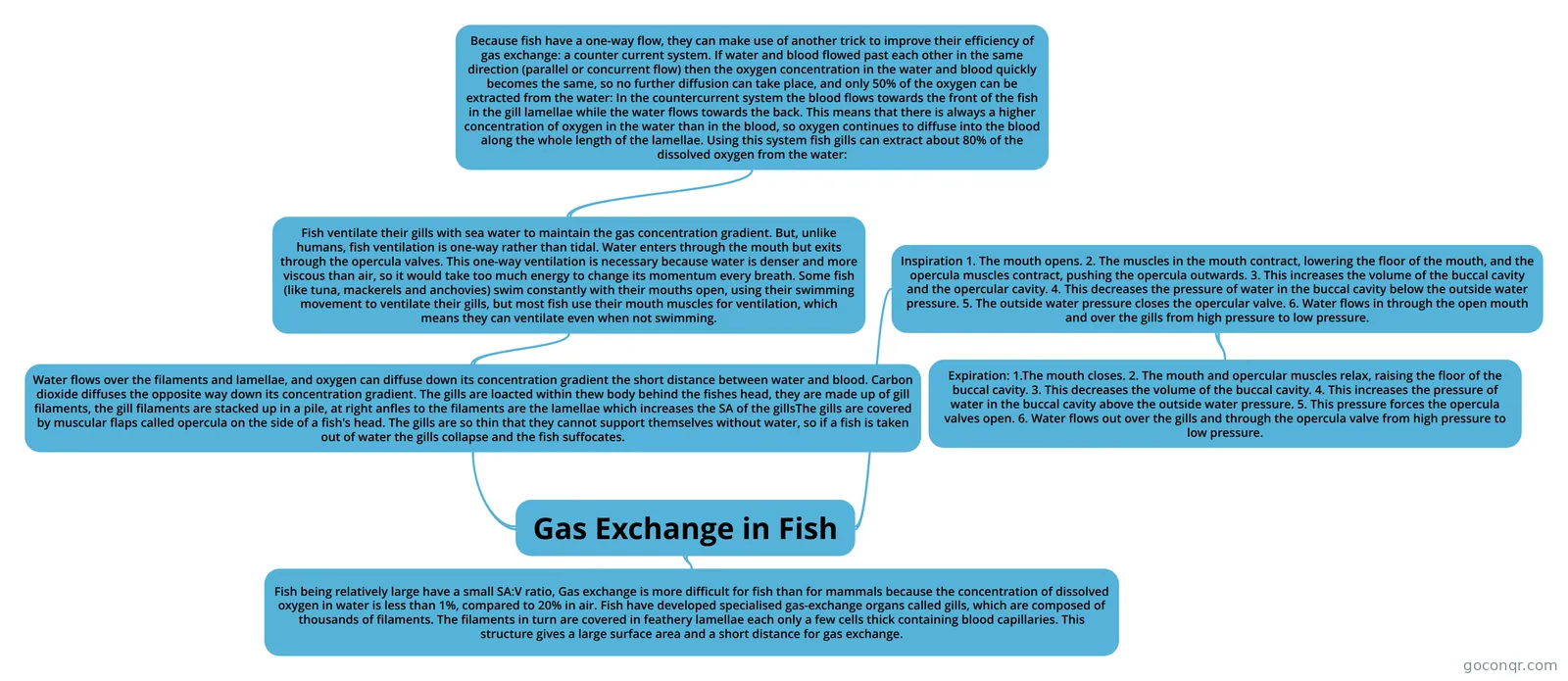
Mind map: Gas exchange in fish
Map content
Gas Exchange in Fish
Fish being relatively large have a small SA:V ratio, Gas exchange is more difficult for fish than for mammals because the concentration of dissolved oxygen in water is less than 1%, compared to 20% in air. Fish have developed specialised gas-exchange organs called gills, which are composed of thousands of filaments. The filaments in turn are covered in feathery lamellae each only a few cells thick containing blood capillaries. This structure gives a large surface area and a short distance for gas exchange.
Water flows over the filaments and lamellae, and oxygen can diffuse down its concentration gradient the short distance between water and blood. Carbon dioxide diffuses the opposite way down its concentration gradient. The gills are loacted within thew body behind the fishes head, they are made up of gill filaments, the gill filaments are stacked up in a pile, at right anfles to the filaments are the lamellae which increases the SA of the gillsThe gills are covered by muscular flaps called opercula on the side of a fish's head. The gills are so thin that they cannot support themselves without water, so if a fish is taken out of water the gills collapse and the fish suffocates.
- Fish ventilate their gills with sea water to maintain the gas concentration gradient. But, unlike humans, fish ventilation is one-way rather than tidal. Water enters through the mouth but exits through the opercula valves. This one-way ventilation is necessary because water is denser and more viscous than air, so it would take too much energy to change its momentum every breath. Some fish (like tuna, mackerels and anchovies) swim constantly with their mouths open, using their swimming movement to ventilate their gills, but most fish use their mouth muscles for ventilation, which means they can ventilate even when not swimming.
- Because fish have a one-way flow, they can make use of another trick to improve their efficiency of gas exchange: a counter current system. If water and blood flowed past each other in the same direction (parallel or concurrent flow) then the oxygen concentration in the water and blood quickly becomes the same, so no further diffusion can take place, and only 50% of the oxygen can be extracted from the water: In the countercurrent system the blood flows towards the front of the fish in the gill lamellae while the water flows towards the back. This means that there is always a higher concentration of oxygen in the water than in the blood, so oxygen continues to diffuse into the blood along the whole length of the lamellae. Using this system fish gills can extract about 80% of the dissolved oxygen from the water:
- Fish ventilate their gills with sea water to maintain the gas concentration gradient. But, unlike humans, fish ventilation is one-way rather than tidal. Water enters through the mouth but exits through the opercula valves. This one-way ventilation is necessary because water is denser and more viscous than air, so it would take too much energy to change its momentum every breath. Some fish (like tuna, mackerels and anchovies) swim constantly with their mouths open, using their swimming movement to ventilate their gills, but most fish use their mouth muscles for ventilation, which means they can ventilate even when not swimming.
Inspiration 1. The mouth opens. 2. The muscles in the mouth contract, lowering the floor of the mouth, and the opercula muscles contract, pushing the opercula outwards. 3. This increases the volume of the buccal cavity and the opercular cavity. 4. This decreases the pressure of water in the buccal cavity below the outside water pressure. 5. The outside water pressure closes the opercular valve. 6. Water flows in through the open mouth and over the gills from high pressure to low pressure.
- Expiration: 1.The mouth closes. 2. The mouth and opercular muscles relax, raising the floor of the buccal cavity. 3. This decreases the volume of the buccal cavity. 4. This increases the pressure of water in the buccal cavity above the outside water pressure. 5. This pressure forces the opercula valves open. 6. Water flows out over the gills and through the opercula valve from high pressure to low pressure.
Information
- Description
- Mind Map on Gas Exchange in Fish, created by basharatbadr on 03/04/2015.
- Created by
- basharatbadr
- Views
- 13
- Rating