
Mind map
2 Industrial and commercial practice
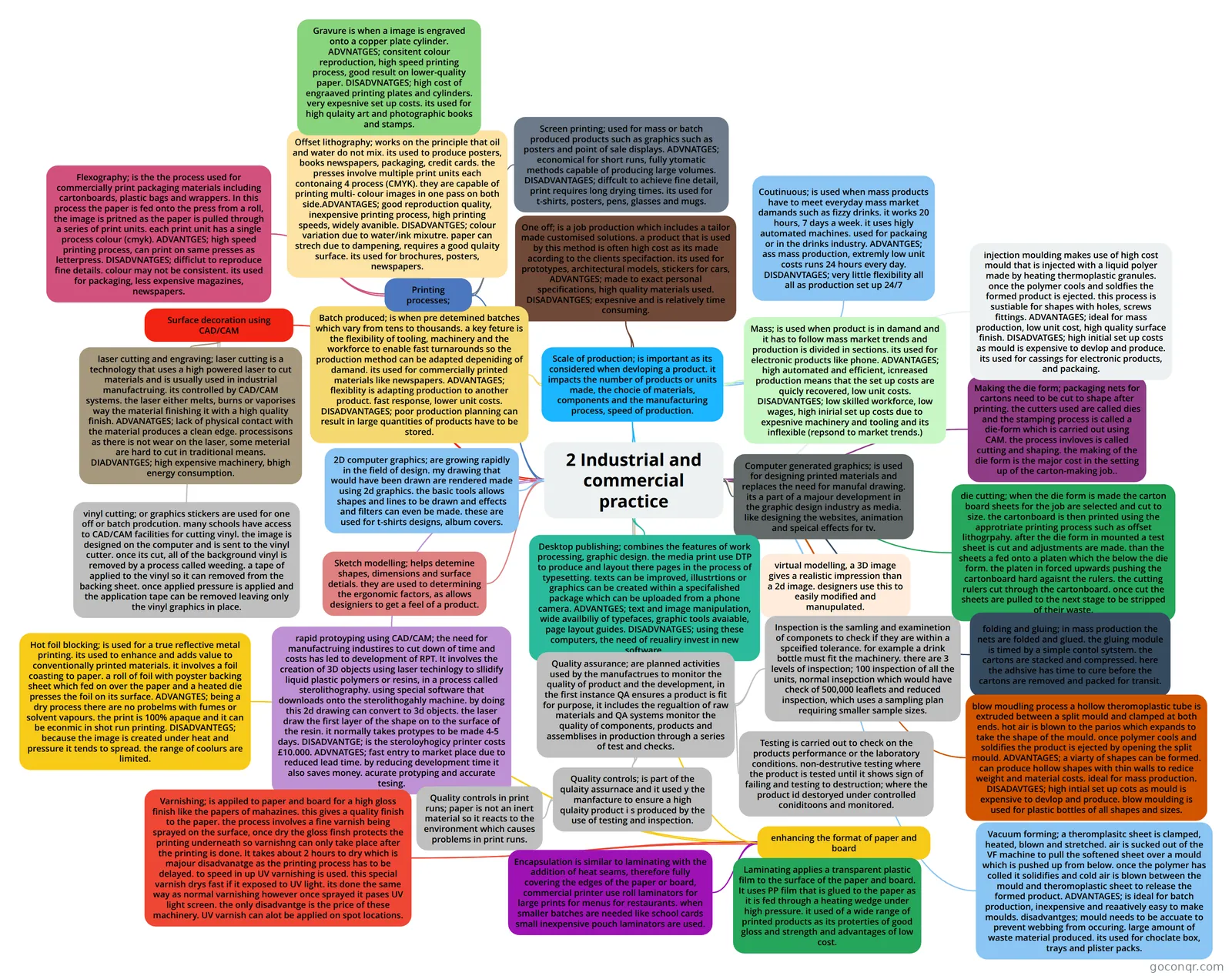
Mind map: Industrial and commercial practice
Map content
2 Industrial and commercial practice
Scale of production; is important as its considered when devloping a product. it impacts the number of products or units made, the chocie of materials, components and the manufacturing process, speed of production.
- One off; is a job production which includes a tailor made customised solutions. a product that is used by this method is often high cost as its made acording to the clients specifaction. its used for prototypes, architectural models, stickers for cars, ADVANTGES; made to exact personal specifications, high quality materials used. DISADVANTGES; expesnive and is relatively time consuming.
- Batch produced; is when pre detemined batches which vary from tens to thousands. a key feture is the flexibility of tooling, machinery and the workforce to enable fast turnarounds so the production method can be adapted depeniding of damand. its used for commercially printed materials like newspapers. ADVANTAGES; flexiblity is adapting production to another product. fast response, lower unit costs. DISADVANTAGES; poor production planning can result in large quantities of products have to be stored.
- Mass; is used when product is in damand and it has to follow mass market trends and production is divided in sections. its used for electronic products like phone. ADVANTAGES; high automated and efficient, icnreased production means that the set up costs are quicly recovered, low unit costs. DISADVANTGES; low skilled workforce, low wages, high inirial set up costs due to expesnive machinery and tooling and its inflexible (repsond to market trends.)
- Coutinuous; is used when mass products have to meet everyday mass market damands such as fizzy drinks. it works 20 hours, 7 days a week. it uses higly automated machines. used for packaing or in the drinks industry. ADVANTGES; ass mass production, extremly low unit costs runs 24 hours every day. DISDANVTAGES; very little flexibility all all as production set up 24/7
Computer generated graphics; is used for designing printed materials and replaces the need for manufal drawing. its a part of a majour development in the graphic design industry as media. like designing the websites, animation and speical effects for tv.
Desktop publishing; combines the features of work processing, graphic design. the media print use DTP to produce and layout there pages in the process of typesetting. texts can be improved, illustrtions or graphics can be created within a specifalished package which can be uploaded from a phone camera. ADVANTGES; text and image manipulation, wide availbiliy of typefaces, graphic tools avaiable, page layout guides. DISADVNATGES; using these computers, the need of reualiry invest in new software.
2D computer graphics; are growing rapidly in the field of design. my drawing that would have been drawn are rendered made using 2d graphics. the basic tools allows shapes and lines to be drawn and effects and filters can even be made. these are used for t-shirts designs, album covers.
Sketch modelling; helps detemine shapes, dimensions and surface detials. they are used to determining the ergonomic factors, as allows designiers to get a feel of a product.
rapid protoyping using CAD/CAM; the need for manufactruing industires to cut down of time and costs has led to development of RPT. It involves the creation of 3D objects using laser techinlogy to sllidify liquid plastic polymers or resins, in a process called sterolithography. using special software that downloads onto the sterolithogahly machine. by doing this 2d drawing can convert to 3d objects. the laser draw the first layer of the shape on to the surface of the resin. it normally takes protypes to be made 4-5 days. DISADVANTGE; is the steroloyhogicy printer costs £10.000. ADVNATGES; fast entry to market place due to reduced lead time. by reducing development time it also saves money. acurate protyping and accurate tesing.
virtual modelling, a 3D image gives a realistic impression than a 2d image. designers use this to easily modified and manupulated.
Quality assurance; are planned activities used by the manufactrues to monitor the quality of product and the development, in the first instance QA ensures a product is fit for purpose, it includes the regualtion of raw materials and QA systems monitor the quality of components, products and assemblises in production through a series of test and checks.
- Quality controls; is part of the qulaity assurnace and it used y the manfacture to ensure a high qulaity product i s produced by the use of testing and inspection.
- Quality controls in print runs; paper is not an inert material so it reacts to the environment which causes problems in print runs.
- Inspection is the samling and examinetion of componets to check if they are within a spceified tolerance. for example a drink bottle must fit the machinery. there are 3 levels of inspection; 100 inspection of all the units, normal insepction which would have check of 500,000 leaflets and reduced inspection, which uses a sampling plan requiring smaller sample sizes.
- Testing is carried out to check on the products performance or the laboratory conditions. non-destrutive testing where the product is tested until it shows sign of failing and testing to destruction; where the product id destoryed under controlled coniditoons and monitored.
- Quality controls; is part of the qulaity assurnace and it used y the manfacture to ensure a high qulaity product i s produced by the use of testing and inspection.
Making the die form; packaging nets for cartons need to be cut to shape after printing. the cutters used are called dies and the stamping process is called a die-form which is carried out using CAM. the process invloves is called cutting and shaping. the making of the die form is the major cost in the setting up of the carton-making job..
die cutting; when the die form is made the carton board sheets for the job are selected and cut to size. the cartonboard is then printed using the approtriate printing process such as offset lithogrpahy. after the die form in mounted a test sheet is cut and adjustments are made. than the sheets a fed onto a platen which the below the die form. the platen in forced upwards pushing the cartonboard hard agaisnt the rulers. the cutting rulers cut through the cartonboard. once cut the sheets are pulled to the next stage to be stripped of their waste.
folding and gluing; in mass production the nets are folded and glued. the gluing module is timed by a simple contol sytstem. the cartons are stacked and compressed. here the adhsive has time to cure before the cartons are removed and packed for transit.
blow moudling process a hollow theromoplastic tube is extruded between a split mould and clamped at both ends. hot air is blown to the parios which expands to take the shape of the mould. once polymer cools and soldifies the product is ejected by opening the split mould. ADVANTAGES; a viarty of shapes can be formed. can produce hollow shapes with thin walls to redice weight and material costs. ideal for mass production. DISADAVTGES; high intial set up cots as mould is expensive to devlop and produce. blow moulding is used for plastic bottles of all shapes and sizes.
injection moulding makes use of high cost mould that is injected with a liquid polyer made by heating thermoplastic granules. once the polymer cools and soldfies the formed product is ejected. this process is sustiable for shapes with holes, screws fittings. ADVANTAGES; ideal for mass production, low unit cost, high quality surface finish. DISADVATGES; high initial set up costs as mould is expensive to devlop and produce. its used for cassings for electronic products, and packaing.
Vacuum forming; a theromplasitc sheet is clamped, heated, blown and stretched. air is sucked out of the VF machine to pull the softened sheet over a mould which is pushed up from below. once the polymer has colled it solidifies and cold air is blown between the mould and theromoplastic sheet to release the formed product. ADVANTAGES; is ideal for batch production, inexpensive and reaatively easy to make moulds. disadvantges; mould needs to be accuate to prevent webbing from occuring. large amount of waste material produced. its used for choclate box, trays and plister packs.
enhancing the format of paper and board
- Laminating applies a transparent plastic film to the surface of the paper and board. It uses PP film that is glued to the paper as it is fed through a heating wedge under high pressure. it used of a wide range of printed products as its proterties of good gloss and strength and advantages of low cost.
- Encapsulation is similar to laminating with the addition of heat seams, therefore fully covering the edges of the paper or board, commercial printer use roll laminators for large prints for menus for restaurants. when smaller batches are needed like school cards small inexpensive pouch laminators are used.
- Varnishing; is appiled to paper and board for a high gloss finish like the papers of mahazines. this gives a quality finish to the paper. the process involves a fine varnish being sprayed on the surface, once dry the gloss finsh protects the printing underneath so varnishng can only take place after the printing is done. It takes about 2 hours to dry which is majour disadvanatge as the printing process has to be delayed. to speed in up UV varnishing is used. this special varnish drys fast if it exposed to UV light. its done the same way as normal varnishing however once sprayed it pases UV light screen. the only disadvantge is the price of these machinery. UV varnish can alot be applied on spot locations.
- Hot foil blocking; is used for a true reflective metal printing. its used to enhance and adds value to conventionally printed materials. it involves a foil coasting to paper. a roll of foil with poyster backing sheet which fed on over the paper and a heated die presses the foil on its surface. ADVANGTES; being a dry process there are no probelms with fumes or solvent vapours. the print is 100% apaque and it can be econmic in shot run printing. DISADVANTEGS; because the image is created under heat and pressure it tends to spread. the range of coolurs are limited.
Surface decoration using CAD/CAM
- laser cutting and engraving; laser cutting is a technology that uses a high powered laser to cut materials and is usually used in industrial manufactruing. its controlled by CAD/CAM systems. the laser either melts, burns or vaporises way the material finishing it with a high quality finish. ADVANATGES; lack of physical contact with the material produces a clean edge. processisons as there is not wear on the laser, some meterial are hard to cut in traditional means. DIADVANTGES; high expensive machinery, bhigh energy consumption.
- vinyl cutting; or graphics stickers are used for one off or batch prodcution. many schools have access to CAD/CAM facilities for cutting vinyl. the image is designed on the computer and is sent to the vinyl cutter. once its cut, all of the background vinyl is removed by a process called weeding. a tape of applied to the vinyl so it can removed from the backing sheet. once applied pressure is applied and the application tape can be removed leaving only the vinyl graphics in place.
Printing processes;
- Offset lithography; works on the principle that oil and water do not mix. its used to produce posters, books newspapers, packaging, credit cards. the presses involve multiple print units each contonaing 4 process (CMYK). they are capable of printing multi- colour images in one pass on both side.ADVANTAGES; good reproduction quality, inexpensive printing process, high printing speeds, widely avanible. DISADVANTGES; colour variation due to water/ink mixutre. paper can strech due to dampening, requires a good qulaity surface. its used for brochures, posters, newspapers.
- Flexography; is the the process used for commercially print packaging materials including cartonboards, plastic bags and wrappers. In this process the paper is fed onto the press from a roll, the image is pritned as the paper is pulled through a series of print units. each print unit has a single process colour (cmyk). ADVANTGES; high speed printing process, can print on same presses as letterpress. DISADVNATGES; difficlut to reproduce fine details. colour may not be consistent. its used for packaging, less expensive magazines, newspapers.
- Screen printing; used for mass or batch produced products such as graphics such as posters and point of sale displays. ADVNATGES; economical for short runs, fully ytomatic methods capable of producing large volumes. DISADVANTAGES; diffcult to achieve fine detail, print requires long drying times. its used for t-shirts, posters, pens, glasses and mugs.
- Gravure is when a image is engraved onto a copper plate cylinder. ADVNATGES; consitent colour reproduction, high speed printing process, good result on lower-quality paper. DISADVNATGES; high cost of engraaved printing plates and cylinders. very expesnive set up costs. its used for high qulaity art and photographic books and stamps.
Information
- Description
- Mind Map on 2 Industrial and commercial practice, created by officialhamza on 09/04/2015.
- Created by
- officialhamza
- Views
- 0
- Rating