
Mind map
The Working Memory Model (Baddeley and Hitch 1974)
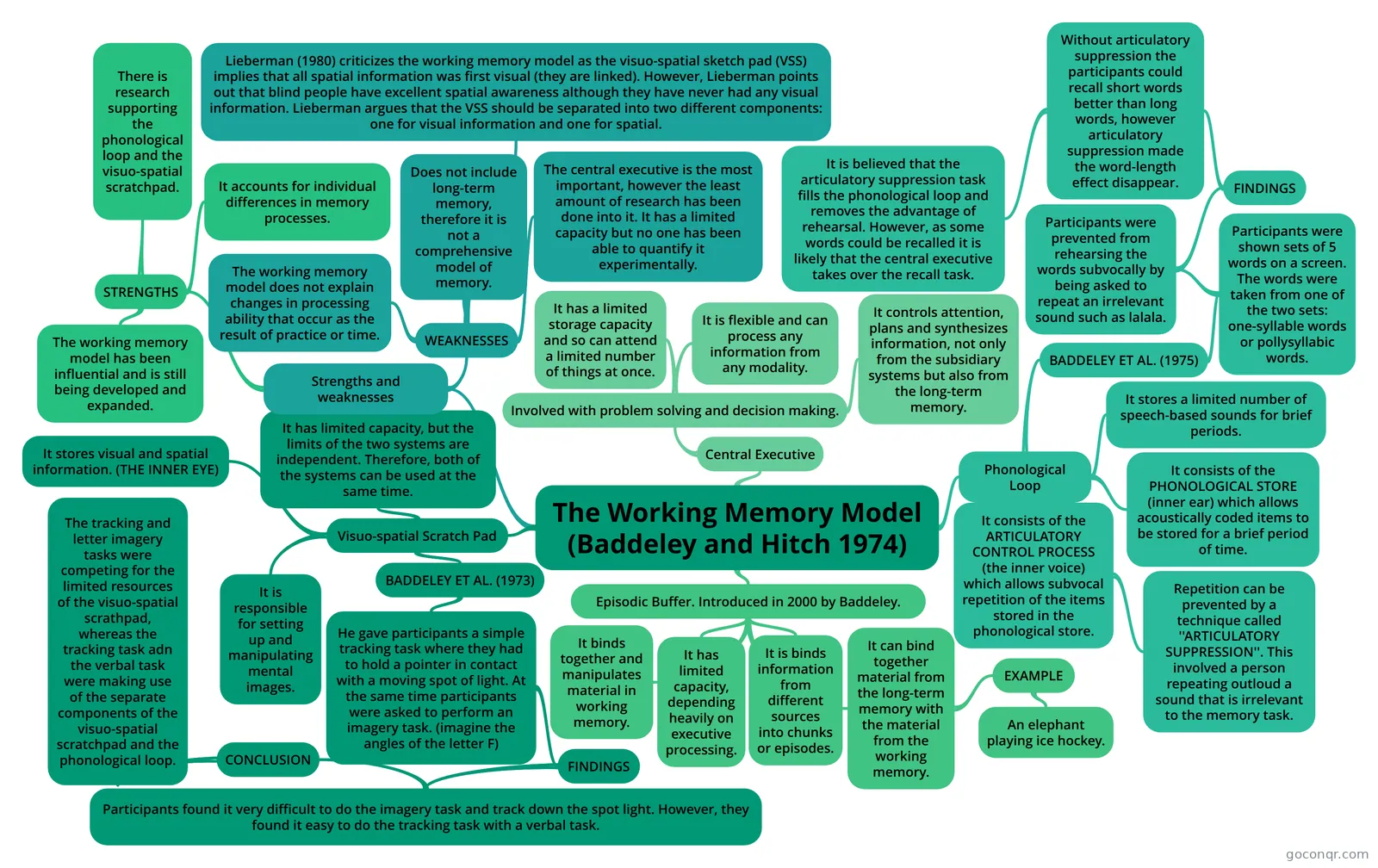
Mind map: The Working Memory Model (Baddeley and Hitch 1974)
Map content
The Working Memory Model (Baddeley and Hitch 1974)
Central Executive
- Involved with problem solving and decision making.
- It controls attention, plans and synthesizes information, not only from the subsidiary systems but also from the long-term memory.
- It is flexible and can process any information from any modality.
- It has a limited storage capacity and so can attend a limited number of things at once.
- Involved with problem solving and decision making.
Visuo-spatial Scratch Pad
- It stores visual and spatial information. (THE INNER EYE)
- It is responsible for setting up and manipulating mental images.
- It has limited capacity, but the limits of the two systems are independent. Therefore, both of the systems can be used at the same time.
- BADDELEY ET AL. (1973)
- He gave participants a simple tracking task where they had to hold a pointer in contact with a moving spot of light. At the same time participants were asked to perform an imagery task. (imagine the angles of the letter F)
- FINDINGS
- Participants found it very difficult to do the imagery task and track down the spot light. However, they found it easy to do the tracking task with a verbal task.
- CONCLUSION
- The tracking and letter imagery tasks were competing for the limited resources of the visuo-spatial scrathpad, whereas the tracking task adn the verbal task were making use of the separate components of the visuo-spatial scratchpad and the phonological loop.
- CONCLUSION
- Participants found it very difficult to do the imagery task and track down the spot light. However, they found it easy to do the tracking task with a verbal task.
- FINDINGS
- He gave participants a simple tracking task where they had to hold a pointer in contact with a moving spot of light. At the same time participants were asked to perform an imagery task. (imagine the angles of the letter F)
Episodic Buffer. Introduced in 2000 by Baddeley.
- It binds together and manipulates material in working memory.
- It has limited capacity, depending heavily on executive processing.
- It is binds information from different sources into chunks or episodes.
- It can bind together material from the long-term memory with the material from the working memory.
- EXAMPLE
- An elephant playing ice hockey.
- EXAMPLE
Phonological Loop
- It stores a limited number of speech-based sounds for brief periods.
- It consists of the PHONOLOGICAL STORE (inner ear) which allows acoustically coded items to be stored for a brief period of time.
- It consists of the ARTICULATORY CONTROL PROCESS (the inner voice) which allows subvocal repetition of the items stored in the phonological store.
- Repetition can be prevented by a technique called ''ARTICULATORY SUPPRESSION''. This involved a person repeating outloud a sound that is irrelevant to the memory task.
- BADDELEY ET AL. (1975)
- Participants were shown sets of 5 words on a screen. The words were taken from one of the two sets: one-syllable words or pollysyllabic words.
- Participants were prevented from rehearsing the words subvocally by being asked to repeat an irrelevant sound such as lalala.
- FINDINGS
- Without articulatory suppression the participants could recall short words better than long words, however articulatory suppression made the word-length effect disappear.
- It is believed that the articulatory suppression task fills the phonological loop and removes the advantage of rehearsal. However, as some words could be recalled it is likely that the central executive takes over the recall task.
- Without articulatory suppression the participants could recall short words better than long words, however articulatory suppression made the word-length effect disappear.
- FINDINGS
- Participants were prevented from rehearsing the words subvocally by being asked to repeat an irrelevant sound such as lalala.
- Participants were shown sets of 5 words on a screen. The words were taken from one of the two sets: one-syllable words or pollysyllabic words.
Strengths and weaknesses
- STRENGTHS
- It accounts for individual differences in memory processes.
- The working memory model has been influential and is still being developed and expanded.
- There is research supporting the phonological loop and the visuo-spatial scratchpad.
- WEAKNESSES
- The central executive is the most important, however the least amount of research has been done into it. It has a limited capacity but no one has been able to quantify it experimentally.
- Does not include long-term memory, therefore it is not a comprehensive model of memory.
- The working memory model does not explain changes in processing ability that occur as the result of practice or time.
- Lieberman (1980) criticizes the working memory model as the visuo-spatial sketch pad (VSS) implies that all spatial information was first visual (they are linked). However, Lieberman points out that blind people have excellent spatial awareness although they have never had any visual information. Lieberman argues that the VSS should be separated into two different components: one for visual information and one for spatial.
- STRENGTHS
Information
- Description
- Mind Map on The Working Memory Model (Baddeley and Hitch 1974), created by NataliaOlsz on 09/04/2015.
- Created by
- NataliaOlsz
- Views
- 1
- Rating