
Mind map
Problems in music and motor control research
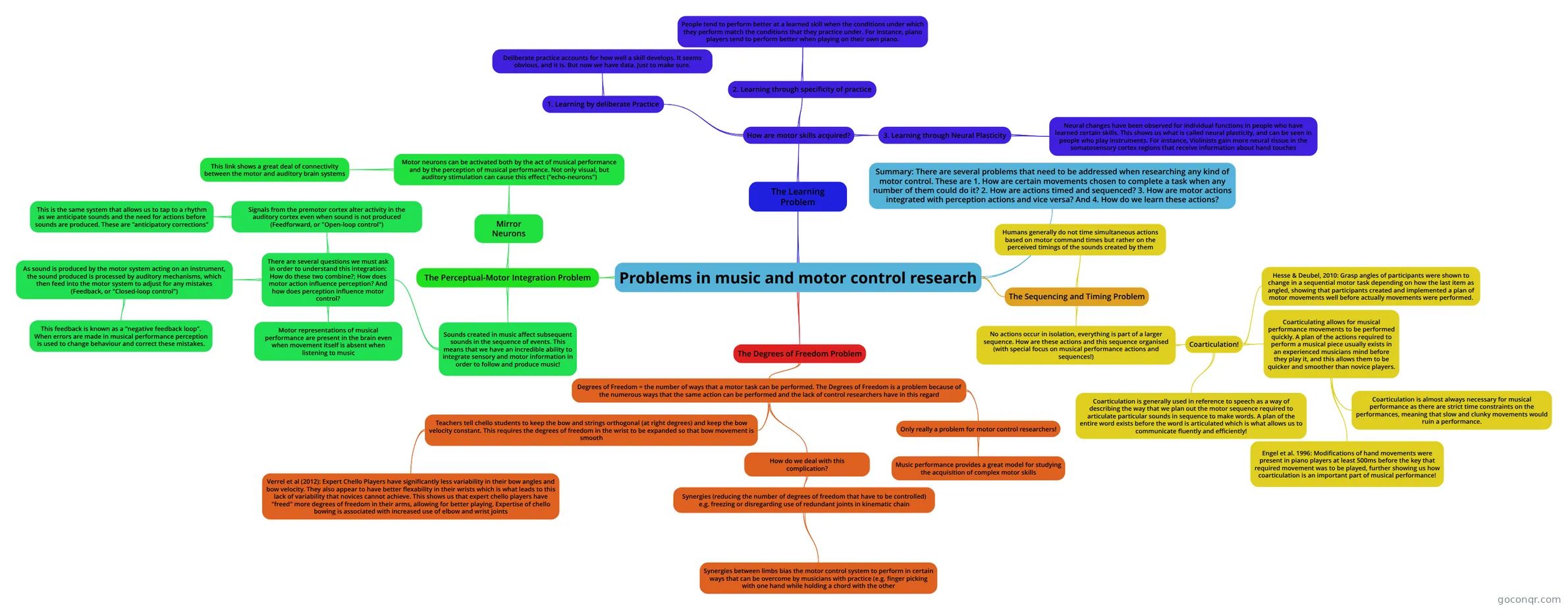
Mind map: Problems in music and motor control research
Map content
Problems in music and motor control research
The Degrees of Freedom Problem
- Degrees of Freedom = the number of ways that a motor task can be performed. The Degrees of Freedom is a problem because of the numerous ways that the same action can be performed and the lack of control researchers have in this regard
- Only really a problem for motor control researchers!
- Music performance provides a great model for studying the acquisition of complex motor skills
- How do we deal with this complication?
- Synergies (reducing the number of degrees of freedom that have to be controlled) e.g. freezing or disregarding use of redundant joints in kinematic chain
- Synergies between limbs bias the motor control system to perform in certain ways that can be overcome by musicians with practice (e.g. finger picking with one hand while holding a chord with the other
- Synergies (reducing the number of degrees of freedom that have to be controlled) e.g. freezing or disregarding use of redundant joints in kinematic chain
- Teachers tell chello students to keep the bow and strings orthogonal (at right degrees) and keep the bow velocity constant. This requires the degrees of freedom in the wrist to be expanded so that bow movement is smooth
- Verrel et al (2012): Expert Chello Players have significantly less variability in their bow angles and bow velocity. They also appear to have better flexability in their wrists which is what leads to this lack of variability that novices cannot achieve. This shows us that expert chello players have "freed" more degrees of freedom in their arms, allowing for better playing. Expertise of chello bowing is associated with increased use of elbow and wrist joints
- Only really a problem for motor control researchers!
- Degrees of Freedom = the number of ways that a motor task can be performed. The Degrees of Freedom is a problem because of the numerous ways that the same action can be performed and the lack of control researchers have in this regard
The Sequencing and Timing Problem
- No actions occur in isolation, everything is part of a larger sequence. How are these actions and this sequence organised (with special focus on musical performance actions and sequences!)
- Coarticulation!
- Coarticulation is generally used in reference to speech as a way of describing the way that we plan out the motor sequence required to articulate particular sounds in sequence to make words. A plan of the entire word exists before the word is articulated which is what allows us to communicate fluently and efficiently!
- Coarticulating allows for musical performance movements to be performed quickly. A plan of the actions required to perform a musical piece usually exists in an experienced musicians mind before they play it, and this allows them to be quicker and smoother than novice players.
- Coarticulation is almost always necessary for musical performance as there are strict time constraints on the performances, meaning that slow and clunky movements would ruin a performance.
- Engel et al. 1996: Modifications of hand movements were present in piano players at least 500ms before the key that required movement was to be played, further showing us how coarticulation is an important part of musical performance!
- Hesse & Deubel, 2010: Grasp angles of participants were shown to change in a sequential motor task depending on how the last item as angled, showing that participants created and implemented a plan of motor movements well before actually movements were performed.
- Coarticulation!
- Humans generally do not time simultaneous actions based on motor command times but rather on the perceived timings of the sounds created by them
- No actions occur in isolation, everything is part of a larger sequence. How are these actions and this sequence organised (with special focus on musical performance actions and sequences!)
The Perceptual-Motor Integration Problem
- Sounds created in music affect subsequent sounds in the sequence of events. This means that we have an incredible ability to integrate sensory and motor information in order to follow and produce music!
- There are several questions we must ask in order to understand this integration: How do these two combine?; How does motor action influence perception? And how does perception influence motor control?
- As sound is produced by the motor system acting on an instrument, the sound produced is processed by auditory mechanisms, which then feed into the motor system to adjust for any mistakes (Feedback, or "Closed-loop control")
- This feedback is known as a "negative feedback loop". When errors are made in musical performance perception is used to change behaviour and correct these mistakes.
- Signals from the premotor cortex alter activity in the auditory cortex even when sound is not produced (Feedforward, or "Open-loop control")
- This is the same system that allows us to tap to a rhythm as we anticipate sounds and the need for actions before sounds are produced. These are "anticipatory corrections"
- Motor representations of musical performance are present in the brain even when movement itself is absent when listening to music
- As sound is produced by the motor system acting on an instrument, the sound produced is processed by auditory mechanisms, which then feed into the motor system to adjust for any mistakes (Feedback, or "Closed-loop control")
- There are several questions we must ask in order to understand this integration: How do these two combine?; How does motor action influence perception? And how does perception influence motor control?
- Mirror Neurons
- Motor neurons can be activated both by the act of musical performance and by the perception of musical performance. Not only visual, but auditory stimulation can cause this effect ("echo-neurons")
- This link shows a great deal of connectivity between the motor and auditory brain systems
- Motor neurons can be activated both by the act of musical performance and by the perception of musical performance. Not only visual, but auditory stimulation can cause this effect ("echo-neurons")
- Sounds created in music affect subsequent sounds in the sequence of events. This means that we have an incredible ability to integrate sensory and motor information in order to follow and produce music!
The Learning Problem
- How are motor skills acquired?
- 1. Learning by deliberate Practice
- Deliberate practice accounts for how well a skill develops. It seems obvious, and it is. But now we have data. Just to make sure.
- 2. Learning through specificity of practice
- People tend to perform better at a learned skill when the conditions under which they perform match the conditions that they practice under. For instance, piano players tend to perform better when playing on their own piano.
- 3. Learning through Neural Plasticity
- Neural changes have been observed for individual functions in people who have learned certain skills. This shows us what is called neural plasticity, and can be seen in people who play instruments. For instance, Violinists gain more neural tissue in the somatosensory cortex regions that receive information about hand touches
- 1. Learning by deliberate Practice
- How are motor skills acquired?
Summary: There are several problems that need to be addressed when researching any kind of motor control. These are 1. How are certain movements chosen to complete a task when any number of them could do it? 2. How are actions timed and sequenced? 3. How are motor actions integrated with perception actions and vice versa? And 4. How do we learn these actions?
Information
- Description
- Undergraduate The Neuroscience of Music ( Motor control and music) Mind Map on Problems in music and motor control research, created by Tomohawk McGinn on 13/04/2015.
- Created by
- Tomohawk McGinn
- Views
- 1
- Rating
More on Motor Control and Motor Programmes