
Mind map
Evolution Concept Map- Janaye Scales (9/9/20)
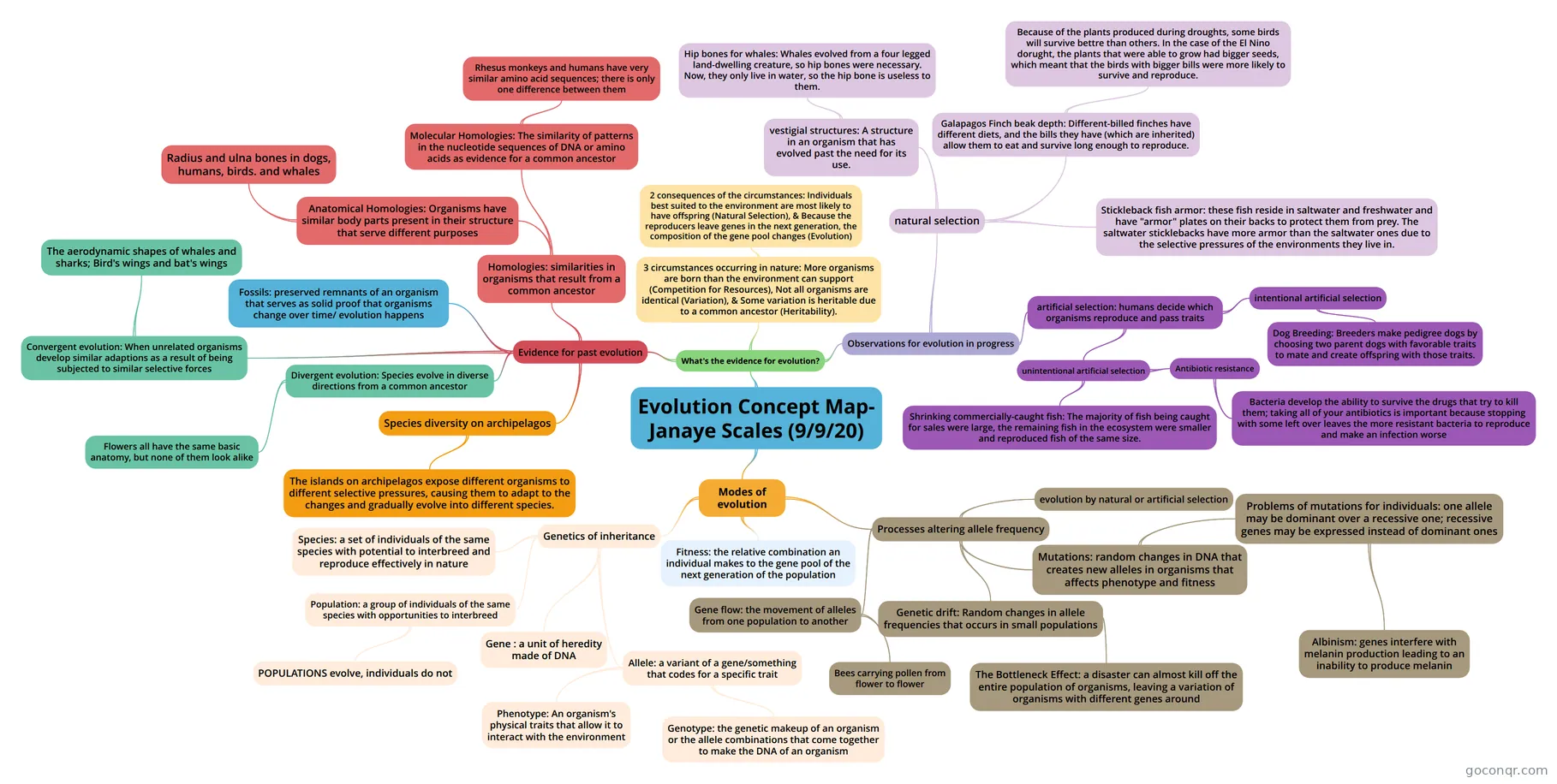
Mind map: Evolution concept map
Map content
Evolution Concept Map- Janaye Scales (9/9/20)
What's the evidence for evolution?
- 3 circumstances occurring in nature: More organisms are born than the environment can support (Competition for Resources), Not all organisms are identical (Variation), & Some variation is heritable due to a common ancestor (Heritability).
- 2 consequences of the circumstances: Individuals best suited to the environment are most likely to have offspring (Natural Selection), & Because the reproducers leave genes in the next generation, the composition of the gene pool changes (Evolution)
- Observations for evolution in progress
- natural selection
- Galapagos Finch beak depth: Different-billed finches have different diets, and the bills they have (which are inherited) allow them to eat and survive long enough to reproduce.
- Because of the plants produced during droughts, some birds will survive bettre than others. In the case of the El Nino dorught, the plants that were able to grow had bigger seeds, which meant that the birds with bigger bills were more likely to survive and reproduce.
- Stickleback fish armor: these fish reside in saltwater and freshwater and have "armor" plates on their backs to protect them from prey. The saltwater sticklebacks have more armor than the saltwater ones due to the selective pressures of the environments they live in.
- vestigial structures: A structure in an organism that has evolved past the need for its use.
- Hip bones for whales: Whales evolved from a four legged land-dwelling creature, so hip bones were necessary. Now, they only live in water, so the hip bone is useless to them.
- Galapagos Finch beak depth: Different-billed finches have different diets, and the bills they have (which are inherited) allow them to eat and survive long enough to reproduce.
- artificial selection: humans decide which organisms reproduce and pass traits
- intentional artificial selection
- Dog Breeding: Breeders make pedigree dogs by choosing two parent dogs with favorable traits to mate and create offspring with those traits.
- unintentional artificial selection
- Shrinking commercially-caught fish: The majority of fish being caught for sales were large, the remaining fish in the ecosystem were smaller and reproduced fish of the same size.
- Antibiotic resistance
- Bacteria develop the ability to survive the drugs that try to kill them; taking all of your antibiotics is important because stopping with some left over leaves the more resistant bacteria to reproduce and make an infection worse
- intentional artificial selection
- natural selection
- Evidence for past evolution
- Fossils: preserved remnants of an organism that serves as solid proof that organisms change over time/ evolution happens
- Homologies: similarities in organisms that result from a common ancestor
- Anatomical Homologies: Organisms have similar body parts present in their structure that serve different purposes
- Radius and ulna bones in dogs, humans, birds. and whales
- Molecular Homologies: The similarity of patterns in the nucleotide sequences of DNA or amino acids as evidence for a common ancestor
- Rhesus monkeys and humans have very similar amino acid sequences; there is only one difference between them
- Anatomical Homologies: Organisms have similar body parts present in their structure that serve different purposes
- Convergent evolution: When unrelated organisms develop similar adaptions as a result of being subjected to similar selective forces
- The aerodynamic shapes of whales and sharks; Bird's wings and bat's wings
- Divergent evolution: Species evolve in diverse directions from a common ancestor
- Flowers all have the same basic anatomy, but none of them look alike
- Species diversity on archipelagos
- The islands on archipelagos expose different organisms to different selective pressures, causing them to adapt to the changes and gradually evolve into different species.
- 3 circumstances occurring in nature: More organisms are born than the environment can support (Competition for Resources), Not all organisms are identical (Variation), & Some variation is heritable due to a common ancestor (Heritability).
Modes of evolution
- Genetics of inheritance
- Population: a group of individuals of the same species with opportunities to interbreed
- POPULATIONS evolve, individuals do not
- Species: a set of individuals of the same species with potential to interbreed and reproduce effectively in nature
- Gene : a unit of heredity made of DNA
- Allele: a variant of a gene/something that codes for a specific trait
- Phenotype: An organism's physical traits that allow it to interact with the environment
- Genotype: the genetic makeup of an organism or the allele combinations that come together to make the DNA of an organism
- Population: a group of individuals of the same species with opportunities to interbreed
- Fitness: the relative combination an individual makes to the gene pool of the next generation of the population
- Processes altering allele frequency
- Mutations: random changes in DNA that creates new alleles in organisms that affects phenotype and fitness
- Problems of mutations for individuals: one allele may be dominant over a recessive one; recessive genes may be expressed instead of dominant ones
- Albinism: genes interfere with melanin production leading to an inability to produce melanin
- Problems of mutations for individuals: one allele may be dominant over a recessive one; recessive genes may be expressed instead of dominant ones
- Gene flow: the movement of alleles from one population to another
- Bees carrying pollen from flower to flower
- evolution by natural or artificial selection
- Genetic drift: Random changes in allele frequencies that occurs in small populations
- The Bottleneck Effect: a disaster can almost kill off the entire population of organisms, leaving a variation of organisms with different genes around
- Mutations: random changes in DNA that creates new alleles in organisms that affects phenotype and fitness
- Genetics of inheritance
Information
- Description
- Mind Map on Evolution Concept Map- Janaye Scales (9/9/20), created by Janaye Scales on 10/09/2020.
- Created by
- Janaye Scales
- Views
- 0
- Rating
More on Evidence for Evolution