
Mind map
Adaptations in Animals in Water
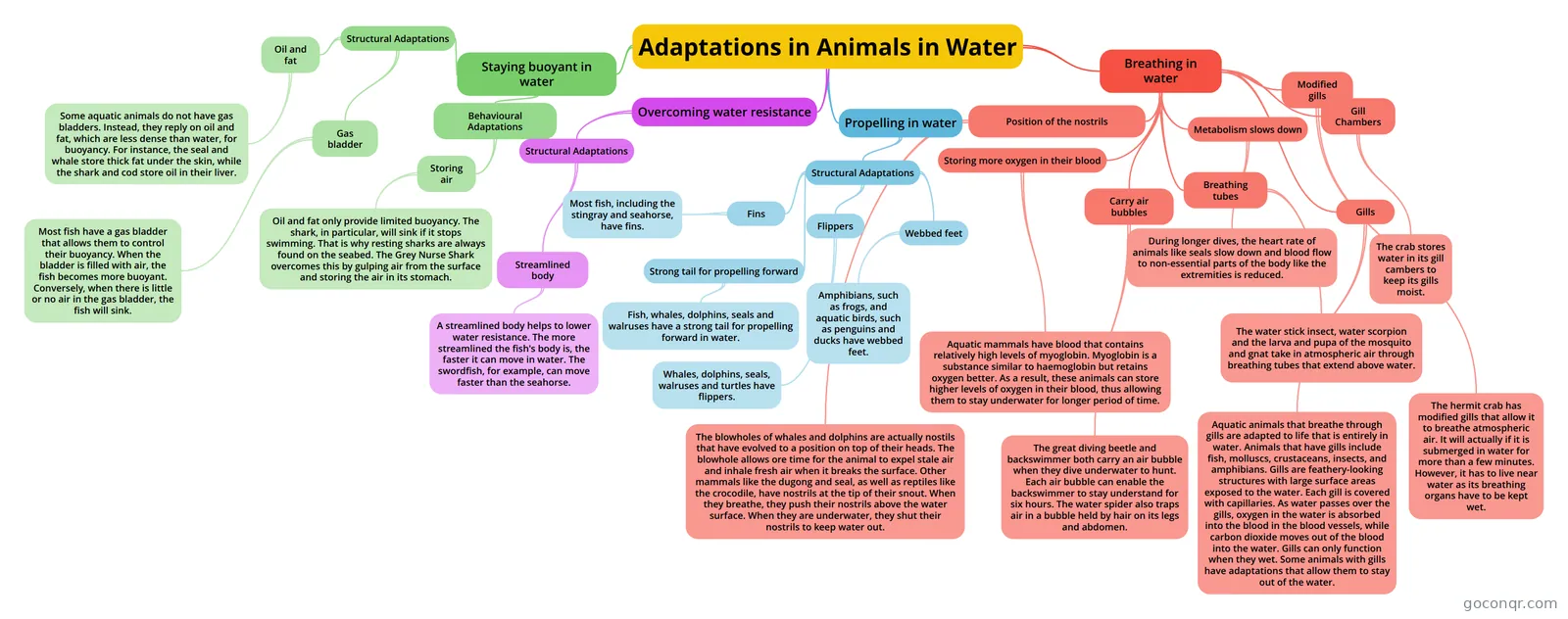
Mind map: Adaptations in animals in water
Map content
Adaptations in Animals in Water
Staying buoyant in water
- Structural Adaptations
- Gas bladder
- Most fish have a gas bladder that allows them to control their buoyancy. When the bladder is filled with air, the fish becomes more buoyant. Conversely, when there is little or no air in the gas bladder, the fish will sink.
- Oil and fat
- Some aquatic animals do not have gas bladders. Instead, they reply on oil and fat, which are less dense than water, for buoyancy. For instance, the seal and whale store thick fat under the skin, while the shark and cod store oil in their liver.
- Gas bladder
- Behavioural Adaptations
- Storing air
- Oil and fat only provide limited buoyancy. The shark, in particular, will sink if it stops swimming. That is why resting sharks are always found on the seabed. The Grey Nurse Shark overcomes this by gulping air from the surface and storing the air in its stomach.
- Storing air
- Structural Adaptations
Overcoming water resistance
- Structural Adaptations
- Streamlined body
- A streamlined body helps to lower water resistance. The more streamlined the fish's body is, the faster it can move in water. The swordfish, for example, can move faster than the seahorse.
- Streamlined body
- Structural Adaptations
Propelling in water
- Structural Adaptations
- Fins
- Most fish, including the stingray and seahorse, have fins.
- Flippers
- Whales, dolphins, seals, walruses and turtles have flippers.
- Webbed feet
- Amphibians, such as frogs, and aquatic birds, such as penguins and ducks have webbed feet.
- Strong tail for propelling forward
- Fish, whales, dolphins, seals and walruses have a strong tail for propelling forward in water.
- Fins
- Structural Adaptations
Breathing in water
- Position of the nostrils
- The blowholes of whales and dolphins are actually nostils that have evolved to a position on top of their heads. The blowhole allows ore time for the animal to expel stale air and inhale fresh air when it breaks the surface. Other mammals like the dugong and seal, as well as reptiles like the crocodile, have nostrils at the tip of their snout. When they breathe, they push their nostrils above the water surface. When they are underwater, they shut their nostrils to keep water out.
- Storing more oxygen in their blood
- Aquatic mammals have blood that contains relatively high levels of myoglobin. Myoglobin is a substance similar to haemoglobin but retains oxygen better. As a result, these animals can store higher levels of oxygen in their blood, thus allowing them to stay underwater for longer period of time.
- Metabolism slows down
- During longer dives, the heart rate of animals like seals slow down and blood flow to non-essential parts of the body like the extremities is reduced.
- Breathing tubes
- The water stick insect, water scorpion and the larva and pupa of the mosquito and gnat take in atmospheric air through breathing tubes that extend above water.
- Carry air bubbles
- The great diving beetle and backswimmer both carry an air bubble when they dive underwater to hunt. Each air bubble can enable the backswimmer to stay understand for six hours. The water spider also traps air in a bubble held by hair on its legs and abdomen.
- Gills
- Aquatic animals that breathe through gills are adapted to life that is entirely in water. Animals that have gills include fish, molluscs, crustaceans, insects, and amphibians. Gills are feathery-looking structures with large surface areas exposed to the water. Each gill is covered with capillaries. As water passes over the gills, oxygen in the water is absorbed into the blood in the blood vessels, while carbon dioxide moves out of the blood into the water. Gills can only function when they wet. Some animals with gills have adaptations that allow them to stay out of the water.
- Gill Chambers
- The crab stores water in its gill cambers to keep its gills moist.
- Modified gills
- The hermit crab has modified gills that allow it to breathe atmospheric air. It will actually if it is submerged in water for more than a few minutes. However, it has to live near water as its breathing organs have to be kept wet.
- Position of the nostrils
Information
- Description
- Mind Map on Adaptations in Animals in Water, created by Genevieve Ng Kim Sim on 25/04/2015.
- Created by
- Genevieve Ng Kim Sim
- Views
- 9
- History
-
- Created by Genevieve Ng Kim Sim · Apr 25, 2015
- Copied by Genevieve Ng Kim Sim · Apr 25, 2015
- Rating