
Mind map
Situation Ethics
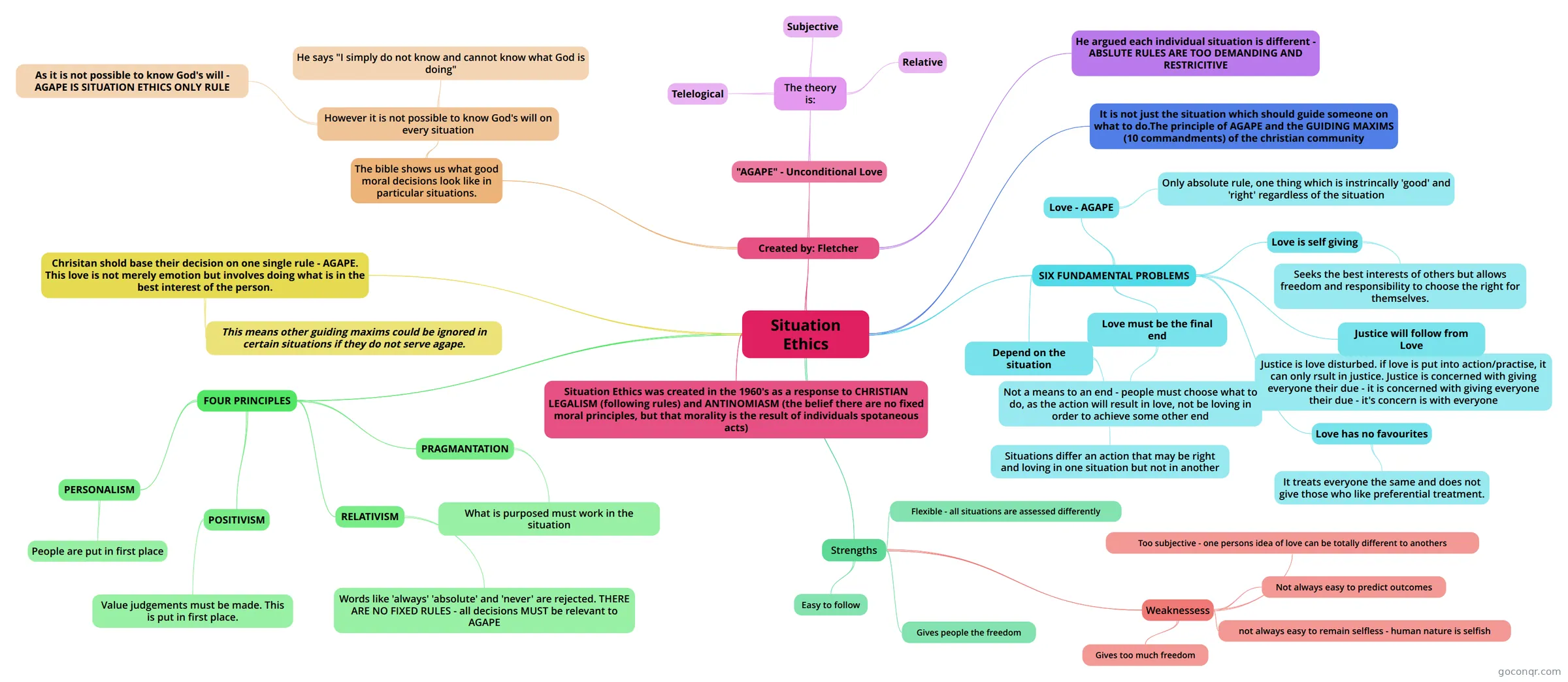
Mind map: Situation Ethics
Map content
Situation Ethics
Created by: Fletcher
- "AGAPE" - Unconditional Love
- The theory is:
- Relative
- Subjective
- Telelogical
- The theory is:
- He argued each individual situation is different - ABSLUTE RULES ARE TOO DEMANDING AND RESTRICITIVE
- The bible shows us what good moral decisions look like in particular situations.
- However it is not possible to know God's will on every situation
- He says "I simply do not know and cannot know what God is doing"
- As it is not possible to know God's will - AGAPE IS SITUATION ETHICS ONLY RULE
- However it is not possible to know God's will on every situation
- "AGAPE" - Unconditional Love
Situation Ethics was created in the 1960's as a response to CHRISTIAN LEGALISM (following rules) and ANTINOMIASM (the belief there are no fixed moral principles, but that morality is the result of individuals spotaneous acts)
It is not just the situation which should guide someone on what to do.The principle of AGAPE and the GUIDING MAXIMS (10 commandments) of the christian community
Chrisitan shold base their decision on one single rule - AGAPE. This love is not merely emotion but involves doing what is in the best interest of the person.
- This means other guiding maxims could be ignored in certain situations if they do not serve agape.
SIX FUNDAMENTAL PROBLEMS
- Love - AGAPE
- Only absolute rule, one thing which is instrincally 'good' and 'right' regardless of the situation
- Love is self giving
- Seeks the best interests of others but allows freedom and responsibility to choose the right for themselves.
- Justice will follow from Love
- Justice is love disturbed. if love is put into action/practise, it can only rsult in justice. Justice is concerned with giving everyone their due - it is concerned with giving everyone their due - it's concern is with everyone
- Love has no favourites
- It treats everyone the same and does not give those who like preferential treatment.
- Love must be the final end
- Not a means to an end - people must choose what to do, as the action will result in love, not be loving in order to achieve some other end
- Depend on the situation
- Situations differ an action that may be right and loving in one situation but not in another
- Love - AGAPE
FOUR PRINCIPLES
- PRAGMANTATION
- What is purposed must work in the situation
- RELATIVISM
- Words like 'always' 'absolute' and 'never' are rejected. THERE ARE NO FIXED RULES - all decisions MUST be relevant to AGAPE
- POSITIVISM
- Value judgements must be made. This is put in first place.
- PERSONALISM
- People are put in first place
- PRAGMANTATION
Strengths
- Flexible - all situations are assessed differently
- Gives people the freedom
- Easy to follow
- Weaknessess
- Too subjective - one persons idea of love can be totally different to anothers
- Not always easy to predict outcomes
- Gives too much freedom
- not always easy to remain selfless - human nature is selfish
Information
- Description
- Mind Map on Situation Ethics, created by oliviat54 on 27/04/2015.
- Created by
- oliviat54
- Views
- 3
- History
-
- Created by j.donaldson97 · Apr 27, 2015
- Copied by oliviat54 · Apr 27, 2015
- Rating