
Mind map
P7: Waves, lenses and telescopes.
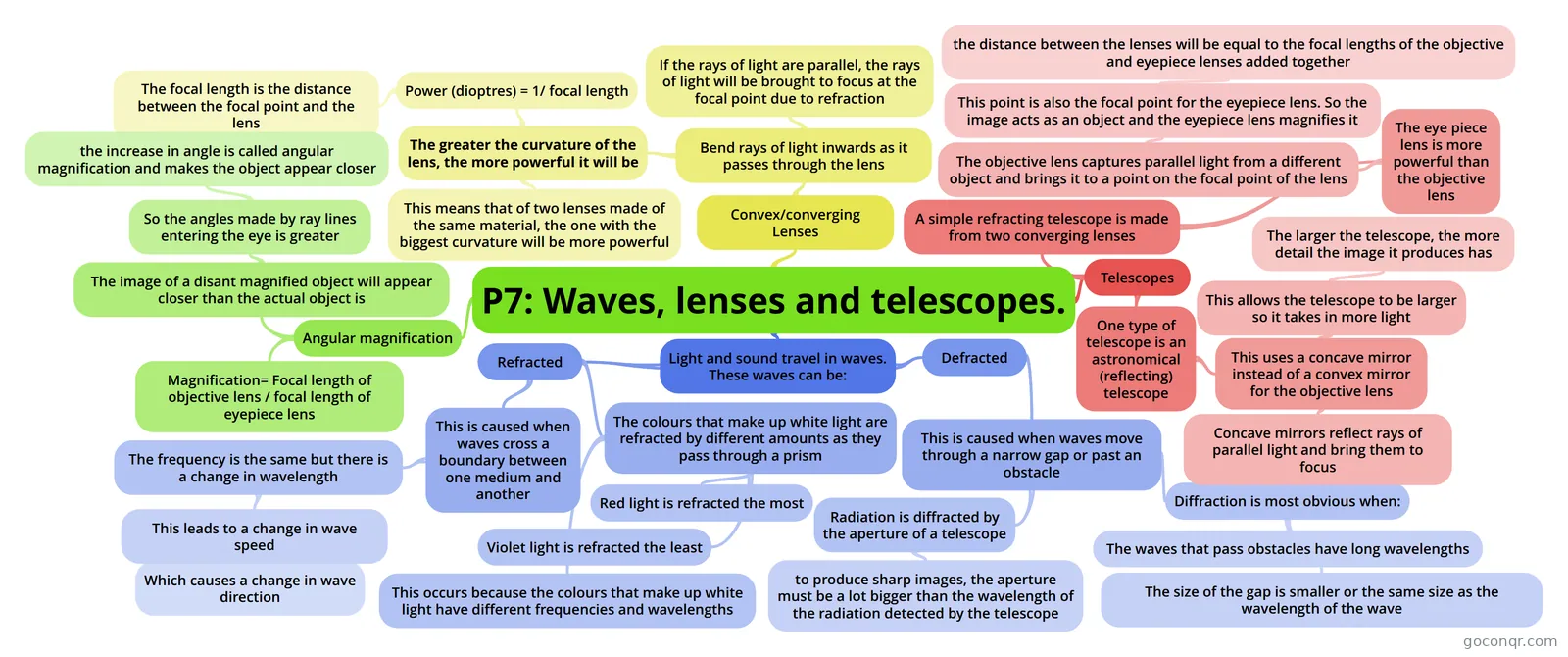
Mind map: Waves, lenses and telescopes
Map content
P7: Waves, lenses and telescopes.
Light and sound travel in waves. These waves can be:
- Refracted
- This is caused when waves cross a boundary between one medium and another
- The frequency is the same but there is a change in wavelength
- This leads to a change in wave speed
- Which causes a change in wave direction
- This leads to a change in wave speed
- The frequency is the same but there is a change in wavelength
- The colours that make up white light are refracted by different amounts as they pass through a prism
- Red light is refracted the most
- Violet light is refracted the least
- This occurs because the colours that make up white light have different frequencies and wavelengths
- This is caused when waves cross a boundary between one medium and another
- Defracted
- This is caused when waves move through a narrow gap or past an obstacle
- Diffraction is most obvious when:
- The size of the gap is smaller or the same size as the wavelength of the wave
- The waves that pass obstacles have long wavelengths
- Radiation is diffracted by the aperture of a telescope
- to produce sharp images, the aperture must be a lot bigger than the wavelength of the radiation detected by the telescope
- Diffraction is most obvious when:
- This is caused when waves move through a narrow gap or past an obstacle
- Refracted
Convex/converging Lenses
- Bend rays of light inwards as it passes through the lens
- If the rays of light are parallel, the rays of light will be brought to focus at the focal point due to refraction
- The greater the curvature of the lens, the more powerful it will be
- This means that of two lenses made of the same material, the one with the biggest curvature will be more powerful
- Power (dioptres) = 1/ focal length
- The focal length is the distance between the focal point and the lens
- Bend rays of light inwards as it passes through the lens
Telescopes
- A simple refracting telescope is made from two converging lenses
- The eye piece lens is more powerful than the objective lens
- The objective lens captures parallel light from a different object and brings it to a point on the focal point of the lens
- This point is also the focal point for the eyepiece lens. So the image acts as an object and the eyepiece lens magnifies it
- the distance between the lenses will be equal to the focal lengths of the objective and eyepiece lenses added together
- This point is also the focal point for the eyepiece lens. So the image acts as an object and the eyepiece lens magnifies it
- The objective lens captures parallel light from a different object and brings it to a point on the focal point of the lens
- The eye piece lens is more powerful than the objective lens
- One type of telescope is an astronomical (reflecting) telescope
- This uses a concave mirror instead of a convex mirror for the objective lens
- This allows the telescope to be larger so it takes in more light
- The larger the telescope, the more detail the image it produces has
- Concave mirrors reflect rays of parallel light and bring them to focus
- This allows the telescope to be larger so it takes in more light
- This uses a concave mirror instead of a convex mirror for the objective lens
- A simple refracting telescope is made from two converging lenses
Angular magnification
- The image of a disant magnified object will appear closer than the actual object is
- So the angles made by ray lines entering the eye is greater
- the increase in angle is called angular magnification and makes the object appear closer
- So the angles made by ray lines entering the eye is greater
- Magnification= Focal length of objective lens / focal length of eyepiece lens
- The image of a disant magnified object will appear closer than the actual object is
Information
- Description
- Science Mind Map on P7: Waves, lenses and telescopes., created by Ellie Tunnicliffe on 27/04/2015.
- Created by
- Ellie Tunnicliffe
- Views
- 4
- Tags
- History
-
- Created by jamiemcparlin · Apr 27, 2015
- Copied by Ellie Tunnicliffe · Apr 27, 2015
- Rating