
Mind map
Chem 121-- Chapter 1
Map content
Chem 121-- Chapter 1
- 1.1 Modern Chemistry 1.2 Experiment and Explanation 1.3 Law of Conversation of Mass 1.4 Matter: Physical State and Chemical Constitution 1.5 Significant Figures 1.6 SI Units 1.7 Derived Units 1.8 Units and Dimensional Analysis
1. 1 Modern Chemistry: A Brief Glimpse
- Chemistry: The study of composition and structure of materials and of changes that materials undergo.
1.2 Experiment and Explanation
- Experiment: An observation of natural phenomena carried out in a controlled manner so that the results can be duplicated and rational conclusions obtained.
- Law: A concise statement or mathematical equation about a fundamental relationship or regularity of nature.
- Hypothesis: A tentative explanation of some regularity of nature.
- Theory: A tested explanation of a basic natural phenomenon.
- Scientific Method
1.3 Law of Conservation of Mass
- Matter: Whatever occupies space and can be perceived by our senses.
- Mass: The quantity of Mass in a material
- Law of Conservation of Mass: The total mass remains constant during a chemical change (chemical reaction)
- EXAMPLE 1.3 You heat 2.53 g of metallic mercury in the air which produces 2.73 g of red-orange residue. Mercury+Oxygen >>>>Red-orange residue What is the mass of oxygen that reacts? First, you apply the law of conservation of mass to this reaction. The total mass remains constant during a chemical reaction. Mass of substances before reaction=Mass of substances after reaction. SO Mass of Mercury+Mass of oxygen= Mass of red-orange residue 2.53 grams (Mercury) + Mass of oxygen = 2.73 grams (red-orange residue) 2.73 grams - 2.53 grams= 0.20 grams of oxygen **** The mass of the oxygen that reacts with the mercury is 0.20 grams****
- Matter: Whatever occupies space and can be perceived by our senses.
1.4 Matter: Physical State and Chemical Constitution
- Solid: Characterized by rigidity; fixed volume and fixed shape
- Liquid: Relatively in compressible fluid; fixed volume, no fixed shape.
- Gas: Compressible fluid; no fixed volume, no fixed shape.
- The States of Matter
- Physical Change: A Change in the form of matter but not in its chemical identity.
- EXAMPLE Melting Dissolving: You can dissolve sodium chloride (table salt) in water.
- Chemical Change/ Chemical Reaction: A change in which one or more kinds of matter are transformed into a new kind of matter or several new kinds of matter.
- EXAMPLE Rusting Burning
- Chemical property: A characteristic of a material involving its chemical change
- EXAMPLE Ability to react with oxygen. Ability to react with fluorine.
- Physical Property: A characteristic that can be observed for a material without changing its chemical identity
- EXAMPLE Physical State Boiling Point Color
- Element: A substance that cannot be decomposed into simpler substances by any chemical reaction.
- EXAMPLE Hydrogen Carbon Oxygen
- Compound: A substance composed of two or more elements chemically combined
- EXAMPLE Italian Salad Dressing Salt water
- Mixture: A material that can be seperated by physical means into two or more substances. >>>Heterogenous and Homozygous mixtures
- Heterogenous Mixture: A mixture that consists of physically distinct parts, each with different properties. (Salt and Iron fillings, Oil and Vinegar) Homogenous Mixture: A mixture that is uniform in its properties; also called a solution (saltwater, air)
- Phase: One of several different homogenous materials in the portion of matter under study.
- Solid: Characterized by rigidity; fixed volume and fixed shape
1.5 Measurement and Significant Figures
- Measurement: The comparison of physical quantity with a fixed standard of measurement---- a unit.
- Precision: The closeness of the set of values obtained from repeated measurement to its value.
- Accuracy: The closeness of a single measurement to its true value
- Measurement: The comparison of physical quantity with a fixed standard of measurement---- a unit.
1.6 SI Units
- Significant Figures
- SF in Multiplication and Division
- Your answer should have the same number of Significant Figures as are in the measurement with the least number of significant figures.
- SF in Addition and Subtraction
- Your answer should have the same number of decimal places as are in the measurement with the least number of decimal places
- Exact number: A counted number or defined number
- Rounding: The procedure of dropping nonsignificant digits and adjusting the last digit reported in the final result of a calculation
- Rounding Procedure: 1. Look at the leftmost digit to the dropped. 2. If this digit is 5 or greater: Add 1 to the last digit to be retained. Drop all digits farther to the right. 3. If this digit is less than 5. Drop all digits farther to the right.
- SF in Multiplication and Division
- SI Units: An international system of units made up of a particular choice of metric units
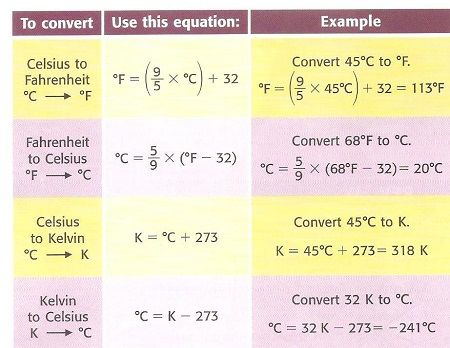
- Temperature: A measure of "hotness." Heat flows from an area of higher temperature to an area of lower temperature
- Celsius C
- Fahrenheit F
- Kelvin K
- Temperature: A measure of "hotness." Heat flows from an area of higher temperature to an area of lower temperature
- Base Units: The seven metric units from which all other units can be derived
- SI Base Units: Length_Meter_m Mass_Kilogram_kg Time_Second_s Temperature_Kelvin_K Amount of substance_mole_mol Electric Current_ampere_A Luminous Intensity_candela_cd
- Selected Prefixes Mega 10^6 M Kilo 10^3 k Deci 10^-1 d Centi 10^-2 c Milli 10^-3 m Micro 10^-6 u (mew) Nano 10^-9 n Pico 10^-12 p
- Significant Figures
1.7 Derived Units
- Derived Units: Combinations of fundamental units
- Area= length*length= m^2 Volume= length*length*length=m^3 Density Speed Acceleration Force Pressure Energy
- Density= m/v
- solids= g/cm^3 liquids=g/mL gases= g/L
- Derived Units: Combinations of fundamental units
1.8 Units and DImensional Analysis
- Factor-Label Method: A method of calculations in which one carries along the units for quantities
- Conversion Factor: A factor equal to 1 that converts a quantity expressed in one unit to a quantity expressed in another unit.
- Factor-Label Method: A method of calculations in which one carries along the units for quantities
Images and files in the map
Information
- Description
- Mind Map on Chem 121-- Chapter 1, created by kaileyemills on 30/04/2015.
- Created by
- kaileyemills · Apr 2015
- Updated
- Apr 6, 2018
- Views
- 1
- Rating