
Mind map
Glycoconjugates
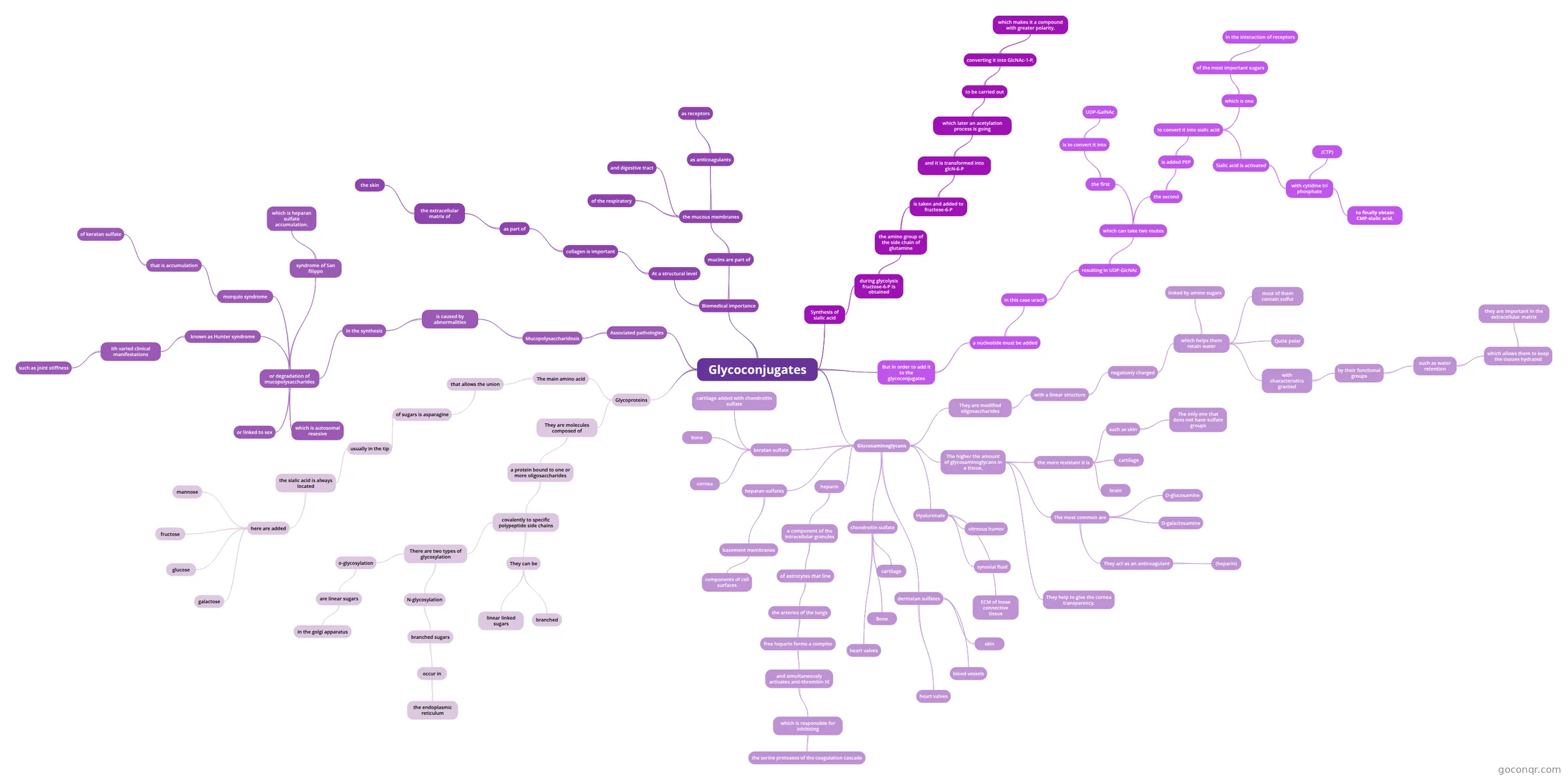
Mind map: Glycoconjugates
Map content
Glycoconjugates
Synthesis of sialic acid
- during glycolysis fructose-6-P is obtained
- the amino group of the side chain of glutamine
- is taken and added to fructose-6-P
- and it is transformed into glcN-6-P
- which later an acetylation process is going
- to be carried out
- converting it into GlcNAc-1-P,
- which makes it a compound with greater polarity.
- converting it into GlcNAc-1-P,
- to be carried out
- which later an acetylation process is going
- and it is transformed into glcN-6-P
- is taken and added to fructose-6-P
- the amino group of the side chain of glutamine
- during glycolysis fructose-6-P is obtained
But in order to add it to the glycoconjugates
- a nucleotide must be added
- in this case uracil
- resulting in UDP-GicNAc
- which can take two routes
- the first
- is to convert it into
- UDP-GalNAc
- is to convert it into
- the second
- is added PEP
- to convert it into sialic acid
- which is one
- of the most important sugars
- in the interaction of receptors
- of the most important sugars
- Sialic acid is activated
- with cytidine tri phosphate
- (CTP)
- to finally obtain CMP-sialic acid.
- with cytidine tri phosphate
- which is one
- to convert it into sialic acid
- is added PEP
- the first
- which can take two routes
- resulting in UDP-GicNAc
- in this case uracil
- a nucleotide must be added
Glucosaminoglycans
- They are modified oligosaccharides
- with a linear structure
- negatively charged
- which helps them retain water
- linked by amino sugars
- most of them contain sulfur
- Quite polar
- with characteristics granted
- by their functional groups
- such as water retention
- which allows them to keep the tissues hydrated
- they are important in the extracellular matrix
- which allows them to keep the tissues hydrated
- such as water retention
- by their functional groups
- which helps them retain water
- negatively charged
- with a linear structure
- The higher the amount of glycosaminoglycans in a tissue,
- the more resistant it is
- such as skin
- The only one that does not have sulfate groups
- cartilage
- brain
- such as skin
- The most common are
- D-glucosamine
- D-galactosamine
- They act as an anticoagulant
- (heparin)
- They help to give the cornea transparency.
- the more resistant it is
- Hyaluronate
- synovial fluid
- vitreous humor
- ECM of loose connective tissue
- dermatan sulfates
- skin
- blood vessels
- heart valves
- chondroitin sulfate
- cartilage
- Bone
- heart valves
- heparin
- a component of the intracellular granules
- of astrocytes that line
- the arteries of the lungs
- free heparin forms a complex
- and simultaneously activates anti-thrombin III
- which is responsible for inhibiting
- the serine proteases of the coagulation cascade
- which is responsible for inhibiting
- and simultaneously activates anti-thrombin III
- free heparin forms a complex
- the arteries of the lungs
- of astrocytes that line
- a component of the intracellular granules
- heparan sulfates
- basement membranes
- components of cell surfaces
- basement membranes
- keratan sulfate
- cornea
- bone
- cartilage added with chondroitin sulfate
- They are modified oligosaccharides
Glycoproteins
- They are molecules composed of
- a protein bound to one or more oligosaccharides
- covalently to specific polypeptide side chains
- They can be
- branched
- linear linked sugars
- There are two types of glycosylation
- N-glycosylation
- branched sugars
- occur in
- the endoplasmic reticulum
- occur in
- branched sugars
- o-glycosylation
- are linear sugars
- in the golgi apparatus
- are linear sugars
- N-glycosylation
- They can be
- covalently to specific polypeptide side chains
- a protein bound to one or more oligosaccharides
- The main amino acid
- that allows the union
- of sugars is asparagine
- usually in the tip
- the sialic acid is always located
- here are added
- galactose
- glucose
- fructose
- mannose
- here are added
- the sialic acid is always located
- usually in the tip
- of sugars is asparagine
- that allows the union
- They are molecules composed of
Associated pathologies
- Mucopolysaccharidosis
- is caused by abnormalities
- in the synthesis
- or degradation of mucopolysaccharides
- which is autosomal resesive
- or linked to sex
- known as Hunter syndrome
- ith varied clinical manifestations
- such as joint stiffness
- ith varied clinical manifestations
- morquio syndrome
- that is accumulation
- of keratan sulfate
- that is accumulation
- syndrome of San filippo
- which is heparan sulfate accumulation.
- or degradation of mucopolysaccharides
- in the synthesis
- is caused by abnormalities
- Mucopolysaccharidosis
Biomedical importance
- At a structural level
- collagen is important
- as part of
- the extracellular matrix of
- the skin
- the extracellular matrix of
- as part of
- collagen is important
- mucins are part of
- the mucous membranes
- of the respiratory
- and digestive tract
- as anticoagulants
- as receptors
- the mucous membranes
- At a structural level
Information
- Description
- Mind Map on Glycoconjugates, created by Paula Rico on 05/10/2020.
- Created by
- Paula Rico
- Views
- 0
- Rating