
Mind map
Ecology & Evolution Exam III
Map content
Ecology & Evolution Exam III
Amphibians
- -first land tetrapods -first vertebrates to come and conquer land
- Stem-tetrapods
- -animals that did not maintain allegiance to land -these fish are too attached to water → are not first complete first land tetrapods; amphibians are
Reptiles
- -“Reptiles” is a hodgepodge of lineages; NOT a monophyletic group
- Phylogeny
- Cranial Morphology
- Mammals
- synapsids: two holes are fused
- Turtles
- anapsids: no holes
- "True Reptiles"
- (Certatopsid) diaspids: two holes
- Mammals
- Herpetology
- -links amphibians and reptiles together because they're cold-blooded reptiles -not actually closely related at all -birds are closer than amphibians are to reptiles
- Birds and Reptiles
- -birds are reptiles (the last living dinosaurs) -crocodiles are closer related to birds
- Homeoderms
- the ability to maintain a constant inner temperature
- Cranial Morphology
- Early Reptiles
- -most dominant during the Triassic + Jurassic
- Saurinicians
- origin of the reptiles from the hip bone
- Ornithischians
- origin of birds (150 MYA) from the hip bone
- Order Testudines (Turtles)
- Plastron
- Ventral rib cage
- Carapace
- Dorsal rib cagee
- Covered by a rib cage all around
- Galapagos Tortoises
- -have adapted on each island for eating (Adaptive Morphology) -different shaped shells + necks -hunting → decimated populations and George is all alone -people hunt the tortoises for the shells
- Sex Detemination
- -based on the temperature → will determine sex hormones -males develop at low temperatures -females develop at high temperatures-general rule, doesn’t always follow
- Plastron
- Order Crocodilia (Crocodiles)
- Sex Determination
- -males develop at higher temperatures -females develop at lower temperatures
- Extant Sister Group to Birds
- -somewhere between the birds + crocodiles = dinosaurs -bird-like characteristics bird-like lungs: air flows in and circles around and comes out → NO AIR MIXES
- Lowly Creatures
- Sex Determination
- Order Squamata (Snakes/Lizards)
- Ecdysis
- shed scales with age
- Geckos
- -can walk on smooth glass -feet are studded with milae -use Van der Waal forces -store fat in their tails
- Chameleons
- -have eyes that move independently of one another -zygodactylous hands: can grab things like we do -keeps tongue in mouth like an accordion (longest tongue in proportion to body) -they do not change colors to blend into their surroundings; they do it based on temperature and mood -cells called chromatophores in their skin control the pigmentation of their skin
- Ectotherms
- -have to maintain a position in their environment that allows them to survive (behavior constrains body temperature) -same temperature as their environment
- Endotherms vs. Ectotherms
- -Endotherm has a different temperature inside its body than the outside -Ectotherm will match the environment’s temperature -Disadvantages: too hot = proteins will denature
- Snakes
- Viperidae
- Vipers -sheathed fangs at front of mouth
- Pit Organs
- -can detect heat (electromagnetic radiation) -modified dermal cells -can tell where everyone in the room is
- Elapidae
- Cobra -short, immovable fangs at front of mouth
- Colubridae
- Constrictors -rear fanged (or no fanged) act as saws -mostly non-poisonous
- Hydrophiidae
- Sea snakes -mostly unimportant -extremely poisonous
- Boidae
- Constrictors -mainly retain vestigiral pelvic structures
- Fangs
- -Fangs have a hinge that can fold back to the back of the mouth -Rifled + spiraled -can eject venom through rifled fangs to allow venom to go straight
- Komodo Dragon
- -mostly gave rise to the snakes (Varanid Lizards --> Snakes) -depends on sense of smell for hunting (darting tongue out) -largest of the lizards + apex predator
- Viperidae
- Ecdysis
- Order Sphenodon (Tuatara)
- General Characteristics
- Reproduction
- Amniotic eggs with shell
- -waterproof and water-tight barrier allows reptiles to live in very dry places -embryo surrounded by a membrane
- Internal fertilization
- -unlike amphibians which are external
- Oviparous, Viviparous, Ovoviparous
- -how the eggs develop: egg-laying, live birth, eggs are developed in the mother
- Direct development
- -forgo the larval stage seen in fishes
- Amniotic eggs with shell
- Epidermal Scales + Claws
- Osteoderm
- -scales are united to the skin by a membrane called the osteoderm (bone)
- Hinged Scales
- -scales are armour that is free to move relative to the other scale (not necessarily completely attached); allows degrees of freedom
- Color of scales
- -melanophores give scales color + darkness
- Osteoderm
- 5 Digits on Each Limb
- Thoracic Ribs (except Turtles)
- -ribs form from vertebrae and unite at the ventral midline → primitive sternum (unlike amphibians where ribs do not join in the middle)
- Turtles
- -turtles don’t have it → shows that it’s not a monophyletic group
- Reproduction
Class Ave & Class Mammilia
- Similar Characteristics
- -large brain cortex -synapsid evolutionary tree --dimetrodon: mammal-like reptile -endothermy
- Mammals
- Mammal Characteristics
- -Hair -Mammary glands -Neocortex (big brain) -Endotherms/Homeotherms
- Monotremes
- -lay eggs -not always live-bearing + placental
- Platypus + Echidna
- Therians
- -give live birth
- Marsupials
- -live birth with incubation
- Kangaroos
- Eutherians
- live birth without incubation
- Primates evolved from rodents
- -we share recent common ancestors with rats rather than dogs or elephants
- Mammal Characteristics
- Birds
- Bird Characteristics
- -Feathers -Two-legged -Wings -Endotherms/homeotherms
- Reptile -> Bird Tree
- Orthinicians
- -give rise to birds (bird hips)
- Archaeopteryx
- -precursor bird dinosaur -hip, jaw, bones; all were very similar to a small bird-hip carnivorous dinosaurs but with WINGS
- Orthinicians
- Large Neocortex
- -allows complex social behavior -birds of paradise
- Bird Characteristics
- Similar Characteristics
Socialiaty
- True Eusociality
- -organisms are making decisions to not only help themselves, but also organisms that are related to them
- How Is It Possible?
- -overlap in generations between parents and offspring -cooperative care of young -reproductive division of labor (irreversibly distinct behavioral groups or castes)
- Cooperative Breeding
- alloparental care and provisioning allows mothers to breed at a faster pace or under adverse, variable or unpredictable ecological conditions without sacrificing offspring survival
- King Penguins
- -they march into the interior of Antarctica and breed together -use body heat to shield each other from harsh weather
- Aggregation, Swarming, Schooling
- Vigilance
- -organism is making a decision that can imperil it
- Meerkats
- -sentinel will make an alarm call for the rest of the population even though it may put itself in peril
- Natal Fidelity
- -tendency of an organism to stay in, or return to, its home area
- Kinship, brood territoriality
- -blood relations/ties linked to territory
- Social hierarchy, division of labor
- Cooperative Feeding
- the requirement of group foraging in order to survive
- True or False: Hamilton’s rule proposes that selection will favor “diverting resources to kin” under conditions where the benefit to the helper exceeds the cost to the helper
- -True
- rB>C
- -r = genetic relatedness of the recipient to the actor -B = the additional reproductive benefit gained by the recipient of the altruistic act -C = the reproductive cost to the individual incurred by performing the act (e.g., increased risk, sterility, death)
- Kin Selection
- -strategies in evolution that favor the reproductive success of an organism’s relatives even at a cost to the organism's own survival reproduction -can transmit copies of their own genes not only directly through their own reproduction, but also indirectly by “favoring the reproduction of kind”, such as siblings or cousins
- Altruism
- -self sacrifice = non viability -non reproductive: diploid ferlized egg from Queen -viable: unfertilized egg from queen
- Paradox
- Darwin
- Darwin believed that kin selection was fatal to natural selection
- W.D. Hamilton
- On Drones: If adaptive evolution unfolds by differential survival of individuals, how can individuals incapable of passing on their genes possibly evolve and persist? Since they do not breed, their fitness should be zero and any genes causing this condition should be eliminated from the population immediately.” -
- JBS Haldane
- -“I would lay down my own life for two brothers or eight cousins” - JBS Haldane -“If an individual loses its life to save two siblings, four nephews, or eight cousins, it is a ‘fair deal’ in evolutionary terms, as siblings are on average 50% identical by descent, nephews 25% and cousins 2.5%.” -Don’t need to reproduce to pass down genetics -If there is no relatedness, there should be no likelihood that you are to help that person out
- Darwin
- Inclusive Fitness
- an individual’s overall fitness is determined by its own survival and reproduction + the survival and reproduction of individual’s with whom it shares genes
- Individual Warning Cry
- -if I don’t make it, at least the others will make it to pass on my genes -the other individuals will have the chance to breed and inclusively increase the fitness of the organism deciding to make the call
- Brother Co-Courtship
- Evolution of Altruism in Robots
- -programmed robots to act altruistically if relatedness helped the benefit beat the cost -optimal behavior = return to the nest with food -better performance = higher probability of making copies of their genomes with added mutations -500 generations = evolution of altruistic foraging behavior ended up bringing food to even other nests → cooperation evolves (blue part of the graph very quickly becomes prevalent)
- True or False: One of the consequences of haplodiploidy is that lower social castes are highly genetically similar
- Queen Bee
- -every individual in the hive is devoted to pleasing the Queen Bee -she can pluck a drone from her population to breed with
- Drones & Workers
- -drone is haploid → diploid workers that are 75% relative to the Queen -workers are supersisters (if females) that are 75% related to their Queen (mother) and 100% related to one another
- haploidiploidy
- -a sex-determination system in which males develop from unfertilized eggs and are haploid, and females develops from fertilized eggs and are diploid
- 1. If a queen mates only once, her daughters are highly related to each other (the father’s sperm are all identical)
- 2. A female is more related to her sisters (75% similar) than she is to her own offspring (50% similar)
- 3. A male’s genetic makeup is entirely derived from the queen (+mutations) = mechanism for the rapid removal of lethal alleles
- Population
- 1. All workers are female
- -males have no special pattern of relatedness that would make working advantageous to them -reproductive division of labor
- 2. Workers will help their mother to lay and rear families
- -(there is a > r and thus more efficient for a female to help their mother produce sisters than to produce their own offspring)
- 3. Drones (males) convert and extend the queen's single unfertilized egg
- -serve as a vehicle to mate with/fertilize a new queen’s eggs
- 1. All workers are female
- Queen Bee
- Sexual selection results from differences in reproductive rates among individuals as a result of differences in their mating success
- selection for the development of features whose function is not to help individuals survive, but to help them to maximize their reproductive success
- Intersexual selection
- making oneself attractive to the opposite sex (mate choice)
- Intrasexual selection
- intimidating, deterring or defeating same-sex rivals (male-male competition)
- Organisms that stay very close to their natal territories (e.g., don’t disperse) exhibit philopatry
- Philopatry
- the behavior of remaining in, or returning to, an individual’s birthplace (natal philopatry)
- Results
- -Elder offspring share the parental burden of rearing their siblings & sibling’s offspring (e.g., kin selection) -A population is able to maintain its adaptation to a particular environment
- Site Fidelity
- -species that return in consecutive years to the same breeding site -migrating animals that utilize distinct staging areas, stop-overs, molting areas, and wintering grounds
- Philopatry
- True Eusociality
Competition
- Interference Competition
- -direct, antagonists, aggressive -two individuals duking it out in the same spot
- Pre-emptive Competition
- -direct, pre-establishment by one species prevents a second species from recruiting, settling, or establishing -an action taken by one individual to exclude another individual
- Fig Trees + Jelly Fish
- Exploitation Competition
- -indirect, dominance of a common (intermediate) limiting resource -both species/individuals use a resource that another species uses → no direct conflict
- Forests + Marine Systems
- Apparent Competition
- indirect, increase in prey species A leads to decrease in prey species B due to a positive response from their common predator
- Eagles
- Self Regulation
- Self Thinning
- -Sunflowers: exponential growth initially → increase in growth → decrease/crash because of competition → stable state -looks at rate of population growth (slope) = R
- Cannibalism
- -cannibalism can be predicted when the # of individuals > the number that can be supported -cause: intraspecific competition for limited resources -effect: population growth leads to density dependent infanticide -coupled with conspecific aggression and adult dispersal
- Self Thinning
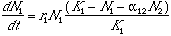
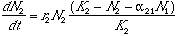
- Lokta-Volterra Competition
- a simple mathematical model that can be used to understand how different factors affect the outcomes of competitive interactions.
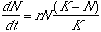
- Logistic Growth Equation
- N = population size t = time K = carrying capacity r = intrinsic rate of increase a = competition coefficient rN = population's growth in the absence of competition (K-N)/N = intraspecific competition (density-dependence) rate of growth depends on the density of the population
- Coyotes
- -a12 = effect of species 2 on species 1 -a12 < 1 = the effect of species 2 on species 1 is less than the effect of species 1 on its own members -a12 > 1 = species 2 will competitively exclude species 1 -coexistence is when intraspecific > interspecific (competition with own members more than with other species) -aN = competition coefficient
- Vultures
- a21 = effect of species 1 on species 2
- Mean Density
- -a harmony of the populations represented in the equation -equal densities = “zero growth” and coexistence
- Isoclines of Zero Population Growth
- K1 - N1 - a12N2 = 0 K2 - N2 - a21 N1 = 0
- State Space Graphs
- -the abundance of species 1 is plotted on the x-axis and the abundance of species 2 is plotted on the y-axis -show how the size of each population increases or decreases when we start with different combinations of species abundances
- Zero Isocline
- -the combination of abundances of both species where species 1 does not change -Combined abundance < K1: species 1 increases (draws to the right) -Combined abundance > K1: species 1 decreases (draws to left) -K1 is filled by equivalent N2: carrying capacity is filled by vultures → species 1 is not present (coyotes) -N1 reaches K1: species 2 is not present (too many coyotes)
- Interference Competition
Population Dynamics
- to know why populations disperse even in unfavorable conditions
- DIspersal
- Emigration
- -dispersal away from parent home range -Common pattern: more individuals closer to the population and fewer individuals farther away from the population
- Gender-Based Reproductive Success
- Females
- -If reproductive success for females is limited by nutritional constraints: If the area in the center is an area of high-competition → females will disperse away from that to avoid competition for food
- Males
- -If reproductive success for males is limited by the number of females encountered: If the area in the center have more females → males will cluster in the center
- Females
- Wind Transport
- Wind transport for plants who don’t walk
- Leptokurtic Curve
- -pattern for wind dispersal -peak of abundance in the population that is close to the mother plant -is the peak of the population density a physical dispersal limitation or is it a dispersal optimum?
- Dandelions
- H2O Transport
- -Fish are moved around by their environment -can only go in one direction (downstream) --> downstream rudder
- Salmon Fry + Testosterone
- -Salmon fry treated with testosterone → prone to wander and move -results: applying testosterone increases dispersal distance -physiological mechanism that can promote dispersal -salmon fry survival decreases with increasing natal dispersal distance -shows that there is an optimum to their dispersal -the optimum (how far they should go) is not always equal to how far they could go
- Passive Navigation
- Portuguese Man of War
- portuguese man of war has a sail on the heel of their bulbous head that they can control (like a sailboat)
- Genetic polymorphism
- -half/half that controls/constrains the direction that the sail is oriented on the body -in half the population it points one direction and in the other half it points the other way -50% tack starboard; 50% tack port → longshore dispersal -shows that dispersal can be controlled by genetic mechanisms
- Portuguese Man of War
- Animal Vector
- Primary + Secondary Dispersal
- -primary dispersal: passive plant just drops seeds population is very close to the mother plant can only go so far -secondary dispersal:facilitated density is stretched out over the geographic area
- Burdock Seed
- -burdock seed bur do not use wind or water; they use the movement of other organisms to disperse -they stick on your clothes these motherfuckers -they stick like velcro with hooks
- Primary + Secondary Dispersal
- Coordinated Gamete Release
- -fish don’t reproduce the same way that mammals do; they release gametes at the same time and their gametes mix in the water -some emigration from the parents because of the current → can predict where the gametes will go
- Sea Urchin Dispersal
- -gametes have a settlement time → they get heavy enough to fall out of the water -gamete size of individuals indicate how old they are -metapopulation: results from two subpopulations that are connected by something -if there was no northerly current (water was stagnant) → these populations would not be connected
- Density Independent Dispersal
- -dispersal that happens regardless of how dense the population is -passive dispersal -dependent on various forms of naturally occurring energy (gravity, wind, animal, or current-vector)
- Density Dependent Dispersal
- -dispersal that happens depending on how dense the population -active dispersal -in response to local population size, resource competition, habitat quality, and habitat size
- Natal Dispersal
- -permanent movement an individual makes from its birth site to the place where it reproduces or would have reproduced had it survived
- Breeding Dispersal
- movement of adults between breeding attempts
- Kernel Density
- -if dispersal is density dependent → (95% dense) will move outside of the threshold -5% kernel density → range expansion could evolve in a low density in the home range → could distribute them back into the home range
- Why Do Individuals Disperse?
- Proximate Causes
- Environmental Dispersal
- absent or highly variable resources
- Golden Eagles
- -duration of pre-dispersal period for young eagles is correlated with blood levels of uric acid -increased levels of uric acid → reduced food intake & increased need to metabolize available proteins → poorer condition → delayed dispersal -environmental mechanism that tells them to leave because they will not get enough food and die
- Parental Aggression
- parents can tell young to go away
- Innate Dispersal
- genetic predisposition to disperse
- Screech Owls
- -juvenile owls at age of first dispersal will secrete increased levels of corticosterone -corticosterone will result in predisposition to move/wander -good body condition: increased corticosterone → leaving immediately/dispersal -poor body condition: decreased corticosterone → stay but increase foraging to get enough food to increase corticosterone -results in a sibling dispersal → reduced aggression & competition → increased to locally build fat stores → net increase in dispersal success -Endogenous cue stimulates locomotor activity in owls
- Environmental Dispersal
- Ultimate Causes
- Inbreeding Avoidance
- avoiding breeding with a sibling
- Competition for Mates
- -can result in reduced fitness -cannot find a mate → no fitness -lotka-volterra: any competition that is intraspecific competition will reduce the ability for any population to gain some growth
- Small Population Paradigm: Extinction Vortex
- -active in small populations -real risk of extinction without dispersal -small populations are susceptible to inbreeding depression and random drift -deleterious alleles can be fixed in a population because of random drift -results in loss of genetic variability → reduction in fitness → higher mortality → lower reproduction → lower population -looks like a toilet, spinning around into a sewer of extinction
- Competition for Resources
- Inbreeding Avoidance
- Push + Pull of Dispersal
- -Increasing colonization ability vs. Decreasing energetic cost of dispersal
- Dispersal Inducers
- -Poor habitat quality: predators, drought, etc. → increase evolution of dispersal -Crowding → dispersal -Kin competition, inbreeding → dispersal -Parent-offspring competition → dispersal
- Cost
- Energy cost (takes energy to walk, run, make structures to float in wind, etc.) Searching for food in an unknown habitat
- Proximate Causes
- Survivorship Curves
- -Describe the proportion of individuals at each age for a given species or group -For all curves, assuming that death will happen eventually -the moment egg hits sperm, you are getting ready to die
- Type I
- -An inverted sigmoidal curve (exponential decrease) -High rate of survivorship early and in middle in life; steep decline in survivorship late in life
- Mammals
- -Mammals produce few young and care for their young -Mammals die later in life after they reproduce
- K selected species
- -operate very close to the carrying capacity of their environment (stable environments) -few individuals are being born but few individuals are dying when they’re young
- Type 2
- -Linear = relatively equal likelihood of death -Constant mortality independent of age
- BIrds
- Type 3
- -Lots of individuals that produce many young -Survivorship of the young is very low
- Mussels, Insects
- r selected species
- -to maintain their demographic, they rely on their growth rate (not on care or maintaining close association with the carrying capacity) -rely on their ability to multiply in great numbers to compensate for the greatest mortality happening early in life -Those surviving the “bottle neck” → low death rates; constant mortality (equal chances of death) -Species live in unstable environments → need to grow quickly so if there is a change in the environment that is 1) unfavorable, they can afford to die back or 2) favorable, they can reach carrying capacity
- Emigration
Predation
- Neutralism (0,0)
- -the fitness of species 1 has no bearing on the fitness of species 2 -no gain or loss of fitness for either individuals -ex: baboons with gazelles; don’t eat the same things, they don’t fight, no competition, no interaction → no positive or negative effect of them interacting
- Mutualism (+,+)
- -species 1 and species 2 benefit -ex: gut flora, pollination of plants with birds, cleaner fish -obligate vs. facultative
- Competition (+,-)
- -fitness of species 1 is lowered via interaction with species 2 -ex: bald eagle vs. golden eagle
- Synnecrosis (-,-)
- -mutually detrimental (simultaneous death) -illusive; few examples (all theoretical)
- Commensalism (+,0)
- Commensalism (0,+)
- -species 1 benefits and species 2 is neither benefited nor harmed (or vice versa) -ex: shark has a remora fish attached to it and remora catches bits of food that falls out of the shark’s mouth (it’s not pulling bits out of its mouth, so shark is not gaining or losing anything by the remora on them)
- Ammensalism (0,-))
- Ammensalism (-,0)
- -byproduct of species 1 has a negative effect on species 2 while species 2 has done nothing/has no effect on species 1 -ex: penicillium on moldy bread that is produced by the fungus kills the bacteria on the bread despite the fact that the bacteria do not pose a threat to the fungus
- Predation/Parasitism (+,-)
- Predation/Parasitism (-,+)
- -parasite taking something from host -predator taking life from prey, fitness becomes 0 -ex: bear eating a salmon
- Boom-Bust Cycles
- Why do their populations oscillate?
- Population Doubling (In Prey)
- -if there is one individual added to the population → each will produce two → doublings -always a population double before the predator can catch up → then predator catches up before the prey can go further -in response, there is a numerical increase in the predator
- Limitation
- -there is a limit to what can happen: -dynamics are limited by what the prey can do in its environment (prey has a carrying capacity) -ex: prey eats too much of plants (overgrazes) and the plant has a defense mechanism → limited by its resources
- Bottom-Up Forcing
- -through the prey (species that sits lower in the food chain)
- Overgrazing
- -if the hare population increases to much → overgrazing → nutritional stress if there is not enough food to go around
- Induced Unpalatability
- -if plants are grazed too hard → they undergo chronic nutritional stress → plants produce toxins to prevent hares from overgrazing on them
- Top-Down Forcing
- through the predator
- Numerical Response
- -Six-fold L increase in predator if there is a doubling in prey -it is the predators’ numbers that drives the increase or decrease of both the predator/prey -predator is the more important player in controlling the numbers
- Functional Response
- -Type II with caching -the predator can choose not to eat every prey that it encounters
- Population Doubling (In Prey)
- Why do their populations oscillate?
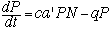
- Lokta-Volterra Predation
- In the absence of prey, predators will decline exponentially
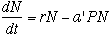
- -change in predator over the change in time (rate of change of the predator) will have an exponential decline in the absence of prey -q= coefficient of decay (natural mortality without prey) --Predator Mortality Rate (rate of decrease) -P = number of predators
- In the presence of prey, decline is opposed by predator birth rate
- -c = Predator’s “ability to turn food into offspring” (conversion efficiency) -a = attack rate -P = number of predators -N = number of prey -PN = encounter rate -when there are more encounters between the two, the number of predators will increase if the number of prey increases -caP = predator numerical response (per capita increase as a function of prey abundance)
- In the absence of predators, prey will increase exponentially
- In the presence of predators, prey increase is prevented by mortality
- -a = attack rate -P = number of predators -N = number of prey -1. predator functional response (rate of prey capture as a function of prey abundance) -2. prey mortality (rate of consumption of prey)
- Boom-Bust Cycles
- Increase in aPN leads to a decrease in the number of prey (N), which in turns causes P to decrease → Prey recover → enabling predators to increase = BOOM-BUST CYCLE
- In the absence of prey, predators will decline exponentially
- Isoclines
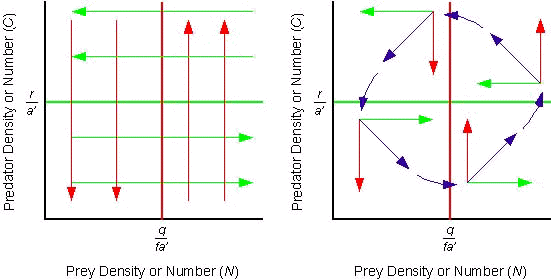
- x-axis: number of prey (N) y-axis: number of predators (P) finding where they equal zero
- Predator Equilibrium Isocline
- Vertical Line isocline -on either side there will be a difference in trajectory in the predator population -left side: predator population decreases -right side: predator population increases
- Prey Equilibrium Isocline
- Horizontal Line isocline -can the predator graze down the prey population enough so that there is no change in the prey population -below isocline: prey population increases because there is not enough predators to put it down -above isocline: prey population decreases because there is too much predators
- Bottom Left-Corner
- -too few prey to compensate for the mortality of the predator -shared trajectory that the predator populations are decreasing while the prey populations increase
- Bottom Right-Corner
- -too few predators to keep up with the rate of growth of the prey -increase in prey (more prey than is needed to compensate for the mortality of the predator) -shared increase in both populations
- Top Right-Corner
- -more predators consuming than the prey population can handle -increase in predators and decrease in prey
- Top Left-Corner
- -decrease in both predator and prey population -too few prey to support the predators -more predators than the growth rate of the populations can sustain
- Spiral Trajectory
- -spiraling to an unstable equilibrium -circular overall = populations are cycling through the states -there is always instability in the system
- Joint Equilibrium
- -inherently unstable -assumes that not even one individual will be added to the population = false -will reach joint equilibrium then pop out to another state by a slight change in the system → spiraling path will start again
- Lokta-Volterra Model Assumptions
- 1. Prey will grow exponentially when predators are absent
- 2. Predators will starve in absence of prey (e.g. no prey switching)
- 3. Predators can consume infinite quantities of prey
- 4. There is no environmental complexity
- -species move randomly in a homogenous environment -just one change in the environment can cause the spiral to start anew
- 4. There is no environmental complexity
- 3. Predators can consume infinite quantities of prey
- 2. Predators will starve in absence of prey (e.g. no prey switching)
- 1. Prey will grow exponentially when predators are absent
- Neutralism (0,0)
Island Biogeography
- -A field of study focused on the factors that affect species richness in natural communities based on habitat isolation, area, and immigration and extinction dynamics -founded by Robert MacArthur and E.O. Wilson (1960)
- The Species:Area Effect
- -larger islands have exponentially larger species than smaller islands (graph is on a log scale) -can predict the amount of biodiversity an island can sustain
- The Equilibrium Model of Island Biogeography
- -Number of species vs. Rate of immigration vs. Rate of extinction -New species must arrive to sustain extinction on an island -Rate of new species to island decreases as number of species on islands increases -fewer species go in when there are more species on the island because most of the niches have already been taken
- Equilibirum
- Where the rates of immigration + rate of extinction intersect is where equilibrium is located IR = ER
- Island Area Effect
- -Large islands can support more immigration -IR are higher to islands with greater area -ER are higher on islands with limited area -smaller islands have fewer resources -more populations that arrive will have to compete + not as many niches
- Small islands
- low IR and high ER result in poor species diversity
- Large Islands
- high IR and low ER result in rich species diversity
- Island Isolation Effect
- -islands that are near to other islands will support immigration -IR are higher to near islands -islands isolated are less likely to experience immigration -far islands have higher extinction rates -ER are higher on far islands -lower diversity of resources
- Far Islands
- low IR and high ER result in poor species diversity
- Near Islands
- high IR and low ER result in rich species diversity
- The Rescue Effect
- Island populations on near and large islands are rescued from extinction due to connectivity with source populations (immigration pools)
- The Target Effect
- -Immigrating species target large islands for their greater number of resources and available niches -Stochastic (random) processes may accumulate more species on larger islands by chance because they are larger
- Fly Over Effect
- a larger island casts a larger “net” on species flying over
- Factors Influencing the Equilibrium Model
- Isolation
- Degree
- -distance to nearest neighbor, mainland -distance increases the likelihood that a population cannot make it there
- Length
- -time since isolation -ecosystems chance; the longer an ecosystem has been isolated → the more uninhabitable by other migrating populations
- Degree
- Habitat Suitability
- Substrate: type, quality, quantity Climate: weather, proximity to wind or current transport vectors
- Initial Species Composition
- plant and animal assemblage if when previously attached to a larger land mass
- Current Species Composition
- island pioneer assemblage, founder population, successional community
- Human Activity
- anthropogenic disturbance
- Isolation
- In Practice
- Obs: National Parks
- -relax towards equilibrium -exhibit ecosystem decay
- Action
- Habitat Corridors
- -pathways for movement increase reserve K -can also allows diseases and pathogens to spread, complicating the simple prescription of “connectivity being good for biodiversity”
- Sonoran Desert Proposal
- a huge landscape is cut by interstates and roads → possibility that managers will begin to put overpasses to uniting the chopped up ecosystems
- Reserve Design
- “single Large Or Several Small” (SLOSS)
- Habitat Corridors
- Obs: National Parks
Conservation Physiology
- how physiology can predict winners and losers in climate change
- Climate Change
- Keeling Curve
- -atmospheric CO2 concentration increases exponentially -carbon will double for every unit of time -carbon traps heat → large changes in temperatures
- Predictions
- -very serious changes in temperatures (terrestrial + marine) -7-8C increase
- Ocean Acidification
- -oceans act as carbon sinks -if you leave carbon dioxide dissolved in water → becomes more acidic (lower pH) and an increase in carbonic acid
- Predictions
- marine temperatures will get warmer and the ocean will become more acidic → many marine animals have calcium carbonate shells that can be dissolved in the acidic water
- Effects
- Shift in Geographic Ranges
- organisms will pick out their optimal environment in order for them to live in and change it if necessary -many are shifting north
- Athleticism + Extinction
- -fish that are able to swim longer and faster are more athletic -if the ability to do exercise is reduced with increased temperature -only the populations that have evolved athleticism will be the only ones that can make it to the farther rivers for optimal environments → other populations may experience slight extinction
- Shrinking of Body Size
- -big fish go one place while small fish go another -50% change in body size is due to physiology (change in the ability to grow) -change in oxygen concentration over time --lots of oxygen → higher ability to assimilate + grow --reduced oxygen from global warming → reduced size in species
- Ocean Acidification on Fishes
- -impairs learning + sensory capacities in fish -lowers body condition + survival -decrease tissue growth -carbonate ions in bones → bone growth can be affected by higher pH
- The Performance Curve
- -Thermal primacy: a performance peak given a certain temperature -Lethal: tolerance limits; death -Controlling: metabolic sensitivity; enzymatic reactions (Q10: 10 degree ranges of temperature) -Limiting: geographic ranges; can only access certain points on the performance curve -Directing: taxis, migration; moving will constrain their performance -Masking: fish response to other factors is influenced by temperature
- Aerobic Scope
- -difference between the resting and metabolic rates = aerobic scope (area between the two curves) -represents ability to do exercise -tipping points for performance at pejus temperatures (turning points where it is not optimal anymore)
- No Response
- If curve no longer changes: -fish can no longer perform at optimum given the temperature that it is at -gives the question of climate change because they are not able to adapt to that change in temperature (if the curve doesn’t move) → cannot access optimal performance
- Adaptive vs. Acclimatization
- Adapation: shift in phenotype frequency in a population Acclimatization: physiological, behavioral or morphological adjustment that broadens the performance curve (phenotypic plasticity) no genetic selection
- Hope for Acclimatization
- -results in increased performance -allows for adaptation to catch up -if fish is fully acclimatized then performance in the new environment has not changed: phenotypic buffering -Different Types: Transgenerational Developmental Reversible
- Shift in Geographic Ranges
- Keeling Curve
- Why is Physiology Important for Conservation?
- -physiologists contribute knowledge, models, perspectives to conservation decision-making -threats to the persistence of a population have often physiological mechanisms -physiology provides mechanistic explanations of how environmental disturbances to individuals have an effect on ecological function, population persistence and ultimately species survival -physiology allows identification of solutions to environmental stress
- Little Skate
- Georges Bank
- -smaller (cannot grow as quickly) -has a smaller aerobic scope than the Gulf of Maine population
- Gulf of Maine
- -larger skates = more metabolically efficient than smaller skates (low metabolic rates) -doesn't perform as well in the tests as the Georges Bank skates in response to varying temperature + acidity
- Georges Bank
Images and files in the map


Information
- Description
- Mind Map on Ecology & Evolution Exam III, created by Tisshu on 02/05/2015.
- Created by
- Tisshu
- Views
- 3
- Rating