
Mind map
Morality and Hypothetical Imperatives
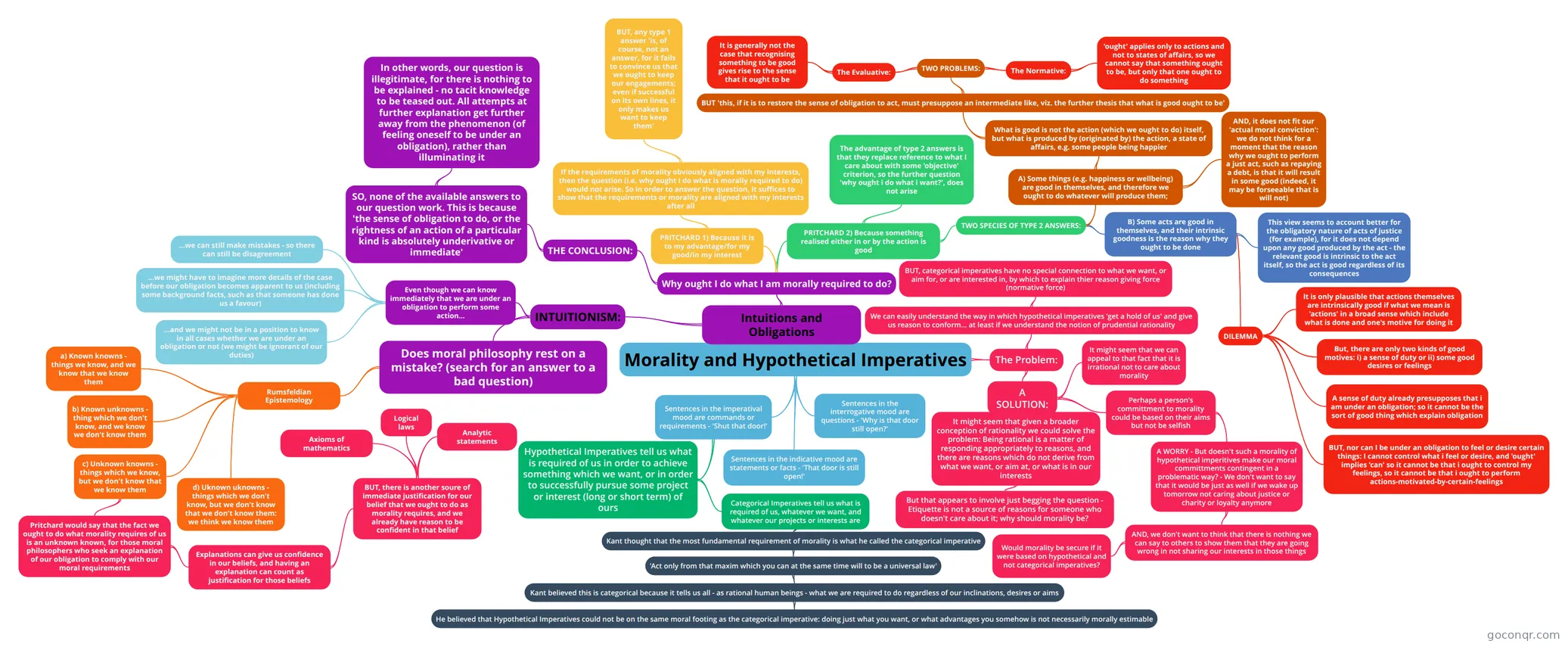
Mind map: morality and hypothetical imperatives
Map content
Morality and Hypothetical Imperatives
Sentences in the imperatival mood are commands or requirements - 'Shut that door!'
- Hypothetical Imperatives tell us what is required of us in order to achieve something which we want, or in order to successfully pursue some project or interest (long or short term) of ours
- Categorical Imperatives tell us what is required of us, whatever we want, and whatever our projects or interests are
- Kant thought that the most fundamental requirement of morality is what he called the categorical imperative
- 'Act only from that maxim which you can at the same time will to be a universal law'
- Kant believed this is categorical because it tells us all - as rational human beings - what we are required to do regardless of our inclinations, desires or aims
- He believed that Hypothetical Imperatives could not be on the same moral footing as the categorical imperative: doing just what you want, or what advantages you somehow is not necessarily morally estimable
- Kant believed this is categorical because it tells us all - as rational human beings - what we are required to do regardless of our inclinations, desires or aims
- 'Act only from that maxim which you can at the same time will to be a universal law'
- Kant thought that the most fundamental requirement of morality is what he called the categorical imperative
- Categorical Imperatives tell us what is required of us, whatever we want, and whatever our projects or interests are
- Hypothetical Imperatives tell us what is required of us in order to achieve something which we want, or in order to successfully pursue some project or interest (long or short term) of ours
Sentences in the indicative mood are statements or facts - 'That door is still open!'
Sentences in the interrogative mood are questions - 'Why is that door still open?'
The Problem:
- We can easily understand the way in which hypothetical imperatives 'get a hold of us' and give us reason to conform... at least if we understand the notion of prudential rationality
- BUT, categorical imperatives have no special connection to what we want, or aim for, or are interested in, by which to explain thier reason giving force (normative force)
- A SOLUTION:
- It might seem that we can appeal to that fact that it is irrational not to care about morality
- It might seem that given a broader conception of rationality we could solve the problem: Being rational is a matter of responding appropriately to reasons, and there are reasons which do not derive from what we want, or aim at, or what is in our interests
- But that appears to involve just begging the question - Etiquette is not a source of reasons for someone who doesn't care about it; why should morality be?
- Perhaps a person's committment to morality could be based on their aims but not be selfish
- A WORRY - But doesn't such a morality of hypothetical imperitives make our moral committments contingent in a problematic way? - We don't want to say that it would be just as well if we wake up tomorrow not caring about justice or charity or loyalty anymore
- AND, we don't want to think that there is nothing we can say to others to show them that they are going wrong in not sharing our interests in those things
- Would morality be secure if it were based on hypothetical and not categorical imperatives?
- AND, we don't want to think that there is nothing we can say to others to show them that they are going wrong in not sharing our interests in those things
- A WORRY - But doesn't such a morality of hypothetical imperitives make our moral committments contingent in a problematic way? - We don't want to say that it would be just as well if we wake up tomorrow not caring about justice or charity or loyalty anymore
- We can easily understand the way in which hypothetical imperatives 'get a hold of us' and give us reason to conform... at least if we understand the notion of prudential rationality
Intuitions and Obligations
- Why ought I do what I am morally required to do?
- PRITCHARD 1) Because it is to my advantage/for my good/in my interest
- If the requirements of morality obviously aligned with my interests, then the question (i.e. why ought I do what is morally required to do) would not arise. So in order to answer the question, it suffices to show that the requirements or morality are aligned with my interests after all
- BUT, any type 1 answer 'is, of course, not an answer, for it fails to convince us that we ought to keep our engagements; even if successful on its own lines, it only makes us want to keep them'
- If the requirements of morality obviously aligned with my interests, then the question (i.e. why ought I do what is morally required to do) would not arise. So in order to answer the question, it suffices to show that the requirements or morality are aligned with my interests after all
- PRITCHARD 2) Because something realised either in or by the action is good
- The advantage of type 2 answers is that they replace reference to what I care about with some 'objective' criterion, so the further question 'why ought i do what i want?', does not arise
- TWO SPECIES OF TYPE 2 ANSWERS:
- A) Some things (e.g. happiness or wellbeing) are good in themselves, and therefore we ought to do whatever will produce them;
- What is good is not the action (which we ought to do) itself, but what is produced by (originated by) the action, a state of affairs, e.g. some people being happier
- BUT 'this, if it is to restore the sense of obligation to act, must presuppose an intermediate like, viz. the further thesis that what is good ought to be'
- TWO PROBLEMS:
- The Evaluative:
- It is generally not the case that recognising something to be good gives rise to the sense that it ought to be
- The Normative:
- 'ought' applies only to actions and not to states of affairs, so we cannot say that something ought to be, but only that one ought to do something
- The Evaluative:
- TWO PROBLEMS:
- BUT 'this, if it is to restore the sense of obligation to act, must presuppose an intermediate like, viz. the further thesis that what is good ought to be'
- AND, it does not fit our 'actual moral conviction': we do not think for a moment that the reason why we ought to perform a just act, such as repaying a debt, is that it will result in some good (indeed, it may be forseeable that is will not)
- What is good is not the action (which we ought to do) itself, but what is produced by (originated by) the action, a state of affairs, e.g. some people being happier
- B) Some acts are good in themselves, and their intrinsic goodness is the reason why they ought to be done
- This view seems to account better for the obligatory nature of acts of justice (for example), for it does not depend upon any good produced by the act - the relevant good is intrinsic to the act itself, so the act is good regardless of its consequences
- DILEMMA
- It is only plausible that actions themselves are intrinsically good if what we mean is 'actions' in a broad sense which include what is done and one's motive for doing it
- But, there are only two kinds of good motives: i) a sense of duty or ii) some good desires or feelings
- A sense of duty already presupposes that i am under an obligation; so it cannot be the sort of good thing which explain obligation
- BUT, nor can I be under an obligation to feel or desire certain things: I cannot control what i feel or desire, and 'ought' implies 'can' so it cannot be that i ought to control my feelings, so it cannot be that i ought to perform actions-motivated-by-certain-feelings
- A) Some things (e.g. happiness or wellbeing) are good in themselves, and therefore we ought to do whatever will produce them;
- THE CONCLUSION:
- SO, none of the available answers to our question work. This is because 'the sense of obligation to do, or the rightness of an action of a particular kind is absolutely underivative or immediate'
- In other words, our question is illegitimate, for there is nothing to be explained - no tacit knowledge to be teased out. All attempts at further explanation get further away from the phenomenon (of feeling oneself to be under an obligation), rather than illuminating it
- SO, none of the available answers to our question work. This is because 'the sense of obligation to do, or the rightness of an action of a particular kind is absolutely underivative or immediate'
- PRITCHARD 1) Because it is to my advantage/for my good/in my interest
- INTUITIONISM:
- Even though we can know immediately that we are under an obligation to perform some action...
- ...we can still make mistakes - so there can still be disagreement
- ...we might have to imagine more details of the case before our obligation becomes apparent to us (including some background facts, such as that someone has done us a favour)
- ...and we might not be in a position to know in all cases whether we are under an obligation or not (we might be ignorant of our duties)
- Does moral philosophy rest on a mistake? (search for an answer to a bad question)
- Rumsfeldian Epistemology
- a) Known knowns - things we know, and we know that we know them
- b) Known unknowns - thing which we don't know, and we know we don't know them
- c) Unknown knowns - things which we know, but we don't know that we know them
- Pritchard would say that the fact we ought to do what morality requires of us is an unknown known, for those moral philosophers who seek an explanation of our obligation to comply with our moral requirements
- Explanations can give us confidence in our beliefs, and having an explanation can count as justification for those beliefs
- BUT, there is another soure of immediate justification for our belief that we ought to do as morality requires, and we already have reason to be confident in that belief
- Axioms of mathematics
- Logical laws
- Analytic statements
- BUT, there is another soure of immediate justification for our belief that we ought to do as morality requires, and we already have reason to be confident in that belief
- Explanations can give us confidence in our beliefs, and having an explanation can count as justification for those beliefs
- Pritchard would say that the fact we ought to do what morality requires of us is an unknown known, for those moral philosophers who seek an explanation of our obligation to comply with our moral requirements
- d) Uknown uknowns - things which we don't know, but we don't know that we don't know them: we think we know them
- Rumsfeldian Epistemology
- Even though we can know immediately that we are under an obligation to perform some action...
- Why ought I do what I am morally required to do?
Information
- Description
- Mind Map on Morality and Hypothetical Imperatives, created by Alice Tonks on 05/05/2015.
- Created by
- Alice Tonks
- Views
- 0
- Rating
More on The Categorical Imperative