
Mind map
Loftus & Palmer (1974)
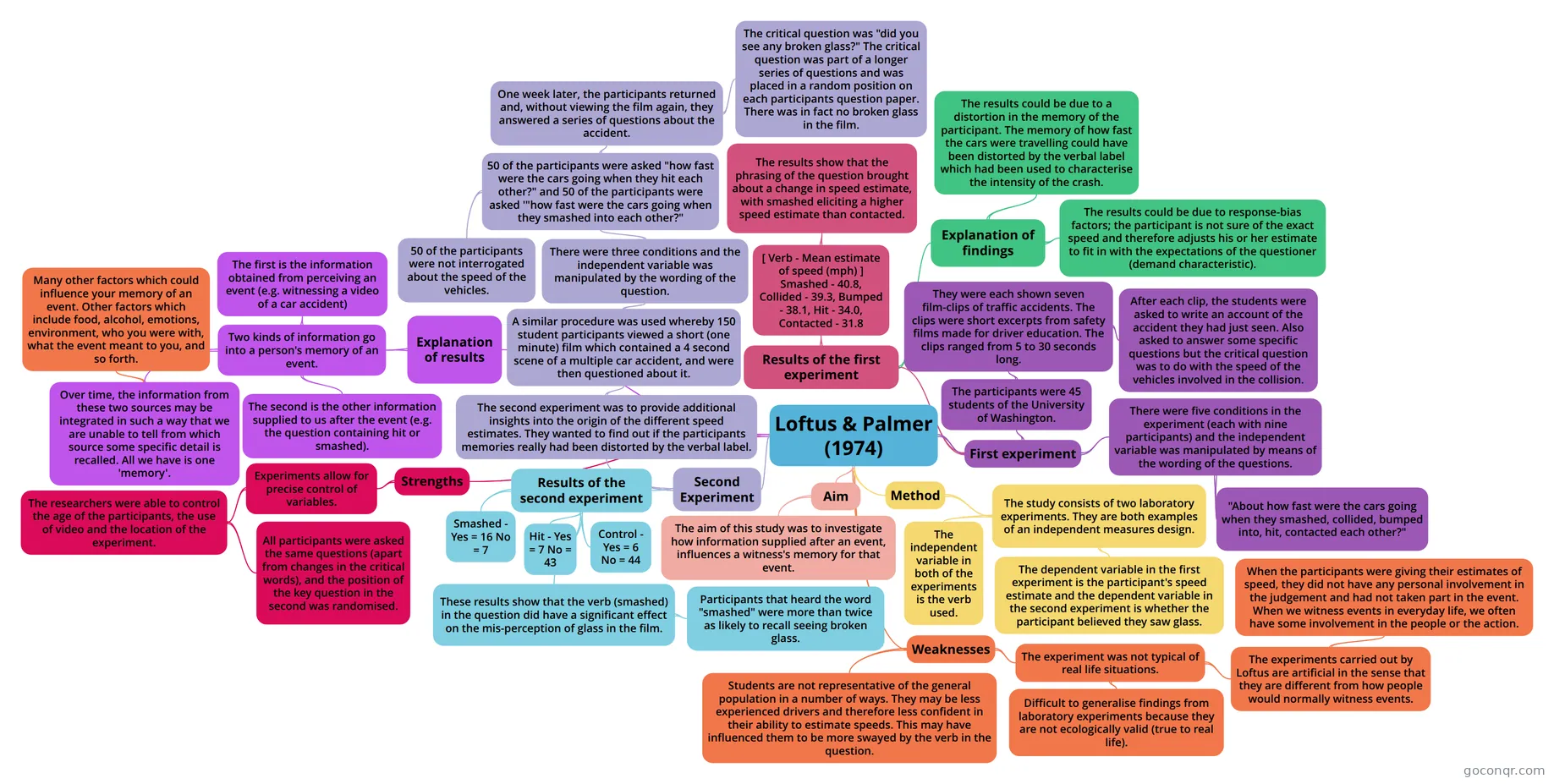
Mind map: Loftus & Palmer (1974)
Map content
Loftus & Palmer (1974)
Aim
- The aim of this study was to investigate how information supplied after an event, influences a witness's memory for that event.
Method
- The study consists of two laboratory experiments. They are both examples of an independent measures design.
- The independent variable in both of the experiments is the verb used.
- The dependent variable in the first experiment is the participant's speed estimate and the dependent variable in the second experiment is whether the participant believed they saw glass.
- The study consists of two laboratory experiments. They are both examples of an independent measures design.
First experiment
- The participants were 45 students of the University of Washington.
- They were each shown seven film-clips of traffic accidents. The clips were short excerpts from safety films made for driver education. The clips ranged from 5 to 30 seconds long.
- After each clip, the students were asked to write an account of the accident they had just seen. Also asked to answer some specific questions but the critical question was to do with the speed of the vehicles involved in the collision.
- They were each shown seven film-clips of traffic accidents. The clips were short excerpts from safety films made for driver education. The clips ranged from 5 to 30 seconds long.
- There were five conditions in the experiment (each with nine participants) and the independent variable was manipulated by means of the wording of the questions.
- "About how fast were the cars going when they smashed, collided, bumped into, hit, contacted each other?"
- Results of the first experiment
- [ Verb - Mean estimate of speed (mph) ] Smashed - 40.8, Collided - 39.3, Bumped - 38.1, Hit - 34.0, Contacted - 31.8
- The results show that the phrasing of the question brought about a change in speed estimate, with smashed eliciting a higher speed estimate than contacted.
- Explanation of findings
- The results could be due to a distortion in the memory of the participant. The memory of how fast the cars were travelling could have been distorted by the verbal label which had been used to characterise the intensity of the crash.
- The results could be due to response-bias factors; the participant is not sure of the exact speed and therefore adjusts his or her estimate to fit in with the expectations of the questioner (demand characteristic).
- [ Verb - Mean estimate of speed (mph) ] Smashed - 40.8, Collided - 39.3, Bumped - 38.1, Hit - 34.0, Contacted - 31.8
- The participants were 45 students of the University of Washington.
Second Experiment
- The second experiment was to provide additional insights into the origin of the different speed estimates. They wanted to find out if the participants memories really had been distorted by the verbal label.
- A similar procedure was used whereby 150 student participants viewed a short (one minute) film which contained a 4 second scene of a multiple car accident, and were then questioned about it.
- There were three conditions and the independent variable was manipulated by the wording of the question.
- 50 of the participants were asked "how fast were the cars going when they hit each other?" and 50 of the participants were asked '"how fast were the cars going when they smashed into each other?"
- 50 of the participants were not interrogated about the speed of the vehicles.
- One week later, the participants returned and, without viewing the film again, they answered a series of questions about the accident.
- The critical question was "did you see any broken glass?" The critical question was part of a longer series of questions and was placed in a random position on each participants question paper. There was in fact no broken glass in the film.
- 50 of the participants were asked "how fast were the cars going when they hit each other?" and 50 of the participants were asked '"how fast were the cars going when they smashed into each other?"
- There were three conditions and the independent variable was manipulated by the wording of the question.
- A similar procedure was used whereby 150 student participants viewed a short (one minute) film which contained a 4 second scene of a multiple car accident, and were then questioned about it.
- Results of the second experiment
- Smashed - Yes = 16 No = 7
- Hit - Yes = 7 No = 43
- Control - Yes = 6 No = 44
- These results show that the verb (smashed) in the question did have a significant effect on the mis-perception of glass in the film.
- Participants that heard the word "smashed" were more than twice as likely to recall seeing broken glass.
- The second experiment was to provide additional insights into the origin of the different speed estimates. They wanted to find out if the participants memories really had been distorted by the verbal label.
Explanation of results
- Two kinds of information go into a person's memory of an event.
- The first is the information obtained from perceiving an event (e.g. witnessing a video of a car accident)
- The second is the other information supplied to us after the event (e.g. the question containing hit or smashed).
- Over time, the information from these two sources may be integrated in such a way that we are unable to tell from which source some specific detail is recalled. All we have is one 'memory'.
- Many other factors which could influence your memory of an event. Other factors which include food, alcohol, emotions, environment, who you were with, what the event meant to you, and so forth.
- Two kinds of information go into a person's memory of an event.
Strengths
- Experiments allow for precise control of variables.
- The researchers were able to control the age of the participants, the use of video and the location of the experiment.
- All participants were asked the same questions (apart from changes in the critical words), and the position of the key question in the second was randomised.
- The researchers were able to control the age of the participants, the use of video and the location of the experiment.
- Experiments allow for precise control of variables.
Weaknesses
- The experiment was not typical of real life situations.
- The experiments carried out by Loftus are artificial in the sense that they are different from how people would normally witness events.
- When the participants were giving their estimates of speed, they did not have any personal involvement in the judgement and had not taken part in the event. When we witness events in everyday life, we often have some involvement in the people or the action.
- Difficult to generalise findings from laboratory experiments because they are not ecologically valid (true to real life).
- The experiments carried out by Loftus are artificial in the sense that they are different from how people would normally witness events.
- Students are not representative of the general population in a number of ways. They may be less experienced drivers and therefore less confident in their ability to estimate speeds. This may have influenced them to be more swayed by the verb in the question.
- The experiment was not typical of real life situations.
Information
- Description
- Mind Map on Loftus & Palmer (1974), created by Annabelle Langmead on 05/06/2015.
- Created by
- Annabelle Langmead
- Views
- 0
- Rating