
Mind map
OCR GCSE SOCIOLOGY BASICS
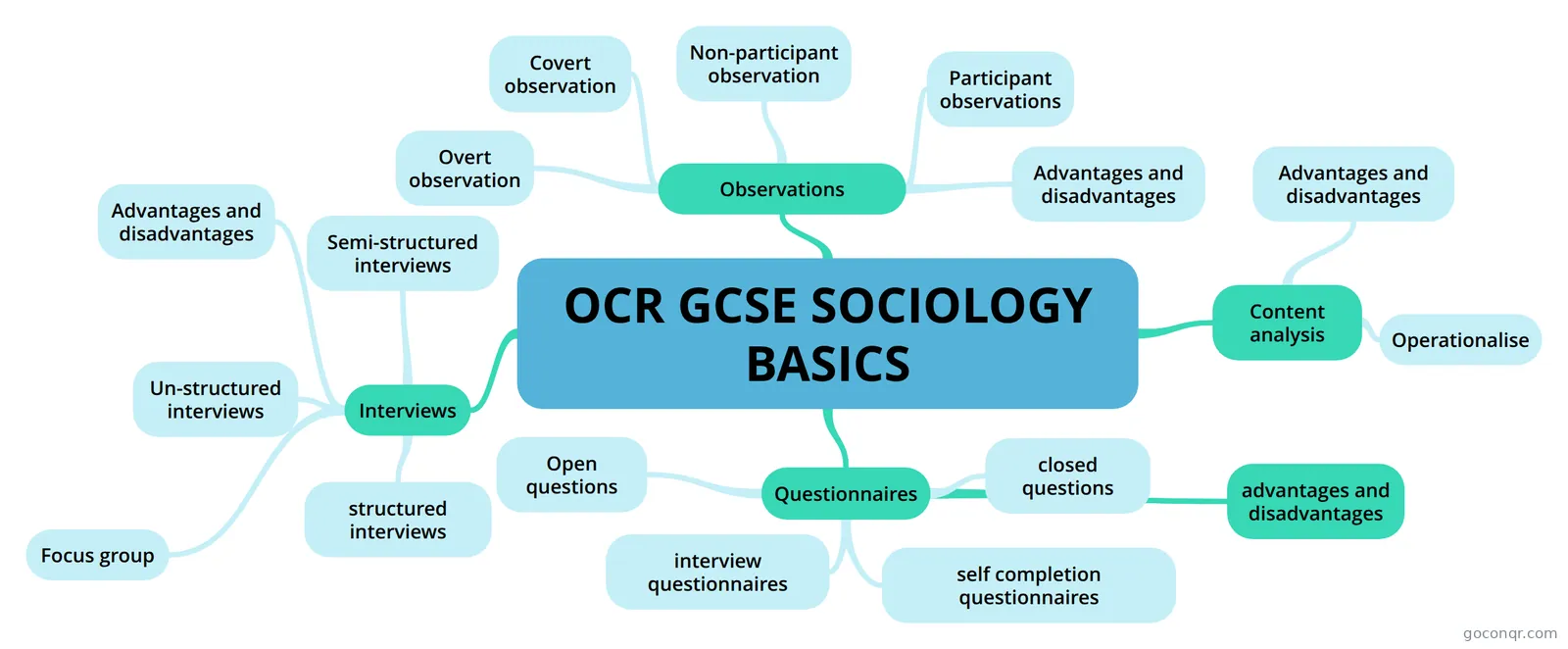
Mind map: OCR GCSE sociology research methods
Map content
OCR GCSE SOCIOLOGY BASICS
Questionnaires
- a list of questions which is completed by a number of respondents
- self completion questionnaires
- Respondent completes the questionnaire themselves and returns it to the researcher
- interview questionnaires
- questions are read out to the respondent by the researcher, who then record the respondents answers.
- closed questions
- respondents are given a list of options or a two way choice and have to pick the one they most agree with.
- Open questions
- Respondents are free to answer the question the way they like; no option given.
- advantages and disadvantages
- advantages=cheap,large number of respondents,trends detected disadvantages=biased,low response rate,out dated.
Interviews
- structured interviews
- set of standardised pre-set questions read out to the respondents by the researcher.
- Un-structured interviews
- Flexible interview; its more like a conversation, rather than having a set of questions, researcher may have topics/ ideas to discuss.
- Semi-structured interviews
- In between a structured and unstructured interview.
- Focus group
- Several people may be interviewed at the same time and may discuss the answers.
- Advantages and disadvantages
- advantages=high response rate, in-depth responses, reactions seen. disadvantages=time taking,costs,interview bias,social desirability.
- structured interviews
Observations
- Participant observations
- Researcher joins in with the group being studied and acts as they do whilst completing the study.
- Non-participant observation
- Researcher watches the group without getting involved with what they are doing.
- Covert observation
- the researcher does not let the group being studied know they are being observed.
- Overt observation
- Researcher tells the group that they are being observed and does not attempt to hide presence from them
- Advantages and disadvantages
- advantages=objective,natural behaviour seen,no deception. disadvantages=difficult to gain access, observer effect, ethics
- Participant observations
Content analysis
- method used for studying the content of media.
- Operationalise
- to define what exactly is meant by the term used for categorisation
- Advantages and disadvantages
- advantages= cheap, comparisons can be made,easy use. Disadvantages=biased, no in-depth data.
Information
- Description
- Mind Map on OCR GCSE SOCIOLOGY BASICS, created by Mahira Hussain on 09/05/2015.
- Created by
- Mahira Hussain
- Views
- 16
- Rating