
Mind map
Article 2: Right to Life
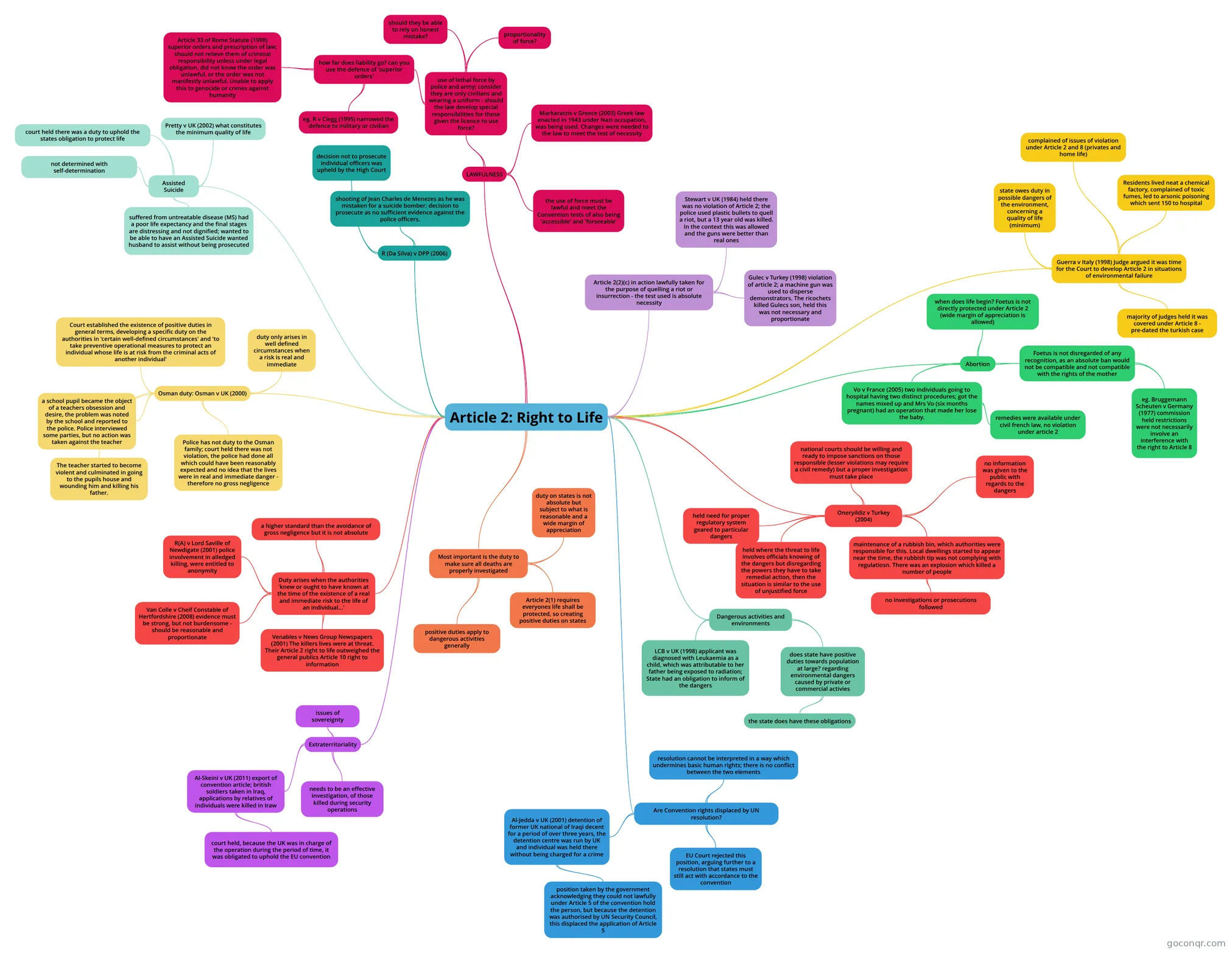
Mind map: Article 2 Right to Life
Map content
Article 2: Right to Life
Article 2(2)(c) in action lawfully taken for the purpose of quelling a riot or insurrection - the test used is absolute necessity
- Stewart v UK (1984) held there was no violation of Article 2; the police used plastic bullets to quell a riot, but a 13 year old was killed. In the context this was allowed and the guns were better than real ones
- Gulec v Turkey (1998) violation of article 2; a machine gun was used to disperse demonstrators. The ricochets killed Gulecs son, held this was not necessary and proportionate
LAWFULNESS
- the use of force must be lawful and meet the Convention tests of also being 'accessible' and 'forseeable'
- Markaratzis v Greece (2003) Greek law enacted in 1943 under Nazi occupation, was being used. Changes were needed to the law to meet the test of necessity
- use of lethal force by police and army; consider they are only civilians and wearing a uniform - should the law develop special responsibilities for those given the licence to use force?
- should they be able to rely on honest mistake?
- proportionality of force?
- how far does liability go? can you use the defence of 'superior orders'
- eg. R v Clegg (1995) narrowed the defence to military or civilian
- Article 33 of Rome Statute (1998) superior orders and prescription of law; should not relieve them of criminal responsibility unless under legal obligation, did not know the order was unlawful, or the order was not manifestly unlawful. Unable to apply this to genocide or crimes against humanity
R (Da Silva) v DPP (2006)
- shooting of Jean Charles de Menezes as he was mistaken for a suicide bomber; decision to prosecute as no sufficient evidence against the police officers.
- decision not to prosecute individual officers was upheld by the High Court
Osman duty: Osman v UK (2000)
- Court established the existence of positive duties in general terms, developing a specific duty on the authorities in 'certain well-defined circumstances' and 'to take preventive operational measures to protect an individual whose life is at risk from the criminal acts of another individual'
- a school pupil became the object of a teachers obsession and desire, the problem was noted by the school and reported to the police. Police interviewed some parties, but no action was taken against the teacher
- The teacher started to become violent and culminated in going to the pupils house and wounding him and killing his father.
- Police has not duty to the Osman family; court held there was not violation, the police had done all which could have been reasonably expected and no idea that the lives were in real and immediate danger - therefore no gross negligence
- duty only arises in well defined circumstances when a risk is real and immediate
Duty arises when the authorities 'knew or ought to have known at the time of the existence of a real and immediate risk to the life of an individual...'
- a higher standard than the avoidance of gross negligence but it is not absolute
- R(A) v Lord Saville of Newdigate (2001) police involvement in alledged killing, were entitled to anonymity
- Van Colle v Cheif Constable of Hertfordshire (2008) evidence must be strong, but not burdensome - should be reasonable and proportionate
- Venables v News Group Newspapers (2001) The killers lives were at threat. Their Article 2 right to life outweighed the general publics Article 10 right to information
Extraterritoriality
- Al-Skeini v UK (2011) export of convention article; british soldiers taken in Iraq, applications by relatives of individuals were killed in Iraw
- court held, because the UK was in charge of the operation during the period of time, it was obligated to uphold the EU convention
- needs to be an effective investigation, of those killed during security operations
- issues of sovereignty
- Al-Skeini v UK (2011) export of convention article; british soldiers taken in Iraq, applications by relatives of individuals were killed in Iraw
Are Convention rights displaced by UN resolution?
- Al-Jedda v UK (2001) detention of former UK national of Iraqi decent for a period of over three years, the detention centre was run by UK and individual was held there without being charged for a crime
- position taken by the government acknowledging they could not lawfully under Article 5 of the convention hold the person, but because the detention was authorised by UN Security Council, this displaced the application of Article 5
- EU Court rejected this position, arguing further to a resolution that states must still act with accordance to the convention
- resolution cannot be interpreted in a way which undermines basic human rights; there is no conflict between the two elements
- Al-Jedda v UK (2001) detention of former UK national of Iraqi decent for a period of over three years, the detention centre was run by UK and individual was held there without being charged for a crime
Dangerous activities and environments
- LCB v UK (1998) applicant was diagnosed with Leukaemia as a child, which was attributable to her father being exposed to radiation; State had an obligation to inform of the dangers
- does state have positive duties towards population at large? regarding environmental dangers caused by private or commercial activies
- the state does have these obligations
Oneryildiz v Turkey (2004)
- held need for proper regulatory system geared to particular dangers
- held where the threat to life involves officials knowing of the dangers but disregarding the powers they have to take remedial action, then the situation is similar to the use of unjustified force
- maintenance of a rubbish bin, which authorities were responsible for this. Local dwellings started to appear near the time, the rubbish tip was not complying with regulatiosn. There was an explosion which killed a number of people
- no investigations or prosecutions followed
- no information was given to the public with regards to the dangers
- national courts should be willing and ready to impose sanctions on those responsible (lesser violations may require a civil remedy) but a proper investigation must take place
Guerra v Italy (1998) Judge argued it was time for the Court to develop Article 2 in situations of environmental failure
- majority of judges held it was covered under Article 8 - pre-dated the turkish case
- Residents lived neat a chemical factory, complained of toxic fumes, led to arsonic poisoning which sent 150 to hospital
- complained of issues of violation under Article 2 and 8 (privates and home life)
- state owes duty in possible dangers of the environment, concerning a quality of life (minimum)
Assisted Suicide
- Pretty v UK (2002) what constitutes the minimum quality of life
- suffered from untreatable disease (MS) had a poor life expectancy and the final stages are distressing and not dignified; wanted to be able to have an Assisted Suicide wanted husband to assist without being prosecuted
- court held there was a duty to uphold the states obligation to protect life
- not determined with self-determination
Abortion
- Vo v France (2005) two individuals going to hospital having two distinct procedures; got the names mixed up and Mrs Vo (six months pregnant) had an operation that made her lose the baby.
- remedies were available under civil french law, no violation under article 2
- when does life begin? Foetus is not directly protected under Article 2 (wide margin of appreciation is allowed)
- Foetus is not disregarded of any recognition, as an absolute ban would not be compatible and not compatible with the rights of the mother
- eg. Bruggemann Scheuten v Germany (1977) commission held restrictions were not necessarily involve an interference with the right to Article 8
- Vo v France (2005) two individuals going to hospital having two distinct procedures; got the names mixed up and Mrs Vo (six months pregnant) had an operation that made her lose the baby.
Most important is the duty to make sure all deaths are properly investigated
- duty on states is not absolute but subject to what is reasonable and a wide margin of appreciation
- Article 2(1) requires everyones life shall be protected, so creating positive duties on states
- positive duties apply to dangerous activities generally
Information
- Description
- Mind Map on Article 2: Right to Life, created by ilonajade on 23/05/2015.
- Created by
- ilonajade
- Views
- 4
- Rating