
Mind map
L12 Memory consolidation
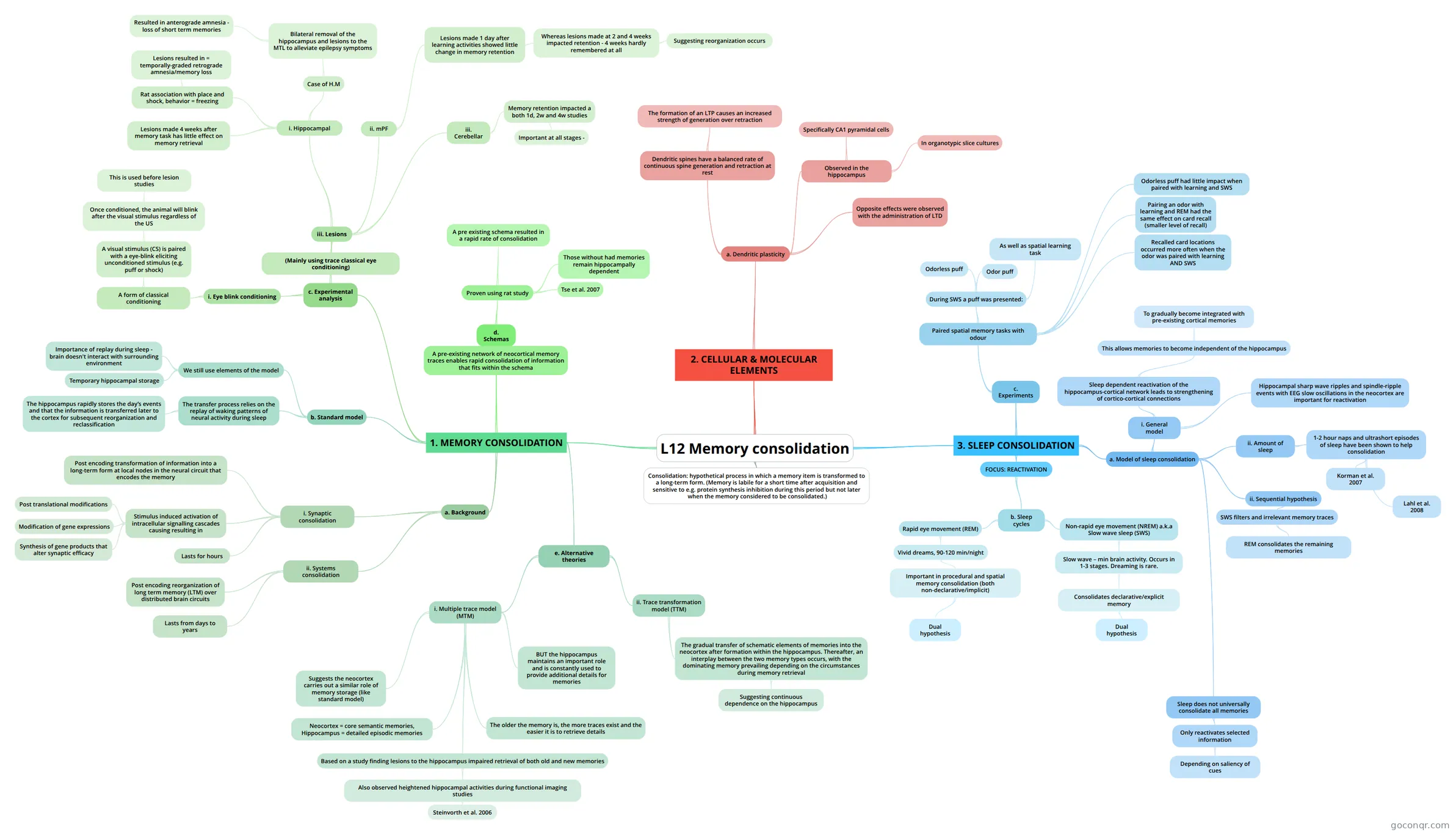
Mind map: Memory consolidation
Map content
L12 Memory consolidation
1. MEMORY CONSOLIDATION
- b. Standard model
- The transfer process relies on the replay of waking patterns of neural activity during sleep
- The hippocampus rapidly stores the day’s events and that the information is transferred later to the cortex for subsequent reorganization and reclassification
- We still use elements of the model
- Temporary hippocampal storage
- Importance of replay during sleep - brain doesn't interact with surrounding environment
- The transfer process relies on the replay of waking patterns of neural activity during sleep
- a. Background
- i. Synaptic consolidation
- Post encoding transformation of information into a long-term form at local nodes in the neural circuit that encodes the memory
- Lasts for hours
- Stimulus induced activation of intracellular signalling cascades causing resulting in
- Post translational modifications
- Modification of gene expressions
- Synthesis of gene products that alter synaptic efficacy
- ii. Systems consolidation
- Post encoding reorganization of long term memory (LTM) over distributed brain circuits
- Lasts from days to years
- i. Synaptic consolidation
- c. Experimental analysis
- i. Eye blink conditioning
- A form of classical conditioning
- A visual stimulus (CS) is paired with a eye-blink eliciting unconditioned stimulus (e.g. puff or shock)
- Once conditioned, the animal will blink after the visual stimulus regardless of the US
- This is used before lesion studies
- Once conditioned, the animal will blink after the visual stimulus regardless of the US
- A visual stimulus (CS) is paired with a eye-blink eliciting unconditioned stimulus (e.g. puff or shock)
- A form of classical conditioning
- iii. Lesions
- i. Hippocampal
- Rat association with place and shock, behavior = freezing
- Lesions resulted in = temporally-graded retrograde amnesia/memory loss
- Case of H.M
- Bilateral removal of the hippocampus and lesions to the MTL to alleviate epilepsy symptoms
- Resulted in anterograde amnesia - loss of short term memories
- Bilateral removal of the hippocampus and lesions to the MTL to alleviate epilepsy symptoms
- Lesions made 4 weeks after memory task has little effect on memory retrieval
- Rat association with place and shock, behavior = freezing
- ii. mPF
- Lesions made 1 day after learning activities showed little change in memory retention
- Whereas lesions made at 2 and 4 weeks impacted retention - 4 weeks hardly remembered at all
- Suggesting reorganization occurs
- Whereas lesions made at 2 and 4 weeks impacted retention - 4 weeks hardly remembered at all
- Lesions made 1 day after learning activities showed little change in memory retention
- iii. Cerebellar
- Memory retention impacted a both 1d, 2w and 4w studies
- Important at all stages -
- Memory retention impacted a both 1d, 2w and 4w studies
- (Mainly using trace classical eye conditioning)
- i. Hippocampal
- i. Eye blink conditioning
- d. Schemas
- A pre-existing network of neocortical memory traces enables rapid consolidation of information that fits within the schema
- Proven using rat study
- A pre existing schema resulted in a rapid rate of consolidation
- Those without had memories remain hippocampally dependent
- Tse et al. 2007
- e. Alternative theories
- i. Multiple trace model (MTM)
- Suggests the neocortex carries out a similar role of memory storage (like standard model)
- BUT the hippocampus maintains an important role and is constantly used to provide additional details for memories
- Neocortex = core semantic memories, Hippocampus = detailed episodic memories
- The older the memory is, the more traces exist and the easier it is to retrieve details
- Based on a study finding lesions to the hippocampus impaired retrieval of both old and new memories
- Also observed heightened hippocampal activities during functional imaging studies
- Steinvorth et al. 2006
- Also observed heightened hippocampal activities during functional imaging studies
- ii. Trace transformation model (TTM)
- The gradual transfer of schematic elements of memories into the neocortex after formation within the hippocampus. Thereafter, an interplay between the two memory types occurs, with the dominating memory prevailing depending on the circumstances during memory retrieval
- Suggesting continuous dependence on the hippocampus
- The gradual transfer of schematic elements of memories into the neocortex after formation within the hippocampus. Thereafter, an interplay between the two memory types occurs, with the dominating memory prevailing depending on the circumstances during memory retrieval
- i. Multiple trace model (MTM)
- b. Standard model
3. SLEEP CONSOLIDATION
- c. Experiments
- Paired spatial memory tasks with odour
- During SWS a puff was presented:
- Odorless puff
- Odor puff
- As well as spatial learning task
- Recalled card locations occurred more often when the odor was paired with learning AND SWS
- Pairing an odor with learning and REM had the same effect on card recall (smaller level of recall)
- Odorless puff had little impact when paired with learning and SWS
- During SWS a puff was presented:
- Paired spatial memory tasks with odour
- a. Model of sleep consolidation
- Sleep does not universally consolidate all memories
- Only reactivates selected information
- Depending on saliency of cues
- Only reactivates selected information
- i. General model
- Sleep dependent reactivation of the hippocampus-cortical network leads to strengthening of cortico-cortical connections
- This allows memories to become independent of the hippocampus
- To gradually become integrated with pre-existing cortical memories
- This allows memories to become independent of the hippocampus
- Hippocampal sharp wave ripples and spindle-ripple events with EEG slow oscillations in the neocortex are important for reactivation
- Sleep dependent reactivation of the hippocampus-cortical network leads to strengthening of cortico-cortical connections
- ii. Sequential hypothesis
- SWS filters and irrelevant memory traces
- REM consolidates the remaining memories
- SWS filters and irrelevant memory traces
- ii. Amount of sleep
- 1-2 hour naps and ultrashort episodes of sleep have been shown to help consolidation
- Korman et al. 2007
- Lahl et al. 2008
- 1-2 hour naps and ultrashort episodes of sleep have been shown to help consolidation
- Sleep does not universally consolidate all memories
- FOCUS: REACTIVATION
- b. Sleep cycles
- Rapid eye movement (REM)
- Vivid dreams, 90-120 min/night
- Important in procedural and spatial memory consolidation (both non-declarative/implicit)
- Dual hypothesis
- Important in procedural and spatial memory consolidation (both non-declarative/implicit)
- Vivid dreams, 90-120 min/night
- Non-rapid eye movement (NREM) a.k.a Slow wave sleep (SWS)
- Slow wave – min brain activity. Occurs in 1-3 stages. Dreaming is rare.
- Consolidates declarative/explicit memory
- Dual hypothesis
- Consolidates declarative/explicit memory
- Slow wave – min brain activity. Occurs in 1-3 stages. Dreaming is rare.
- Rapid eye movement (REM)
- b. Sleep cycles
- c. Experiments
Consolidation: hypothetical process in which a memory item is transformed to a long-term form. (Memory is labile for a short time after acquisition and sensitive to e.g. protein synthesis inhibition during this period but not later when the memory considered to be consolidated.)
2. CELLULAR & MOLECULAR ELEMENTS
- a. Dendritic plasticity
- Dendritic spines have a balanced rate of continuous spine generation and retraction at rest
- The formation of an LTP causes an increased strength of generation over retraction
- Observed in the hippocampus
- Specifically CA1 pyramidal cells
- In organotypic slice cultures
- Opposite effects were observed with the administration of LTD
- Dendritic spines have a balanced rate of continuous spine generation and retraction at rest
- a. Dendritic plasticity
Information
- Description
- university Neural Circuits Mind Map on L12 Memory consolidation, created by Tara Cox on 23/05/2015.
- Created by
- Tara Cox
- Views
- 8
- Rating