
Mind map
Optical System
Map content
Optical System
Elecrtomagnetic Spectrum
- Radio Waves (Lowest Frequency. Doesn't cause any harm.)
- Microwaves (Second Lowest Frequency. No major problem can be caused but you can be burned)
- Infared (Third Lowest Frequency. This is the light that causes something to be warm and, using special technology, we can see this type of light. Can burn you)
- Visible (Light we can see! No major problems unless you put a bright object close up to you eyes)
- Ultraviolet (Third Highest Frequency, can cause skin problems like skin cancer and sun burns)
- We don't see all light there is, we only see what is visible to our eyes
- Light is broken up into different parts, depending on their frequency. This is the electromagnetic spectrum
- Light waves have a length, a frequency and a speed
- X-Ray (Second Highest Frequency, can cause major issues throughout your body, including your reproductive system)
- Gamma Rays (Highest Frequency, can cause major issues and can be caused do to supernovas, etc. One giant ray from a supernova can wipe humanity completely)
Theories of Light
- Pythagoras: Our eyeballs emmit light and that's why we see(False because, if that was so, we would be able to see in the dark)
- Euclid: "When you shinea beam of light onto a flat mirror, the agnle between the incoming beam and the mirror is equal to the angle between the reflected beam and the mirror (True because, when you look into a mirror, you see yourself the way you are, also the way that other people see you)
- AI-Haytham: first one to accurately describe how vision works. "He showed that light bounces off objects and then travels to the eyes. As soon as this theory came along, Pythagoras' theory was abandoned" (He corrected Pythagoras' theory)
- Sir Issac Newton: "By shining light into a prism, Newton showed that white light is actually a mixture of different colors of light" (It has been proven)
- Albert A. Michelson: "He descovered the speed of light using the mirror mountain experiment (Speed=distance/time)" (True because it has been proven)
Proporties of Light
- Light travels in straight lines
- Light can be relfected: Euclid discovered that light reflected on mirrors and had exactly the same angles
- Light can bend
- Light is a form of energy
How Light Travels
- Light passes through transparent objects without alterations in the lights path
- Glare is when light is reflected off of glass and other transparent objects (Not a Mirror)
- Ray diagrams show us how light travels
- Light travels in straight lines, though it can be bent in some circumstances
- Light can go through translucent objects but not all the light gets through. Some of it is bounced back and some of it goes through but is bent on the way through
- Light cannot go through opaque objects and gets bounced back or absorbed when it hits one of these objects
Mirrors
- The Law of Reflection: When light hits a plane mirror, the angle between the incident ray and the normal line is gonna be equal to the angle between the normal and the reflected ray
- Rays travel parallel to each other and bounce off plane mirrors parallel to each other as well
- Regular Reflection happens when light hits a smooth surface
- Regular reflections create perfect images of a scene but your eyes have to be in the direct path of the light
- Diffuse reflection happens when light hits a rough surface, causing all the light rays to reflect at different angles
- The incident rays are the rays of light that hit the surface of the mirror (The space between the reflected ray and the normal line being the reflected angle)
- The reflected rays are the rays of light that are reflected off of the mirror (The space between the incident ray and normal line being the incident angle)
- When calculating the angle of a reflection, the normal line is the '0 degrees' line.
- The reflecting surface is the mirror (The normal line is always perpendicular to the reflecting surface)
- Concave mirrors are mirrors that are curved inwards. This causes it to collect light, obey the law of reflection... this also causes light rays to head to a main point called the focal point. We see this type of mirror in flashlights, telescopes, cosmetic mirrors and car headlights. The image appears upside down
- Convex mirrors are mirrors that curve outwards. This causes it to spread light out making the image appear smaller than it really is. This type of mirror is usually used in car mirrors. The image appears right side up
Refraction of Light
- Light refraction happens when light rays are going through different materials (ex. a fish's position looking at it from outside the water is different from when we look at it underwater
- When light goes through water after going through air, it refracts and bends because of the change in the speed of light
- The denser the medium, the slower light travels through it. For example, Light travels through air faster than it would through methanol and even slower through ethanol
- When light goes through a prism, it will be bent when it goes into the prism and coming out of the prism
- Light can change how we see things. For example, when you look at a straw that's half why in water, it looks like its bent but, in reality, it' completely straight
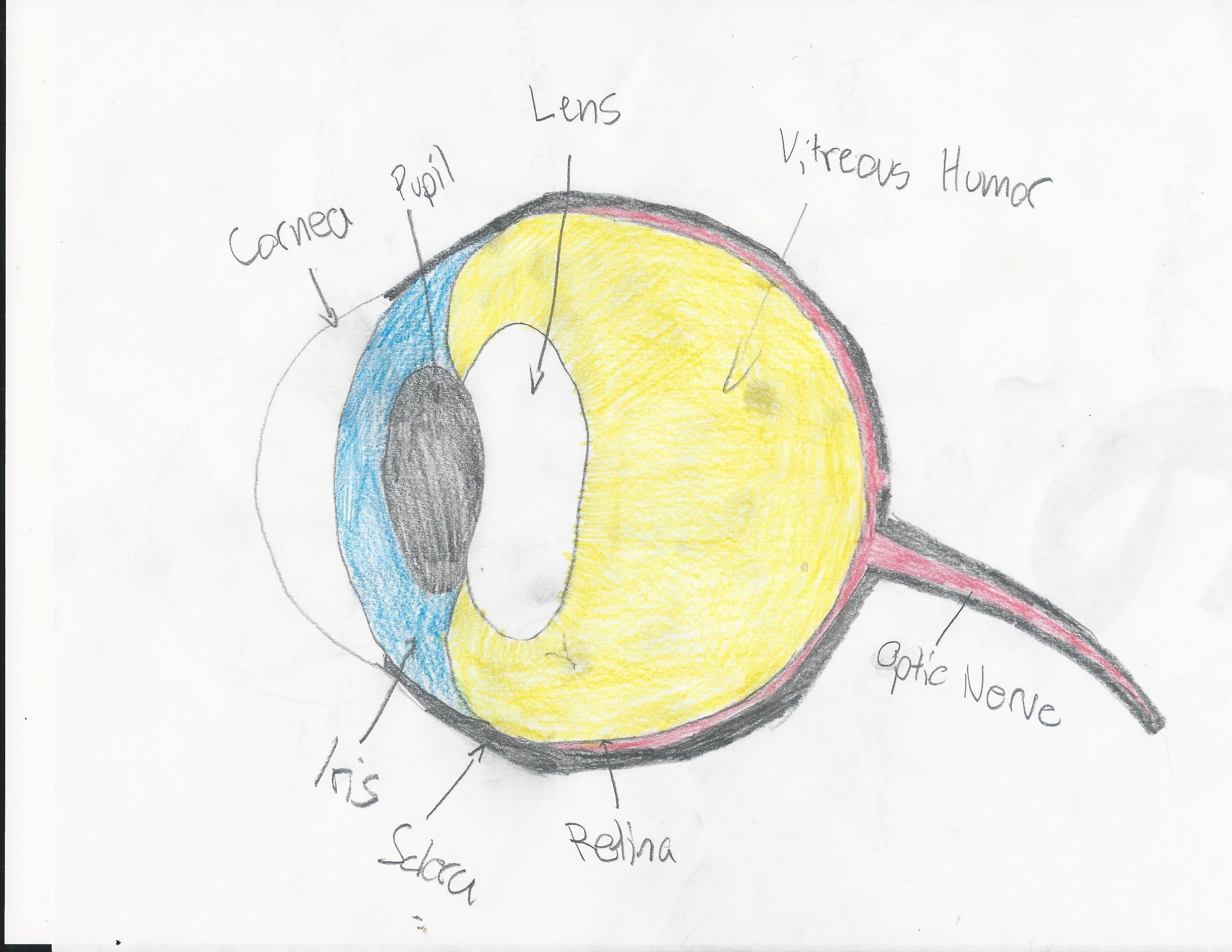
Human Vision
- Cornea: A clear window covering the pupil and the iris
- Iris: Surrounds the pupil and controls how much light goes through
- Lens: Sits behind the pupil and acts like a camera lens and changes shape when the ciliary muscles push and pull on it to focus on images
- Pupil: An opening for light to get into the eye
- Sclera: A form of protection for the eye that doesn't effect your sight at all
- Retina: Takes light that comes in through the pupil and turns it into an electrical impulse and is sent to rods and cones
- Optic Nerve: A bunch of nerve bundles that travel from the retina to the brain
- Vitreous Humor: A thick jelly like liquid that refracts light at a constant rate. It also hold the shape of the eyeball
Animal Vision
- Camera Eyes: Humans and Vertebrae have this type of eye. It has a cornea, retina and a lens and is round in shape
- Octopus Eye: is technically a camera eye BUT has three major differences:
- The lens doesn't change shape and instead goes further and closer to its retina.
- Octopus eyes don't have blind spots because their eyes develop from outside inwards instead of from the brain out
- They only have one photo recepter but aren't colour blind because of their weirdly shaped pupils that force light to come in at different wave lengths
- Bird's Eye: has 4 cones instead of 3 because they can see ultraviolet. they have sharper vision because of it. They also have an eye bone, a manual control of the iris and also have pecten within the eye for nutrience without effect their eye sight
- Fish Eye: Very similar to camera eye but, lens is more spherical than ours and sticks out more, pupil may be slit shaped, some fish have more than 1 type of cone for vision and many fish can see ultraviolet
- Nocturnal Eye: they have large eyes to collect as much light as possible and have more rods than cones. Animal eyes that appear to be glowing is actually just tapetum lucidum: a way for photoreceptors to get a 2nd chance to catch light
- Compound Eye: Insects use this type of eye. Has many units called ommatidium and all gather light to send to the brain. an advantage is that they can see a wide range of area all at the same time and can see movement easily but, they cannot see a clear image
Optical Devices
- An optical device is a device that uses light. It doesn't have to be complicated, it can be s simple as a mirror
- Microscope: Helps you see very small things tthat are already up close to you EX. a cell
- Telescope: Helps you see very large things that are very far away EX. a planet
- Binoculars: Helps you see normal sized things that are not too far away. EX. Birds
- Glasses: Help people with impaired vision to see more clearly
Images and files in the map
Information
- Description
- Mind Map on Optical System, created by Mekdes Abraham on 15/12/2020.
- Created by
- Mekdes Abraham
- Views
- 0
- Rating