
Mind map
Attraction 3
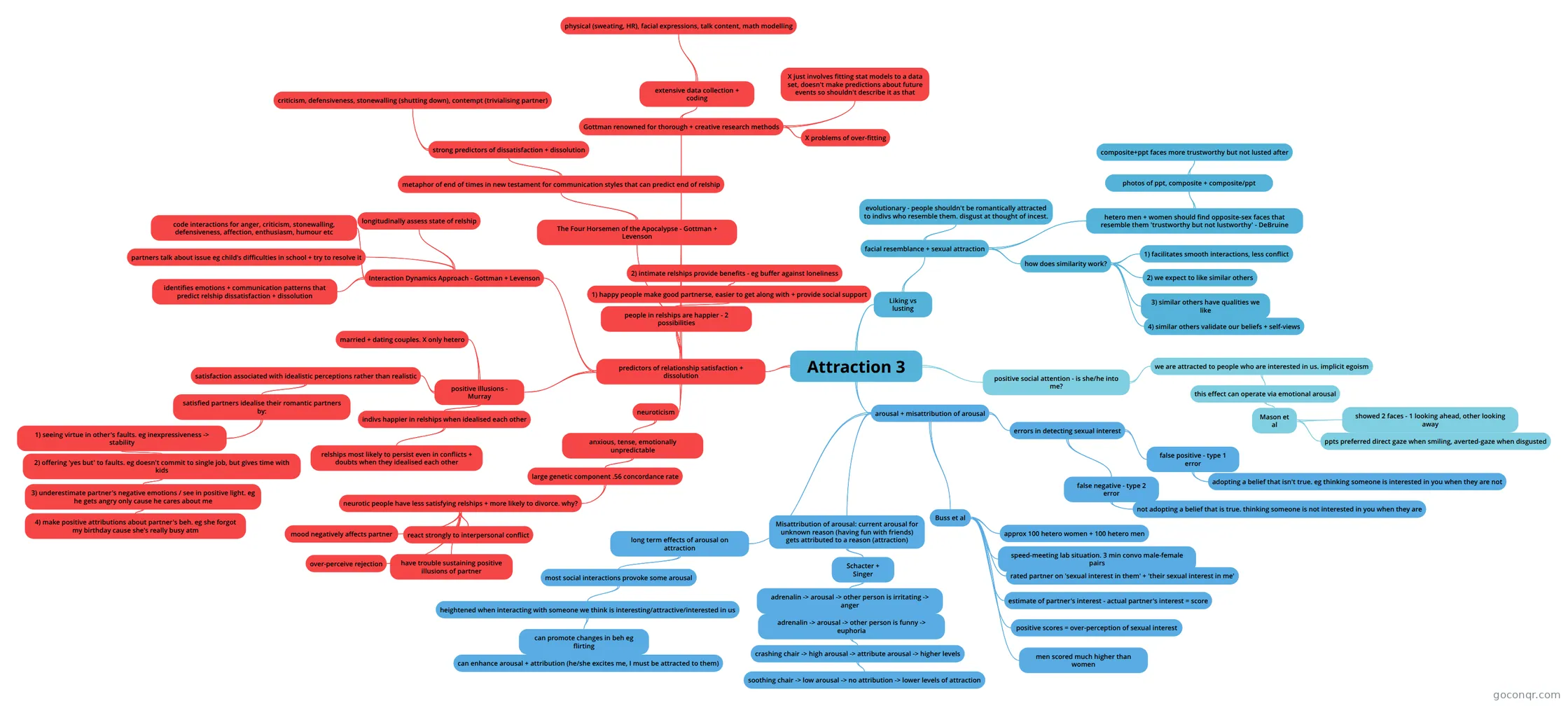
Mind map: Attraction psychology
Map content
Attraction 3
Liking vs lusting
- facial resemblance + sexual attraction
- evolutionary - people shouldn't be romantically attracted to indivs who resemble them. disgust at thought of incest.
- hetero men + women should find opposite-sex faces that resemble them 'trustworthy but not lustworthy' - DeBruine
- photos of ppt, composite + composite/ppt
- composite+ppt faces more trustworthy but not lusted after
- photos of ppt, composite + composite/ppt
- how does similarity work?
- 1) facilitates smooth interactions, less conflict
- 2) we expect to like similar others
- 3) similar others have qualities we like
- 4) similar others validate our beliefs + self-views
- facial resemblance + sexual attraction
positive social attention - is she/he into me?
- we are attracted to people who are interested in us. implicit egoism
- this effect can operate via emotional arousal
- Mason et al
- showed 2 faces - 1 looking ahead, other looking away
- ppts preferred direct gaze when smiling, averted-gaze when disgusted
- Mason et al
- this effect can operate via emotional arousal
- we are attracted to people who are interested in us. implicit egoism
arousal + misattribution of arousal
- errors in detecting sexual interest
- false positive - type 1 error
- adopting a belief that isn't true. eg thinking someone is interested in you when they are not
- false negative - type 2 error
- not adopting a belief that is true. thinking someone is not interested in you when they are
- false positive - type 1 error
- Buss et al
- approx 100 hetero women + 100 hetero men
- speed-meeting lab situation. 3 min convo male-female pairs
- rated partner on 'sexual interest in them' + 'their sexual interest in me'
- estimate of partner's interest - actual partner's interest = score
- positive scores = over-perception of sexual interest
- men scored much higher than women
- Misattribution of arousal: current arousal for unknown reason (having fun with friends) gets attributed to a reason (attraction)
- Schacter + Singer
- adrenalin -> arousal -> other person is irritating -> anger
- adrenalin -> arousal -> other person is funny -> euphoria
- crashing chair -> high arousal -> attribute arousal -> higher levels
- soothing chair -> low arousal -> no attribution -> lower levels of attraction
- crashing chair -> high arousal -> attribute arousal -> higher levels
- adrenalin -> arousal -> other person is funny -> euphoria
- adrenalin -> arousal -> other person is irritating -> anger
- Schacter + Singer
- long term effects of arousal on attraction
- most social interactions provoke some arousal
- heightened when interacting with someone we think is interesting/attractive/interested in us
- can promote changes in beh eg flirting
- can enhance arousal + attribution (he/she excites me, I must be attracted to them)
- can promote changes in beh eg flirting
- heightened when interacting with someone we think is interesting/attractive/interested in us
- most social interactions provoke some arousal
- errors in detecting sexual interest
predictors of relationship satisfaction + dissolution
- neuroticism
- anxious, tense, emotionally unpredictable
- large genetic component .56 concordance rate
- neurotic people have less satisfying relships + more likely to divorce. why?
- mood negatively affects partner
- react strongly to interpersonal conflict
- over-perceive rejection
- have trouble sustaining positive illusions of partner
- neurotic people have less satisfying relships + more likely to divorce. why?
- large genetic component .56 concordance rate
- anxious, tense, emotionally unpredictable
- positive illusions - Murray
- satisfaction associated with idealistic perceptions rather than realistic
- satisfied partners idealise their romantic partners by:
- 1) seeing virtue in other's faults. eg inexpressiveness -> stability
- 2) offering 'yes but' to faults. eg doesn't commit to single job, but gives time with kids
- 3) underestimate partner's negative emotions / see in positive light. eg he gets angry only cause he cares about me
- 4) make positive attributions about partner's beh. eg she forgot my birthday cause she's really busy atm
- 3) underestimate partner's negative emotions / see in positive light. eg he gets angry only cause he cares about me
- 2) offering 'yes but' to faults. eg doesn't commit to single job, but gives time with kids
- 1) seeing virtue in other's faults. eg inexpressiveness -> stability
- satisfied partners idealise their romantic partners by:
- indivs happier in relships when idealised each other
- relships most likely to persist even in conflicts + doubts when they idealised each other
- married + dating couples. X only hetero
- satisfaction associated with idealistic perceptions rather than realistic
- Interaction Dynamics Approach - Gottman + Levenson
- identifies emotions + communication patterns that predict relship dissatisfaction + dissolution
- partners talk about issue eg child's difficulties in school + try to resolve it
- code interactions for anger, criticism, stonewalling, defensiveness, affection, enthusiasm, humour etc
- longitudinally assess state of relship
- The Four Horsemen of the Apocalypse - Gottman + Levenson
- metaphor of end of times in new testament for communication styles that can predict end of relship
- strong predictors of dissatisfaction + dissolution
- criticism, defensiveness, stonewalling (shutting down), contempt (trivialising partner)
- strong predictors of dissatisfaction + dissolution
- metaphor of end of times in new testament for communication styles that can predict end of relship
- Gottman renowned for thorough + creative research methods
- extensive data collection + coding
- physical (sweating, HR), facial expressions, talk content, math modelling
- X just involves fitting stat models to a data set, doesn't make predictions about future events so shouldn't describe it as that
- X problems of over-fitting
- extensive data collection + coding
- people in relships are happier - 2 possibilities
- 1) happy people make good partnerse, easier to get along with + provide social support
- 2) intimate relships provide benefits - eg buffer against loneliness
- 1) happy people make good partnerse, easier to get along with + provide social support
- neuroticism
Information
- Description
- Mind Map on Attraction 3, created by lady_pisces on 25/05/2015.
- Created by
- lady_pisces
- Views
- 0
- Rating
More on Relationship formation and attraction