
Mind map
Biology - module 3
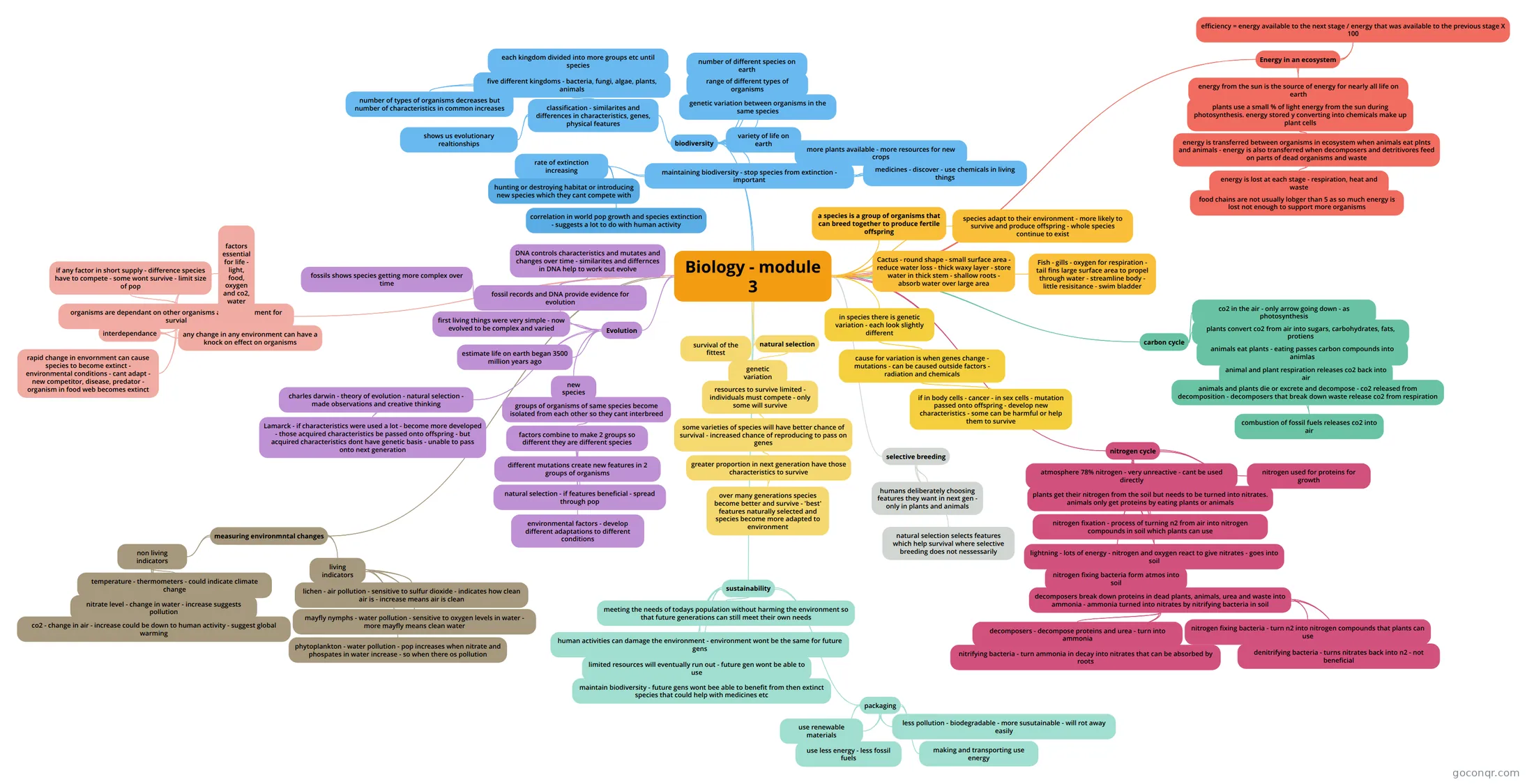
Mind map: Biology module 3
Map content
Biology - module 3
a species is a group of organisms that can breed together to produce fertile offspring
species adapt to their environment - more likely to survive and produce offspring - whole species continue to exist
Cactus - round shape - small surface area - reduce water loss - thick waxy layer - store water in thick stem - shallow roots - absorb water over large area
Fish - gills - oxygen for respiration - tail fins large surface area to propel through water - streamline body - little resisitance - swim bladder
in species there is genetic variation - each look slightly different
- cause for variation is when genes change - mutations - can be caused outside factors - radiation and chemicals
- if in body cells - cancer - in sex cells - mutation passed onto offspring - develop new characteristics - some can be harmful or help them to survive
- cause for variation is when genes change - mutations - can be caused outside factors - radiation and chemicals
natural selection
- survival of the fittest
- genetic variation
- resources to survive limited - individuals must compete - only some will survive
- some varieties of species will have better chance of survival - increased chance of reproducing to pass on genes
- greater proportion in next generation have those characteristics to survive
- over many generations species become better and survive - 'best' features naturally selected and species become more adapted to environment
- greater proportion in next generation have those characteristics to survive
- some varieties of species will have better chance of survival - increased chance of reproducing to pass on genes
- resources to survive limited - individuals must compete - only some will survive
selective breeding
- humans deliberately choosing features they want in next gen - only in plants and animals
- natural selection selects features which help survival where selective breeding does not nessessarily
Evolution
- estimate life on earth began 3500 million years ago
- first living things were very simple - now evolved to be complex and varied
- new species
- groups of organisms of same species become isolated from each other so they cant interbreed
- factors combine to make 2 groups so different they are different species
- different mutations create new features in 2 groups of organisms
- natural selection - if features beneficial - spread through pop
- environmental factors - develop different adaptations to different conditions
- factors combine to make 2 groups so different they are different species
- groups of organisms of same species become isolated from each other so they cant interbreed
- fossil records and DNA provide evidence for evolution
- fossils shows species getting more complex over time
- DNA controls characteristics and mutates and changes over time - similarites and differnces in DNA help to work out evolve
- charles darwin - theory of evolution - natural selection - made observations and creative thinking
- Lamarck - if characteristics were used a lot - become more developed - those acquired characteristics be passed onto offspring - but acquired characteristics dont have genetic basis - unable to pass onto next generation
biodiversity
- variety of life on earth
- number of different species on earth
- range of different types of organisms
- genetic variation between organisms in the same species
- maintaining biodiversity - stop species from extinction - important
- more plants available - more resources for new crops
- medicines - discover - use chemicals in living things
- rate of extinction increasing
- correlation in world pop growth and species extinction - suggests a lot to do with human activity
- hunting or destroying habitat or introducing new species which they cant compete with
- classification - similarites and differences in characteristics, genes, physical features
- five different kingdoms - bacteria, fungi, algae, plants, animals
- each kingdom divided into more groups etc until species
- number of types of organisms decreases but number of characteristics in common increases
- shows us evolutionary realtionships
- five different kingdoms - bacteria, fungi, algae, plants, animals
organisms are dependant on other organisms and environment for survial
- factors essential for life - light, food, oxygen and co2, water
- if any factor in short supply - difference species have to compete - some wont survive - limit size of pop
- interdependance
- any change in any environment can have a knock on effect on organisms
- rapid change in envornment can cause species to become extinct - environmental conditions - cant adapt - new competitor, disease, predator - organism in food web becomes extinct
Energy in an ecosystem
- energy from the sun is the source of energy for nearly all life on earth
- plants use a small % of light energy from the sun during photosynthesis. energy stored y converting into chemicals make up plant cells
- energy is transferred between organisms in ecosystem when animals eat plnts and animals - energy is also transferred when decomposers and detritivores feed on parts of dead organisms and waste
- energy is lost at each stage - respiration, heat and waste
- food chains are not usually lobger than 5 as so much energy is lost not enough to support more organisms
- energy is lost at each stage - respiration, heat and waste
- energy is transferred between organisms in ecosystem when animals eat plnts and animals - energy is also transferred when decomposers and detritivores feed on parts of dead organisms and waste
- plants use a small % of light energy from the sun during photosynthesis. energy stored y converting into chemicals make up plant cells
- efficiency = energy available to the next stage / energy that was available to the previous stage X 100
- energy from the sun is the source of energy for nearly all life on earth
nitrogen cycle
- atmosphere 78% nitrogen - very unreactive - cant be used directly
- nitrogen used for proteins for growth
- plants get their nitrogen from the soil but needs to be turned into nitrates. animals only get proteins by eating plants or animals
- nitrogen fixation - process of turning n2 from air into nitrogen compounds in soil which plants can use
- lightning - lots of energy - nitrogen and oxygen react to give nitrates - goes into soil
- nitrogen fixing bacteria form atmos into soil
- decomposers break down proteins in dead plants, animals, urea and waste into ammonia - ammonia turned into nitrates by nitrifying bacteria in soil
- decomposers - decompose proteins and urea - turn into ammonia
- nitrifying bacteria - turn ammonia in decay into nitrates that can be absorbed by roots
- nitrogen fixing bacteria - turn n2 into nitrogen compounds that plants can use
- denitrifying bacteria - turns nitrates back into n2 - not beneficial
carbon cycle
- co2 in the air - only arrow going down - as photosynthesis
- plants convert co2 from air into sugars, carbohydrates, fats, protiens
- animals eat plants - eating passes carbon compounds into animlas
- animal and plant respiration releases co2 back into air
- animals and plants die or excrete and decompose - co2 released from decomposition - decomposers that break down waste release co2 from respiration
- combustion of fossil fuels releases co2 into air
- animals and plants die or excrete and decompose - co2 released from decomposition - decomposers that break down waste release co2 from respiration
- animal and plant respiration releases co2 back into air
- animals eat plants - eating passes carbon compounds into animlas
sustainability
- meeting the needs of todays population without harming the environment so that future generations can still meet their own needs
- human activities can damage the environment - environment wont be the same for future gens
- limited resources will eventually run out - future gen wont be able to use
- maintain biodiversity - future gens wont bee able to benefit from then extinct species that could help with medicines etc
- packaging
- use renewable materials
- use less energy - less fossil fuels
- less pollution - biodegradable - more susutainable - will rot away easily
- making and transporting use energy
measuring environmntal changes
- non living indicators
- temperature - thermometers - could indicate climate change
- nitrate level - change in water - increase suggests pollution
- co2 - change in air - increase could be down to human activity - suggest global warming
- living indicators
- lichen - air pollution - sensitive to sulfur dioxide - indicates how clean air is - increase means air is clean
- mayfly nymphs - water pollution - sensitive to oxygen levels in water - more mayfly means clean water
- phytoplankton - water pollution - pop increases when nitrate and phospates in water increase - so when there os pollution
- non living indicators
Information
- Description
- Mind Map on Biology - module 3, created by Olivia Warren on 27/05/2015.
- Created by
- Olivia Warren
- Views
- 3
- Rating