
Mind map
Who was the Buddha?
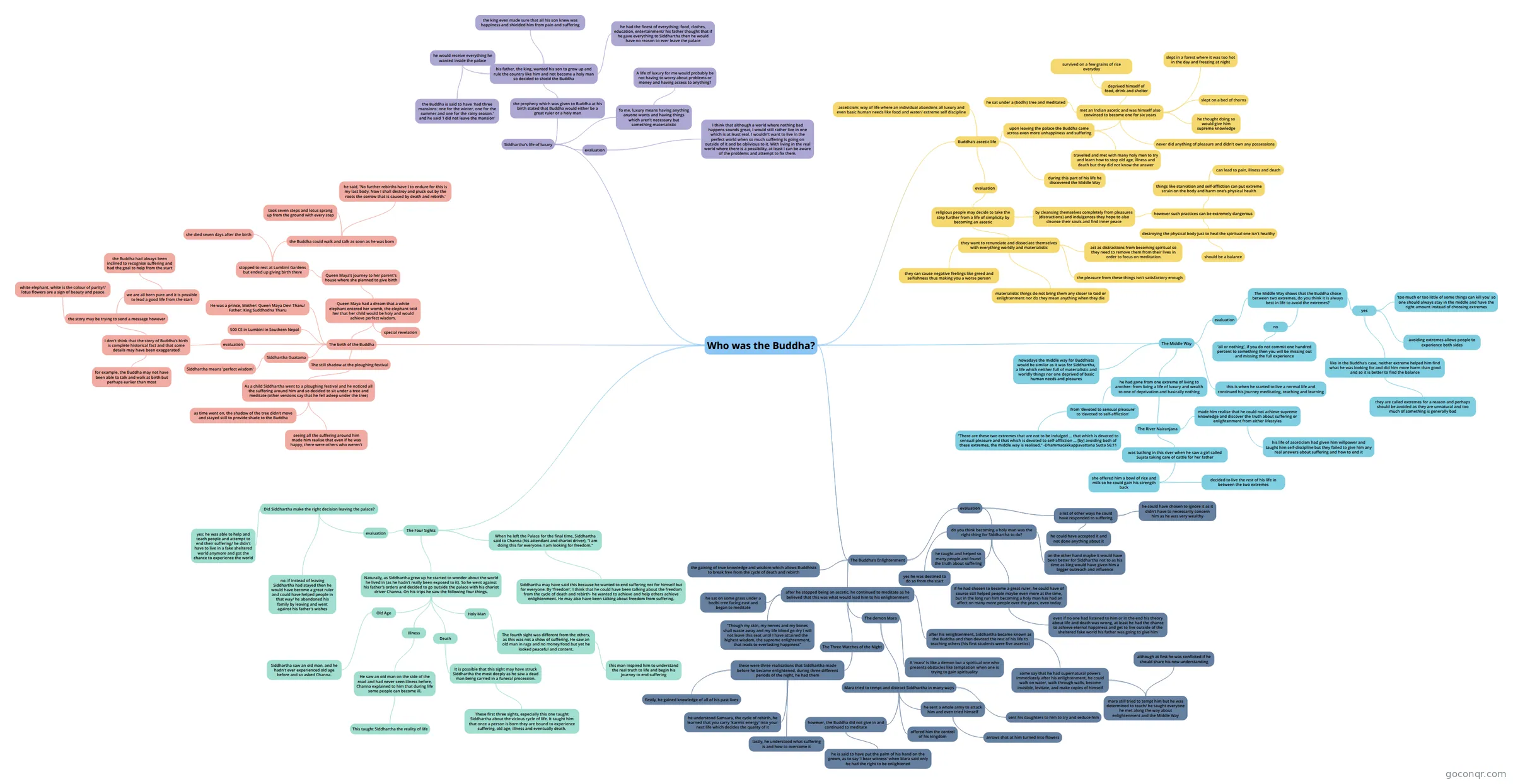
Mind map: Who was the Buddha?
Map content
Who was the Buddha?
The birth of the Buddha
- Siddhartha Guatama
- Siddhartha means 'perfect wisdom'
- 500 CE in Lumbini in Southern Nepal
- He was a prince, Mother: Queen Maya Devi Tharu/ Father: King Suddhodna Tharu
- Queen Maya had a dream that a white elephant entered her womb, the elephant told her that her child would be holy and would achieve perfect wisdom.
- Queen Maya's journey to her parent's house where she planned to give birth
- stopped to rest at Lumbini Gardens but ended up giving birth there
- the Buddha could walk and talk as soon as he was born
- took seven steps and lotus sprang up from the ground with every step
- he said, 'No further rebirths have I to endure for this is my last body. Now I shall destroy and pluck out by the roots the sorrow that is caused by death and rebirth.'
- she died seven days after the birth
- the Buddha could walk and talk as soon as he was born
- stopped to rest at Lumbini Gardens but ended up giving birth there
- special revelation
- Queen Maya's journey to her parent's house where she planned to give birth
- The still shadow at the ploughing festival
- As a child Siddhartha went to a ploughing festival and he noticed all the suffering around him and so decided to sit under a tree and meditate (other versions say that he fell asleep under the tree)
- as time went on, the shadow of the tree didn't move and stayed still to provide shade to the Buddha
- seeing all the suffering around him made him realise that even if he was happy, there were others who weren't
- As a child Siddhartha went to a ploughing festival and he noticed all the suffering around him and so decided to sit under a tree and meditate (other versions say that he fell asleep under the tree)
- evaluation
- I don't think that the story of Buddha's birth is complete historical fact and that some details may have been exaggerated
- for example, the Buddha may not have been able to talk and walk at birth but perhaps earlier than most
- the story may be trying to send a message however
- we are all born pure and it is possible to lead a good life from the start
- the Buddha had always been inclined to recognise suffering and had the goal to help from the start
- white elephant, white is the colour of purity// lotus flowers are a sign of beauty and peace
- we are all born pure and it is possible to lead a good life from the start
- I don't think that the story of Buddha's birth is complete historical fact and that some details may have been exaggerated
- Siddhartha Guatama
Siddhartha's life of luxary
- the prophecy which was given to Buddha at his birth stated that Buddha would either be a great ruler or a holy man
- his father, the king, wanted his son to grow up and rule the country like him and not become a holy man so decided to shield the Buddha
- he would receive everything he wanted inside the palace
- the Buddha is said to have 'had three mansions: one for the winter, one for the summer and one for the rainy season.' and he said 'I did not leave the mansion'
- he had the finest of everything: food, clothes, education, entertainment/ his father thought that if he gave everything to Siddhartha then he would have no reason to ever leave the palace
- the king even made sure that all his son knew was happiness and shielded him from pain and suffering
- he would receive everything he wanted inside the palace
- his father, the king, wanted his son to grow up and rule the country like him and not become a holy man so decided to shield the Buddha
- To me, luxury means having anything anyone wants and having things which aren't necessary but something materialistic
- A life of luxury for me would probably be not having to worry about problems or money and having access to anything?
- evaluation
- I think that although a world where nothing bad happens sounds great, I would still rather live in one which is at least real. I wouldn't want to live in the perfect world when so much suffering is going on outside of it and be oblivious to it. With living in the real world where there is a possibility, at least I can be aware of the problems and attempt to fix them.
- the prophecy which was given to Buddha at his birth stated that Buddha would either be a great ruler or a holy man
The Four Sights
- Naturally, as Siddhartha grew up he started to wonder about the world he lived in (as he hadn't really been exposed to it). So he went against his father's orders and decided to go outside the palace with his chariot driver Channa. On his trips he saw the following four things.
- Old Age
- Siddhartha saw an old man, and he hadn't ever experienced old age before and so asked Channa.
- Illness
- He saw an old man on the side of the road and had never seen illness before, Channa explained to him that during life some people can become ill.
- This taught Siddhartha the reality of life
- He saw an old man on the side of the road and had never seen illness before, Channa explained to him that during life some people can become ill.
- Death
- It is possible that this sight may have struck Siddhartha the most deeply as he saw a dead man being carried in a funeral procession.
- These first three sights, especially this one taught Siddhartha about the vicious cycle of life. It taught him that once a person is born they are bound to experience suffering, old age, illness and eventually death.
- It is possible that this sight may have struck Siddhartha the most deeply as he saw a dead man being carried in a funeral procession.
- Holy Man
- The fourth sight was different from the others, as this was not a show of suffering. He saw an old man in rags and no money/food but yet he looked peaceful and content.
- this man inspired him to understand the real truth to life and begin his journey to end suffering
- The fourth sight was different from the others, as this was not a show of suffering. He saw an old man in rags and no money/food but yet he looked peaceful and content.
- Old Age
- When he left the Palace for the final time, Siddhartha said to Channa (his attendant and chariot driver), “I am doing this for everyone. I am looking for freedom.”
- Siddhartha may have said this because he wanted to end suffering not for himself but for everyone. By 'freedom', I think that he could have been talking about the freedom from the cycle of death and rebirth- he wanted to achieve and help others achieve enlightenment. He may also have been talking about freedom from suffering.
- evaluation
- Did Siddhartha make the right decision leaving the palace?
- yes: he was able to help and teach people and attempt to end their suffering/ he didn't have to live in a fake sheltered world anymore and got the chance to experience the world
- no: if instead of leaving Siddhartha had stayed then he would have become a great ruler and could have helped people in that way/ he abandoned his family by leaving and went against his father's wishes
- Did Siddhartha make the right decision leaving the palace?
- Naturally, as Siddhartha grew up he started to wonder about the world he lived in (as he hadn't really been exposed to it). So he went against his father's orders and decided to go outside the palace with his chariot driver Channa. On his trips he saw the following four things.
Buddha's ascetic life
- asceticism: way of life where an individual abandons all luxury and even basic human needs like food and water/ extreme self discipline
- upon leaving the palace the Buddha came across even more unhappiness and suffering
- met an Indian ascetic and was himself also convinced to become one for six years
- he sat under a (bodhi) tree and meditated
- deprived himself of food, drink and shelter
- survived on a few grains of rice everyday
- he thought doing so would give him supreme knowledge
- slept on a bed of thorns
- slept in a forest where it was too hot in the day and freezing at night
- never did anything of pleasure and didn't own any possessions
- travelled and met with many holy men to try and learn how to stop old age, illness and death but they did not know the answer
- met an Indian ascetic and was himself also convinced to become one for six years
- during this part of his life he discovered the Middle Way
- evaluation
- religious people may decide to take the step further from a life of simplicity by becoming an ascetic
- they want to renunciate and dissociate themselves with everything worldly and materialistic
- they can cause negative feelings like greed and selfishness thus making you a worse person
- materialistic things do not bring them any closer to God or enlightenment nor do they mean anything when they die
- the pleasure from these things isn't satisfactory enough
- act as distractions from becoming spiritual so they need to remove them from their lives in order to focus on meditation
- by cleansing themselves completely from pleasures (distractions) and indulgences they hope to also cleanse their souls and find inner peace
- however such practices can be extremely dangerous
- things like starvation and self-affliction can put extreme strain on the body and harm one's physical health
- can lead to pain, illness and death
- destroying the physical body just to heal the spiritual one isn't healthy
- should be a balance
- things like starvation and self-affliction can put extreme strain on the body and harm one's physical health
- however such practices can be extremely dangerous
- they want to renunciate and dissociate themselves with everything worldly and materialistic
- religious people may decide to take the step further from a life of simplicity by becoming an ascetic
The Middle Way
- he had gone from one extreme of living to another- from living a life of luxury and wealth to one of deprivation and basically nothing
- from 'devoted to sensual pleasure' to 'devoted to self-affliction'
- "There are these two extremes that are not to be indulged … that which is devoted to sensual pleasure and that which is devoted to self-affliction … [by] avoiding both of these extremes, the middle way is realised." -Dhammacakkappavattana Sutta 56:11
- The River Nairanjana
- made him realise that he could not achieve supreme knowledge and discover the truth about suffering or enlightenment from either lifestyles
- his life of asceticism had given him willpower and taught him self-discipline but they failed to give him any real answers about suffering and how to end it
- was bathing in this river when he saw a girl called Sujata taking care of cattle for her father
- she offered him a bowl of rice and milk so he could gain his strength back
- decided to live the rest of his life in between the two extremes
- she offered him a bowl of rice and milk so he could gain his strength back
- made him realise that he could not achieve supreme knowledge and discover the truth about suffering or enlightenment from either lifestyles
- from 'devoted to sensual pleasure' to 'devoted to self-affliction'
- this is when he started to live a normal life and continued his journey meditating, teaching and learning
- nowadays the middle way for Buddhists would be similar as it was for Siddhartha, a life which neither full of materialistic and worldly things nor one deprived of basic human needs and pleaures
- evaluation
- The Middle Way shows that the Buddha chose between two extremes, do you think it is always best in life to avoid the extremes?
- no
- 'all or nothing', if you do not commit one hundred percent to something then you will be missing out and missing the full experience
- yes
- 'too much or too little of some things can kill you' so one should always stay in the middle and have the right amount instead of choosing extremes
- avoiding extremes allows people to experience both sides
- like in the Buddha's case, neither extreme helped him find what he was looking for and did him more harm than good and so it is better to find the balance
- they are called extremes for a reason and perhaps should be avoided as they are unnatural and too much of something is generally bad
- no
- The Middle Way shows that the Buddha chose between two extremes, do you think it is always best in life to avoid the extremes?
- he had gone from one extreme of living to another- from living a life of luxury and wealth to one of deprivation and basically nothing
The Buddha's Enlightenment
- the gaining of true knowledge and wisdom which allows Buddhists to break free from the cycle of death and rebirth
- after he stopped being an ascetic, he continued to meditate as he believed that this was what would lead him to his enlightenment
- he sat on some grass under a bodhi tree facing east and began to meditate
- “Though my skin, my nerves and my bones shall waste away and my life blood go dry I will not leave this seat until I have attained the highest wisdom, the supreme enlightenment, that leads to everlasting happiness”
- The demon Mara
- A 'mara' is like a demon but a spiritual one who presents obstacles like temptation when one is trying to gain spirituality
- Mara tried to tempt and distract Siddhartha in many ways
- sent his daughters to him to try and seduce him
- he sent a whole army to attack him and even tried himself
- arrows shot at him turned into flowers
- offered him the control of his kingdom
- however, the Buddha did not give in and continued to meditate
- he is said to have put the palm of his hand on the grown, as to say 'I bear witness' when Mara said only he had the right to be enlightened
- The Three Watches of the Night
- these were three realisations that Siddhartha made before he became enlightened, during three different periods of the night, he had them
- firstly, he gained knowledge of all of his past lives
- he understood Samsara, the cycle of rebirth, he learned that you carry 'karmic energy' into your next life which decides the quality of it
- lastly, he understood what suffering is and how to overcome it
- these were three realisations that Siddhartha made before he became enlightened, during three different periods of the night, he had them
- after his enlightenment, Siddhartha became known as the Buddha and then devoted the rest of his life to teaching others (his first students were five ascetics)
- some say that he had supernatural powers immediately after his enlightenment, he could walk on water, walk through walls, become invisible, levitate, and make copies of himself
- mara still tried to tempt him but he was determined to teach/ he taught everyone he met along the way about enlightenment and the Middle Way
- although at first he was conflicted if he should share his new understanding
- mara still tried to tempt him but he was determined to teach/ he taught everyone he met along the way about enlightenment and the Middle Way
- some say that he had supernatural powers immediately after his enlightenment, he could walk on water, walk through walls, become invisible, levitate, and make copies of himself
- evaluation
- do you think becoming a holy man was the right thing for Siddhartha to do?
- if he had chosen to become a great ruler, he could have of course still helped people maybe even more at the time, but in the long run him becoming a holy man has had an affect on many more people over the years, even today
- even if no one had listened to him or in the end his theory about life and death was wrong, at least he had the chance to achieve eternal happiness and get to live outside of the sheltered fake world his father was going to give him
- yes he was destined to do so from the start
- he taught and helped so many people and found the truth about suffering
- on the other hand maybe it would have been better for Siddhartha not to as his time as king would have given him a bigger outreach and influence
- if he had chosen to become a great ruler, he could have of course still helped people maybe even more at the time, but in the long run him becoming a holy man has had an affect on many more people over the years, even today
- a list of other ways he could have responded to suffering
- he could have accepted it and not done anything about it
- he could have chosen to ignore it as it didn't have to necessarily concern him as he was very wealthy
- do you think becoming a holy man was the right thing for Siddhartha to do?
Information
- Description
- Mind Map on Who was the Buddha?, created by Harbinn Kaur Mann on 26/01/2021.
- Created by
- Harbinn Kaur Mann
- Views
- 0
- Rating