
Mind map
Maths Revision - Numbers
Map content
Maths Revision - Numbers
Index Notation
- Substitution
- Substituting a number into an expression
- E.g. what is the value of 4p² when P = 2
- We know that 4p² means 4 x p x p so when we substitute into the expression: 4 x 2 x 2 (or 4 x 2²) = 16
- E.g. what is the value of 4p² when P = 2
- Substituting a number into an expression
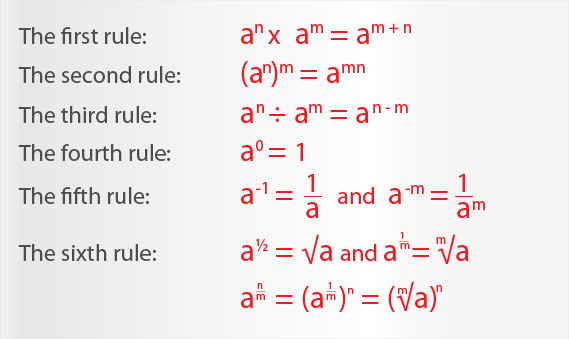
- Rules
- Used to represent powers
- a² means a x a here the index is 2
- Substitution
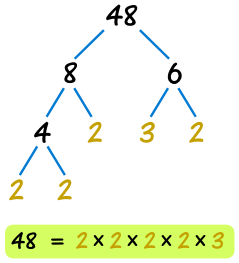
Prime Factors
- Prime factorisation
- A number greater than 1, that has no positive divisors other than one and itself.
Rounding Numbers
- Upper and Lower bounds
- Whenever a measurement is rounded to a given UNIT, the actual measurement can be anything up to HALF A UNIT bigger or smaller
- E.g. A room is 9m long to the nearest metre. Find the upper and lower bounds for its length. The length could be half a metre either side of 9m.
- Lower bound: 8.5m Upper bound: 9.5m
- E.g. The mass of a cake is given as 2.4kg to the nearest 0.1kg. What is the upper and lower bound? The rounding unit is 0.1kg so the actual value could be anything between 2.4kg -+ 0.05kg
- Lower bound: 2.4 - 0.05 = 2.35kg Upper bound: 2.4 + 0.05 = 2.45kg
- E.g. A room is 9m long to the nearest metre. Find the upper and lower bounds for its length. The length could be half a metre either side of 9m.
- Maximum and minimum value
- E.g. A floor is measured as 5.3m by 4.2m, to the nearest 10 cm. Calculate the minimum and maximum possible values for the area of the floor. The actual dimensions of the floor could be anything from 5.25m to 5.35m and 4.15m to 4.25m.
- Find the maximum area by multiplying the lower bounds, and the maximum by multiplying the upper bounds. Minimum possible floor area: 5.25 x 4.15 = 21.7875m² Maximum possible floor area: 5.35 x 4.25 = 22.7375m²
- The bigger the number you divide by, the smaller the answer, so: max(a ÷ b) = max(a) ÷ min(b) and min(a ÷ b) = min(a) ÷ max(b)
- Max. value of a ÷ b = 5.35 ÷ 4.15 = 1.289 (to 3 d.p.) Min value of a ÷ b = 5.25 ÷4.25 = 1.235 (to 3 d.p.)
- The bigger the number you divide by, the smaller the answer, so: max(a ÷ b) = max(a) ÷ min(b) and min(a ÷ b) = min(a) ÷ max(b)
- Find the maximum area by multiplying the lower bounds, and the maximum by multiplying the upper bounds. Minimum possible floor area: 5.25 x 4.15 = 21.7875m² Maximum possible floor area: 5.35 x 4.25 = 22.7375m²
- E.g. A floor is measured as 5.3m by 4.2m, to the nearest 10 cm. Calculate the minimum and maximum possible values for the area of the floor. The actual dimensions of the floor could be anything from 5.25m to 5.35m and 4.15m to 4.25m.
- Whenever a measurement is rounded to a given UNIT, the actual measurement can be anything up to HALF A UNIT bigger or smaller
- Decimal Places
- 4 main rules are: 1) Identify the position of the 'last digit' (last one in the rounded version, not original number) from the number of decimal places. 2) Then look at the next digit to the right - the decider. 3) If the decider is 5+, it rounds up the last digit. If the decider is 4-, it stays the same. 4) There must ne no more digits after the last digit (not even zeros).
- If there is a 9 to round up (to 10), replace the 9 with a 0 and carry the one (to the left). Remember that there needs to be enough zeros to fill the right number of decimal places.
- 4 main rules are: 1) Identify the position of the 'last digit' (last one in the rounded version, not original number) from the number of decimal places. 2) Then look at the next digit to the right - the decider. 3) If the decider is 5+, it rounds up the last digit. If the decider is 4-, it stays the same. 4) There must ne no more digits after the last digit (not even zeros).
- Significant Figures
- 3 main rules are: 1) The 1st significant figure of any number is simply the first digit which isn't a zero. 2) The 2nd, 3rd, 4th etc. significant figures follow on immediately after the 1st, regardless of being zero not zeros. 3) After rounding the last digit, end zeros must be filled in up to, but not beyond, the decimal point. NO EXTRA ZEROS
- Estimating
- 2 easy steps: 1) round off everything to easy, manageable numbers. 2) Work out the answer using the simple numbers.
- Upper and Lower bounds
Standard form
- Used for writing long numbers (with loads of zeros) in a more simple way.
- 3 main rules are: 1) The front number must be between numbers 1 and 10. 2) The power of 10 (n) is how far the decimal point moves. 3) n is positive for big numbers and negative for small numbers.
- A (between 1 and 10) x 10ⁿ (show the number of decimal places to be moved).
- E.g. 35 600 in standard form becomes 3.56 the decimal place moves 4 places so n = 4 giving 10⁴. The full answer is 3.56 x 10⁴. 35 600 is a big number so n is + not -
- Multiplying and Dividing are not to bad. You divide/multiply the front numbers and then the powers of 10 together, using the index notation rules. Make sure the answer is in standard form.
- Adding and subtracting slightly harder. Make sure the powers of 10 are the same (have to rewrite one). Then add/ subtract the front numbers. If necessary convert back to standard form.
- Used for writing long numbers (with loads of zeros) in a more simple way.
Images and files in the map
Information
- Description
- Mind Map on Maths Revision - Numbers, created by Zoe Carr on 29/05/2015.
- Created by
- Zoe Carr · May 2015
- Updated
- Feb 19, 2016
- Views
- 1
- Rating