
Mind map
Determinism, freewill and libertarianism
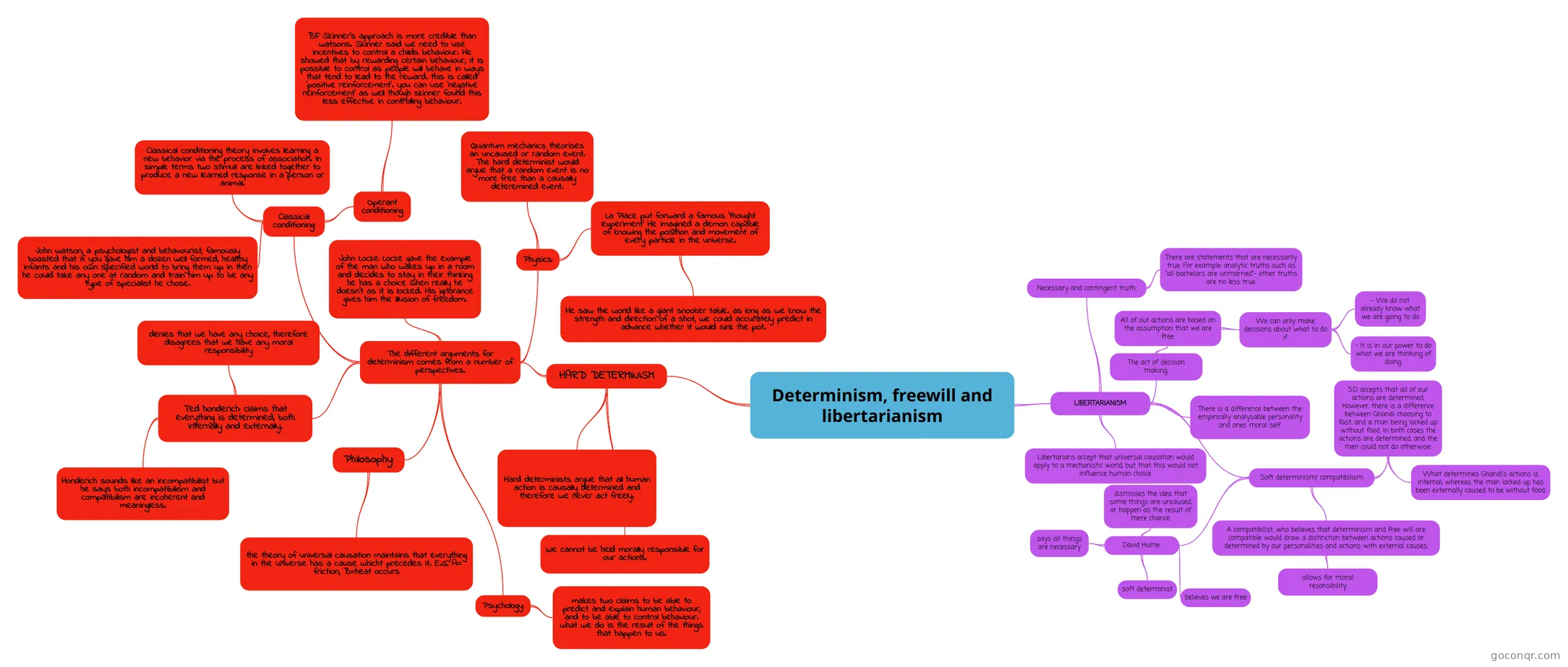
Mind map: Determinism, freewill and libertarianism
Map content
Determinism, freewill and libertarianism
HARD DETERMINISM
- Hard determinists argue that all human action is causally determined and therefore we never act freely.
- We cannot be held morally responsible for our actions.
- The different arguments for determinism comes from a number of perspectives.
- Philosophy:
- the theory of universal causation maintains that everything in the universe has a cause whicht precedes it. E.G. A= friction, B=heat occurs
- John Locke: Locke gave the example of the man who wakes up in a room and decides to stay in their thinking he has a choice when really he doesn't as it is locked. His ignorance gives him the illusion of freedom.
- Ted honderich: claims that everything is determined, both internally and externally.
- denies that we have any choice, therefore disagrees that we have any moral responsibility
- Honderich sounds like an incompatibilist but he says both incompatibilism and compatibilism are incoherent and meaningless.
- Physics:
- La Place put forward a famous 'thought experiment' He imagined a demon capable of knowing the position and movement of every particle in the universe.
- He saw the world like a giant snooker table. as long as we know the strength and direction of a shot, we could accurately predict in advance whether it would sink the pot.
- Quantum mechanics theorises an uncaused or random event. The hard determinist would argue that a random event is no more free than a causally deteremined event.
- La Place put forward a famous 'thought experiment' He imagined a demon capable of knowing the position and movement of every particle in the universe.
- Psychology:
- makes two claims to be able to predict and explain human behaviour, and to be able to control behaviour. what we do is the result of the things that happen to us.
- Classical conditioning:
- Classical conditioning theory involves learning a new behavior via the process of association. In simple terms two stimuli are linked together to produce a new learned response in a person or animal.
- John watson, a psychologist and behavourist, famously boasted that if you gave him a dozen well formed, healthy infants and his own specified world to bring them up in then he could take any one at random and train him up to be any type of specialist he chose.
- Operant conditioning
- BF Skinner's approach is more credible than watsons. Skinner said we need to use incentives to control a childs behaviour. He showed that by rewarding certain behaviour, it is possible to control as people will behave in ways that tend to lead to the reward. this is called 'positive reinforcement'. you can use 'negative reinforcement' as well though skinner found this less effective in controlling behaviour.
- Philosophy:
LIBERTARIANISM
- Libertarians accept that universal causation would apply to a mechanistic world, but that this would not influence human choice.
- There is a difference between the empirically analysable personality and ones moral self.
- The act of decision making:
- All of out actions are based on the assumption that we are free.
- We can only make decisions about what to do if:
- - We do not already know what we are going to do
- - It is in our power to do what we are thinking of doing.
- We can only make decisions about what to do if:
- All of out actions are based on the assumption that we are free.
- Necessary and contingent truth:
- There are statements that are necessarily true. For example: analytic truths such as "all bachelors are unmarried"- other truths are no less true.
- Soft determinism/ compatibilism
- S.D accepts that all of our actions are determined. However, there is a difference between Ghandi choosing to fast, and a man being locked up without food. In both cases the actions are determined, and the men could not do otherwise.
- What determines Ghandi's actions is internal, whereas the man locked up has been externally caused to be without food.
- A compatibilist, who believes that determinism and free will are compatible would draw a distinction between actions caused or determined by our personalities and actions with external causes.
- allows for moral resonsibility
- David Hume:
- soft determinist
- says all things are necessary
- dismisses the idea that some things are uncaused, or happen as the result of mere chance.
- believes we are free
- S.D accepts that all of our actions are determined. However, there is a difference between Ghandi choosing to fast, and a man being locked up without food. In both cases the actions are determined, and the men could not do otherwise.
Information
- Description
- Mind Map on Determinism, freewill and libertarianism, created by courtneygeorgia1 on 31/05/2015.
- Created by
- courtneygeorgia1
- Views
- 1
- Rating