
Mind map
Random Access Protocols
Map content
Random Access Protocols
ALOHA
- ALOHA is a multiple access protocol for transmission of data via a shared network channel.
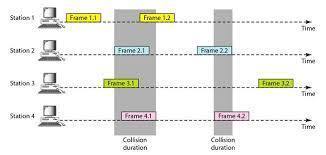
- Pure
- In pure ALOHA, the time of transmission is continuous. Whenever a station has an available frame, it sends the frame. If there is a collision and the frame is destroyed, the sender waits for a random amount of time before retransmitting it.
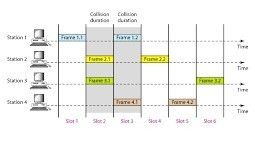
- Slotted
- Slotted ALOHA reduces the number of collisions and doubles the capacity of pure ALOHA. The shared channel is divided into a number of discrete-time intervals called slots. A station can transmit only at the beginning of each slot. However, there can still be collisions if more than one station tries to transmit at the beginning of the same time slot.
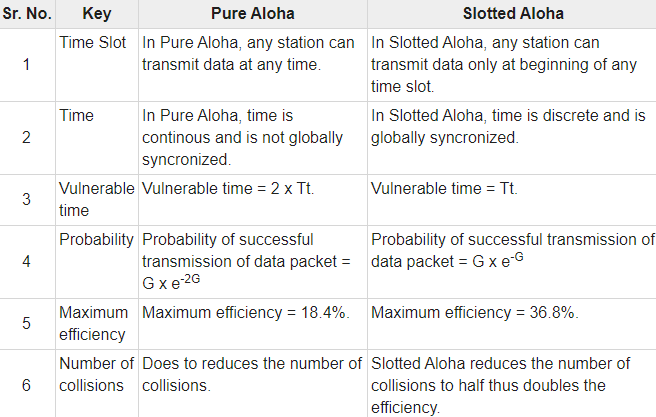
- The differences between Pure and Slotted ALOHA
- Pure
- ALOHA is a multiple access protocol for transmission of data via a shared network channel.
CSMA
- CSMA is based on the principle “sense before transmit” or “listen before talk.”
- CSMA\CD
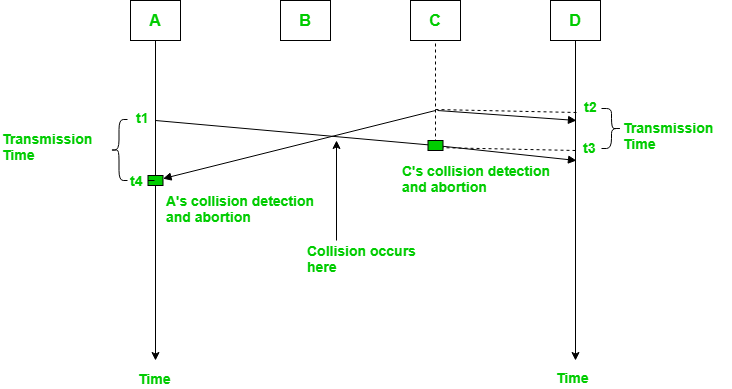
- In this method, a station monitors the medium after it sends a frame to see if the transmission was successful. If successful, the station is finished, if not, the frame is sent again.
- In the diagram on the rigth, A starts sending the first bit of its frame at t1 and since C sees the channel idle at t2, starts sending its frame at t2. C detects A’s frame at t3 and aborts transmission. A detects C’s frame at t4 and aborts its transmission. Transmission time for C’s frame is therefore t3-t2 and for A’s frame is t4-t1. So, the frame transmission time (Tfr) should be at least twice the maximum propagation time (Tp). This can be deduced when the two stations involved in a collision are a maximum distance apart.
- In this method, a station monitors the medium after it sends a frame to see if the transmission was successful. If successful, the station is finished, if not, the frame is sent again.
- CSMA\CA
- The basic idea behind CSMA/CA is that the station should be able to receive while transmitting to detect a collision from different stations. In wired networks, if a collision has occurred then the energy of the received signal almost doubles, and the station can sense the possibility of collision.
- InterFrame Space
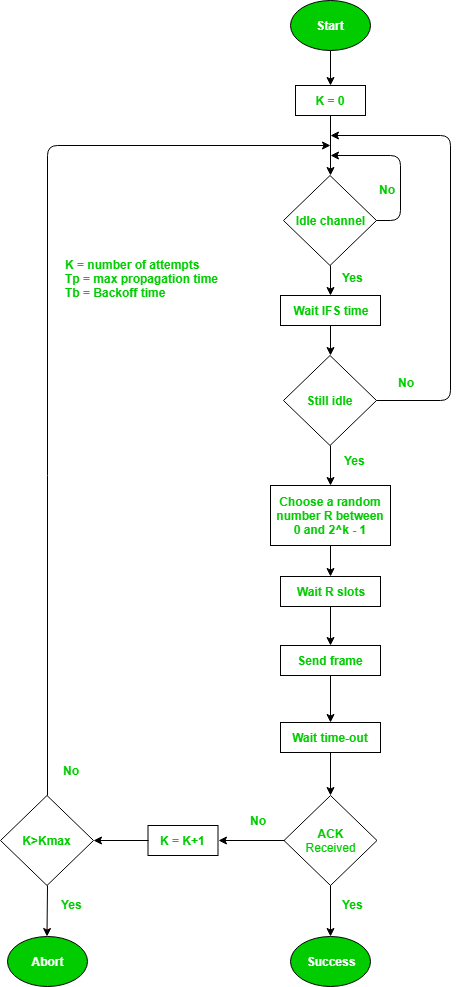
- When a station finds the channel busy, it waits for a period of time called IFS time. IFS can also be used to define the priority of a station or a frame. Higher the IFS lower is the priority.
- Contention Window
- It is the amount of time divided into slots. A station that is ready to send frames chooses the random number of slots as wait time.
- Acknowledgments
- The positive acknowledgments and time-out timer can help guarantee a successful transmission of the frame.
- This flowchart, show the process of collision avoidance.
- InterFrame Space
- The basic idea behind CSMA/CA is that the station should be able to receive while transmitting to detect a collision from different stations. In wired networks, if a collision has occurred then the energy of the received signal almost doubles, and the station can sense the possibility of collision.
- P-Persistent
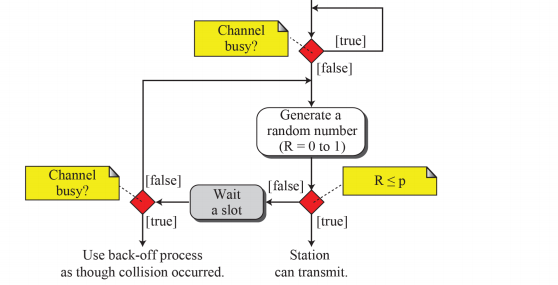
- In p-persistent CSMA, is used if the channel is slotted in time slots with a slot duration equal to or greater than the maximum propagation time. the p-persistent method reduces the chance of collision and improves efficiency. In this method.
- After the station finds the channel idle it follows the following steps:
- 1- With probability p, the station sends its frame. 2- With probability q = 1 -p, the station waits for the beginning of the next time slot and checks the line again.
- a- If the line is idle, it goes to step 1.
- b- If the line is busy, it acts as though a collision has occurred and uses the back-off procedure like Aloha.
- 1- With probability p, the station sends its frame. 2- With probability q = 1 -p, the station waits for the beginning of the next time slot and checks the line again.
- After the station finds the channel idle it follows the following steps:
- In p-persistent CSMA, is used if the channel is slotted in time slots with a slot duration equal to or greater than the maximum propagation time. the p-persistent method reduces the chance of collision and improves efficiency. In this method.
- NonPersistent
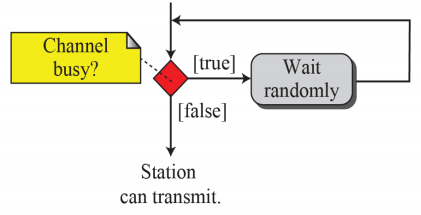
- In NonPersistence CSMA, a station that has a frame ready to be sent senses the line first. If the channel is idle, it sends immediately. If the channel is not idle, it waits a random amount of time and then senses the line again. This method reduces the chance of collision because it is unlikely that two or more stations will wait for the same amount of time since it’s random and retry to send simultaneously.
- Persistent
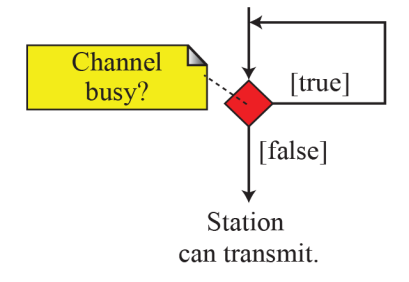
- In persistence CSMA, is simple and straightforward. When a station finds the channel idle, it sends its frame immediately (with probability 1). This method has the highest chance of collision because two or more stations may find the channel idle at the same time and send their frames immediately.
- CSMA\CD
- CSMA is based on the principle “sense before transmit” or “listen before talk.”
Images and files in the map
Information
- Description
- Mind Map on Random Access Protocols, created by Arwa Alshehri on 04/02/2021.
- Created by
- Arwa Alshehri
- Views
- 0
- Rating