
Mind map
Freedom Walkers
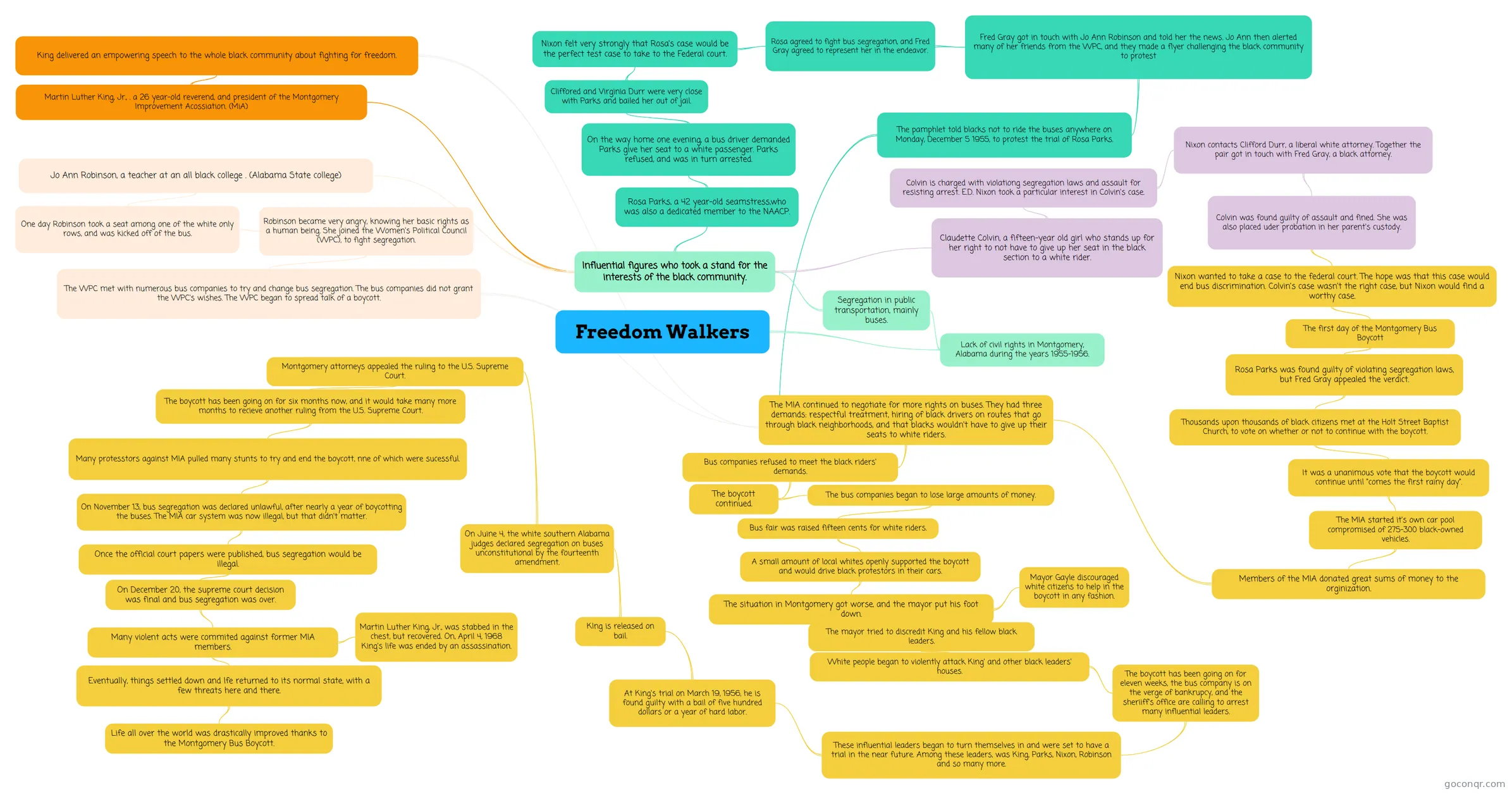
Mind map: Freedom Walkers
Map content
Freedom Walkers
Lack of civil rights in Montgomery, Alabama during the years 1955-1956.
- Segregation in public transportation, mainly buses.
- Influential figures who took a stand for the interests of the black community.
- Jo Ann Robinson, a teacher at an all black college . (Alabama State college)
- One day Robinson took a seat among one of the white only rows, and was kicked off of the bus.
- Robinson became very angry, knowing her basic rights as a human being. She joined the Women's Political Council (WPC), to fight segregation.
- The WPC met with numerous bus companies to try and change bus segregation. The bus companies did not grant the WPC's wishes. The WPC began to spread talk of a boycott.
- The WPC met with numerous bus companies to try and change bus segregation. The bus companies did not grant the WPC's wishes. The WPC began to spread talk of a boycott.
- Robinson became very angry, knowing her basic rights as a human being. She joined the Women's Political Council (WPC), to fight segregation.
- One day Robinson took a seat among one of the white only rows, and was kicked off of the bus.
- Claudette Colvin, a fifteen-year old girl who stands up for her right to not have to give up her seat in the black section to a white rider.
- Colvin is charged with violationg segregation laws and assault for resisting arrest. E.D. Nixon took a particular interest in Colvin's case.
- Nixon contacts Clifford Durr, a liberal white attorney. Together the pair got in touch with Fred Gray, a black attorney.
- Colvin was found guilty of assault and fined. She was also placed uder probation in her parent's custody.
- Nixon wanted to take a case to the federal court. The hope was that this case would end bus discrimination. Colvin's case wasn't the right case, but Nixon would find a worthy case.
- The first day of the Montgomery Bus Boycott
- Rosa Parks was found guilty of violating segregation laws, but Fred Gray appealed the verdict.
- Thousands upon thousands of black citizens met at the Holt Street Baptist Church, to vote on whether or not to continue with the boycott.
- It was a unanimous vote that the boycott would continue until "comes the first rainy day".
- The MIA started it's own car pool compromised of 275-300 black-owned vehicles.
- Members of the MIA donated great sums of money to the orginization.
- The MIA continued to negotiate for more rights on buses. They had three demands: respectful treatment, hiring of black drivers on routes that go through black neighborhoods, and that blacks wouldn't have to give up their seats to white riders.
- Bus companies refused to meet the black riders' demands.
- The boycott continued.
- The bus companies began to lose large amounts of money.
- Bus fair was raised fifteen cents for white riders.
- A small amount of local whites openly supported the boycott and would drive black protestors in their cars.
- The situation in Montgomery got worse, and the mayor put his foot down.
- The mayor tried to discredit King and his fellow black leaders.
- White people began to violently attack King' and other black leaders' houses.
- The boycott has been going on for eleven weeks, the bus company is on the verge of bankrupcy, and the sheriiff's office are calling to arrest many influential leaders.
- These influential leaders began to turn themselves in and were set to have a trial in the near future. Among these leaders, was King, Parks, Nixon, Robinson and so many more.
- At King's trial on March 19, 1956, he is found guilty with a bail of five hundred dollars or a year of hard labor.
- KIng is released on bail.
- On Juine 4, the white southern Alabama judges declared segregation on buses unconstitutional by the fourteenth amendment.
- Montgomery attorneys appealed the ruling to the U.S. Supreme Court.
- The boycott has been going on for six months now, and it would take many more months to recieve another ruling from the U.S. Supreme Court.
- Many protesstors against MIA pulled many stunts to try and end the boycott, nne of which were sucessful.
- On November 13, bus segregation was declared unlawful, after nearly a year of boycotting the buses. The MIA car system was now illegal, but that didn't matter.
- Once the official court papers were published, bus segregation would be illegal.
- On December 20, the supreme court decision was final and bus segregation was over.
- Many violent acts were commited against former MIA members.
- Eventually, things settled down and lfe returned to its normal state, with a few threats here and there.
- Life all over the world was drastically improved thanks to the Montgomery Bus Boycott.
- Martin Luther King, Jr., was stabbed in the chest, but recovered. On, April 4, 1968 King's life was ended by an assassination.
- Eventually, things settled down and lfe returned to its normal state, with a few threats here and there.
- Many violent acts were commited against former MIA members.
- On December 20, the supreme court decision was final and bus segregation was over.
- Once the official court papers were published, bus segregation would be illegal.
- On November 13, bus segregation was declared unlawful, after nearly a year of boycotting the buses. The MIA car system was now illegal, but that didn't matter.
- Many protesstors against MIA pulled many stunts to try and end the boycott, nne of which were sucessful.
- The boycott has been going on for six months now, and it would take many more months to recieve another ruling from the U.S. Supreme Court.
- Montgomery attorneys appealed the ruling to the U.S. Supreme Court.
- On Juine 4, the white southern Alabama judges declared segregation on buses unconstitutional by the fourteenth amendment.
- KIng is released on bail.
- At King's trial on March 19, 1956, he is found guilty with a bail of five hundred dollars or a year of hard labor.
- These influential leaders began to turn themselves in and were set to have a trial in the near future. Among these leaders, was King, Parks, Nixon, Robinson and so many more.
- The boycott has been going on for eleven weeks, the bus company is on the verge of bankrupcy, and the sheriiff's office are calling to arrest many influential leaders.
- White people began to violently attack King' and other black leaders' houses.
- Mayor Gayle discouraged white citizens to help in the boycott in any fashion.
- The mayor tried to discredit King and his fellow black leaders.
- The situation in Montgomery got worse, and the mayor put his foot down.
- A small amount of local whites openly supported the boycott and would drive black protestors in their cars.
- Bus fair was raised fifteen cents for white riders.
- The bus companies began to lose large amounts of money.
- The boycott continued.
- Bus companies refused to meet the black riders' demands.
- The MIA continued to negotiate for more rights on buses. They had three demands: respectful treatment, hiring of black drivers on routes that go through black neighborhoods, and that blacks wouldn't have to give up their seats to white riders.
- Members of the MIA donated great sums of money to the orginization.
- The MIA started it's own car pool compromised of 275-300 black-owned vehicles.
- It was a unanimous vote that the boycott would continue until "comes the first rainy day".
- Thousands upon thousands of black citizens met at the Holt Street Baptist Church, to vote on whether or not to continue with the boycott.
- Rosa Parks was found guilty of violating segregation laws, but Fred Gray appealed the verdict.
- The first day of the Montgomery Bus Boycott
- Nixon wanted to take a case to the federal court. The hope was that this case would end bus discrimination. Colvin's case wasn't the right case, but Nixon would find a worthy case.
- Colvin was found guilty of assault and fined. She was also placed uder probation in her parent's custody.
- Nixon contacts Clifford Durr, a liberal white attorney. Together the pair got in touch with Fred Gray, a black attorney.
- Colvin is charged with violationg segregation laws and assault for resisting arrest. E.D. Nixon took a particular interest in Colvin's case.
- Rosa Parks, a 42 year-old seamstress,who was also a dedicated member to the NAACP.
- On the way home one evening, a bus driver demanded Parks give her seat to a white passenger. Parks refused, and was in turn arrested.
- Cliffored and Virginia Durr were very close with Parks and bailed her out of jail.
- Nixon felt very strongly that Rosa's case would be the perfect test case to take to the Federal court.
- Rosa agreed to fight bus segregation, and Fred Gray agreed to represent her in the endeavor.
- Fred Gray got in touch with Jo Ann Robinson and told her the news. Jo Ann then alerted many of her friends from the WPC, and they made a flyer challenging the black community to protest
- The pamphlet told blacks not to ride the buses anywhere on Monday, December 5 1955, to protest the trial of Rosa Parks.
- The pamphlet told blacks not to ride the buses anywhere on Monday, December 5 1955, to protest the trial of Rosa Parks.
- Fred Gray got in touch with Jo Ann Robinson and told her the news. Jo Ann then alerted many of her friends from the WPC, and they made a flyer challenging the black community to protest
- Rosa agreed to fight bus segregation, and Fred Gray agreed to represent her in the endeavor.
- Nixon felt very strongly that Rosa's case would be the perfect test case to take to the Federal court.
- Cliffored and Virginia Durr were very close with Parks and bailed her out of jail.
- On the way home one evening, a bus driver demanded Parks give her seat to a white passenger. Parks refused, and was in turn arrested.
- Martin Luther King, Jr., . a 26 year-old reverend, and president of the Montgomery Improvement Acossiation. (MiA)
- King delivered an empowering speech to the whole black community about fighting for freedom.
- King delivered an empowering speech to the whole black community about fighting for freedom.
- Jo Ann Robinson, a teacher at an all black college . (Alabama State college)
- Influential figures who took a stand for the interests of the black community.
- Segregation in public transportation, mainly buses.