
Mind map
“MAKING DIFFICULT DECISIONS IN TURBULENT TIMES”
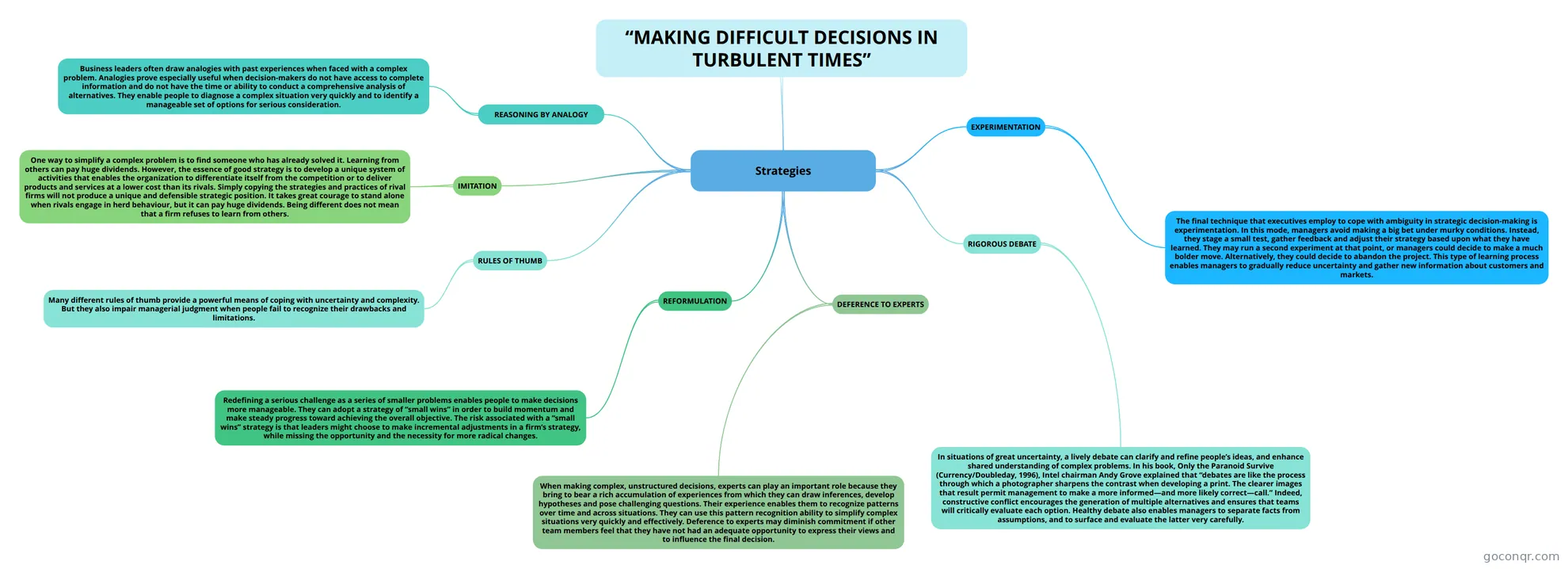
Mind map: Making difficult decisions in turbulent times
Map content
“MAKING DIFFICULT DECISIONS IN TURBULENT TIMES”
- TOMAR DECISIONES DIFÍCILES EN TIEMPOS TURBULENTES
Strategies
- Las estrategias son razonamiento por analogía, imitación, reglas empíricas, reformulación, deferencia a los expertos, debate riguroso y experimentación.
- REASONING BY ANALOGY
- Razonamiento por analogía.
- Business leaders often draw analogies with past experiences when faced with a complex problem. Analogies prove especially useful when decision-makers do not have access to complete information and do not have the time or ability to conduct a comprehensive analysis of alternatives. They enable people to diagnose a complex situation very quickly and to identify a manageable set of options for serious consideration.
- IMITATION
- Imitación
- One way to simplify a complex problem is to find someone who has already solved it. Learning from others can pay huge dividends. However, the essence of good strategy is to develop a unique system of activities that enables the organization to differentiate itself from the competition or to deliver products and services at a lower cost than its rivals. Simply copying the strategies and practices of rival firms will not produce a unique and defensible strategic position. It takes great courage to stand alone when rivals engage in herd behaviour, but it can pay huge dividends. Being different does not mean that a firm refuses to learn from others.
- RULES OF THUMB
- Reglas empíricas.
- Many different rules of thumb provide a powerful means of coping with uncertainty and complexity. But they also impair managerial judgment when people fail to recognize their drawbacks and limitations.
- REFORMULATION
- Reformulación.
- Redefining a serious challenge as a series of smaller problems enables people to make decisions more manageable. They can adopt a strategy of “small wins” in order to build momentum and make steady progress toward achieving the overall objective. The risk associated with a “small wins” strategy is that leaders might choose to make incremental adjustments in a firm’s strategy, while missing the opportunity and the necessity for more radical changes.
- DEFERENCE TO EXPERTS
- Deferencia a los expertos.
- When making complex, unstructured decisions, experts can play an important role because they bring to bear a rich accumulation of experiences from which they can draw inferences, develop hypotheses and pose challenging questions. Their experience enables them to recognize patterns over time and across situations. They can use this pattern recognition ability to simplify complex situations very quickly and effectively. Deference to experts may diminish commitment if other team members feel that they have not had an adequate opportunity to express their views and to influence the final decision.
- RIGOROUS DEBATE
- Debate riguroso.
- In situations of great uncertainty, a lively debate can clarify and refine people’s ideas, and enhance shared understanding of complex problems. In his book, Only the Paranoid Survive (Currency/Doubleday, 1996), Intel chairman Andy Grove explained that “debates are like the process through which a photographer sharpens the contrast when developing a print. The clearer images that result permit management to make a more informed—and more likely correct—call.” Indeed, constructive conflict encourages the generation of multiple alternatives and ensures that teams will critically evaluate each option. Healthy debate also enables managers to separate facts from assumptions, and to surface and evaluate the latter very carefully.
- EXPERIMENTATION
- experimentación.
- The final technique that executives employ to cope with ambiguity in strategic decision-making is experimentation. In this mode, managers avoid making a big bet under murky conditions. Instead, they stage a small test, gather feedback and adjust their strategy based upon what they have learned. They may run a second experiment at that point, or managers could decide to make a much bolder move. Alternatively, they could decide to abandon the project. This type of learning process enables managers to gradually reduce uncertainty and gather new information about customers and markets.
Information
- Description
- Mind Map on “MAKING DIFFICULT DECISIONS IN TURBULENT TIMES”, created by JOSE ALFREDO JACOME JULIO on 01/06/2021.
- Created by
- JOSE ALFREDO JACOME JULIO
- Views
- 0
- Rating
More on Decision-Making Techniques and Tools