
Mind map
Theme of Madness
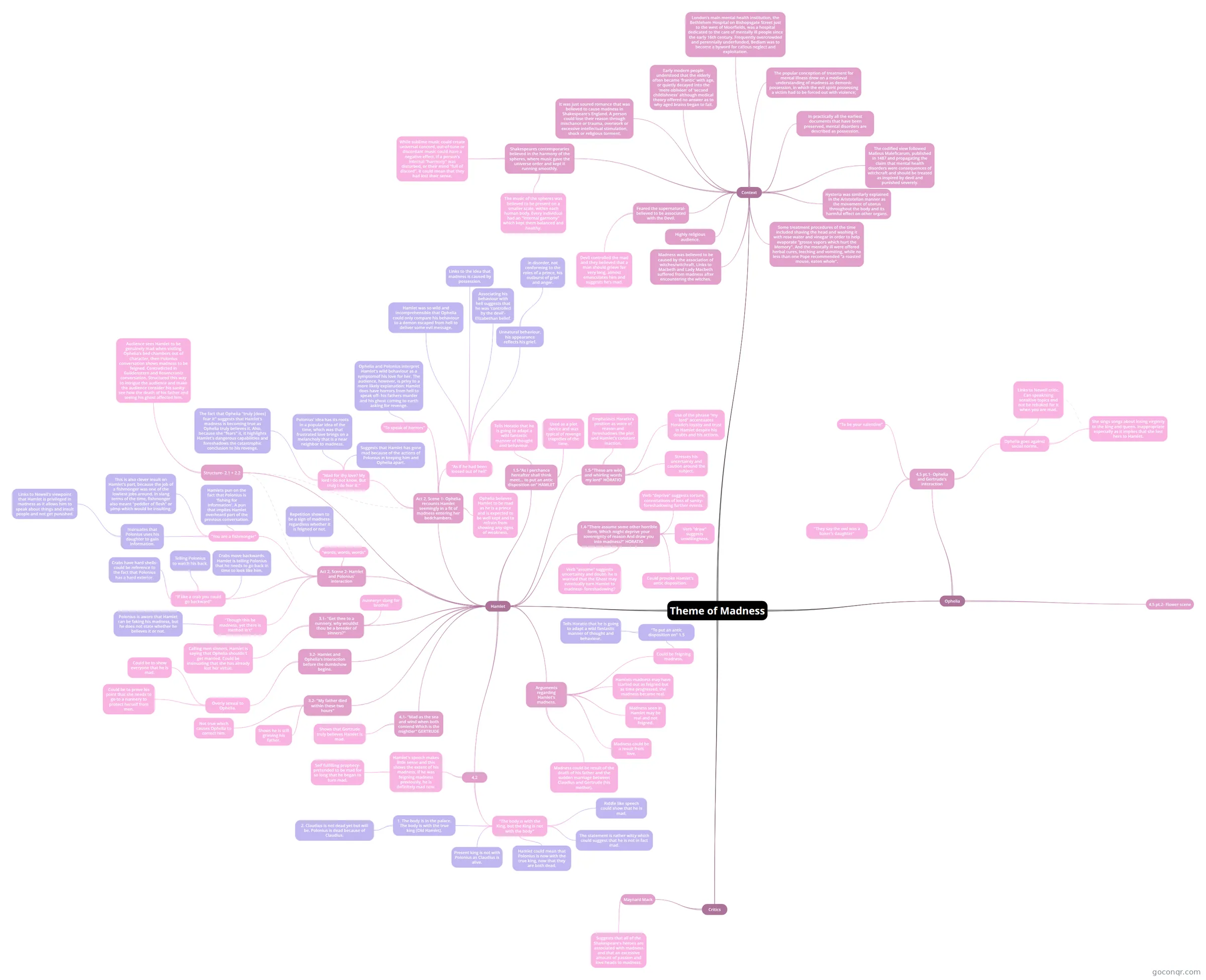
Mind map: Theme of madness in Hamlet
Map content
Theme of Madness
Hamlet
- Arguments regarding Hamlet's madness.
- Could be feigning madness.
- "To put an antic disposition on" 1.5
- Tells Horatio that he is going to adapt a wild fantastic manner of thought and behaviour.
- "To put an antic disposition on" 1.5
- Madness seen in Hamlet may be real and not feigned.
- Madness could be a result from love.
- Madness could be result of the death of his father and the sudden marriage between Claudius and Gertrude (his mother).
- Hamlets madness may have started out as feigned but as time progressed, the madness became real.
- Could be feigning madness.
- Act 2, Scene 1- Ophelia recounts Hamlet seemingly in a fit of madness entering her bedchambers.
- "As if he had been loosed out of hell"
- Hamlet was so wild and incomprehensible that Ophelia could only compare his behaviour to a demon escaped from hell to deliver some evil message.
- Links to the idea that madness is caused by possession.
- Unnatural behaviour, his appearance reflects his grief.
- In disorder, not conforming to the roles of a prince, his outburst of grief and anger.
- Associating his behaviour with hell suggests that he was 'controlled by the devil'- Elizabethan belief.
- "To speak of horrors"
- Ophelia and Polonius interpret Hamlet's wild behaviour as a symptomof his love for her. The audience, however, is privy to a more likely explanation: Hamlet does have horrors from hell to speak off- his fathers murder and his ghost coming to earth asking for revenge.
- "Mad for thy love? My lord I do not know, But truly I do fear it."
- Suggests that Hamlet has gone mad because of the actions of Polonius in keeping him and Ophelia apart.
- Polonius' idea has its roots in a popular idea of the time, which was that frustrated love brings on a melancholy that is a near neighbor to madness.
- The fact that Ophelia "truly [does] fear it" suggests that Hamlet's madness is becoming true as Ophelia truly believes it. Also, because she "fears" it, it highlights Hamlet's dangerous capabilities and foreshadows the catastrophic conclusion to his revenge.
- Ophelia believes Hamlet to be mad as he is a prince and is expected to be well kept and to refrain from showing any signs of weakness.
- "As if he had been loosed out of hell"
- Act 2, Scene 2- Hamlet and Polonius' interaction
- "You are a fishmonger"
- Hamlets pun on the fact that Polonius is 'fishing for information'. A pun that implies Hamlet overheard part of the previous conversation.
- This is also clever insult on Hamlet's part, because the job of a fishmonger was one of the lowliest jobs around. In slang terms of the time, fishmonger also meant "peddler of flesh" or pimp which would be insulting.
- Insinuates that Polonius uses his daughter to gain information.
- Links to Newell's viewpoint that Hamlet is privileged in madness as it allows him to speak about things and insult people and not get punished.
- "If like a crab you could go backward"
- Crabs move backwards. Hamlet is telling Polonius that he needs to go back in time to look like him.
- Telling Polonius to watch his back.
- Crabs have hard shells- could be reference to the fact that Polonius has a hard exterior.
- "Though this be madness, yet there is method in't"
- Polonius is aware that Hamlet can be faking his madness, but he does not state whether he believes it or not.
- "words, words, words"
- Repetition shown to be a sign of madness- regardless whether it is feigned or not.
- "You are a fishmonger"
- 1.4-"There assume some other horrible form, Which might deprive your sovereignty of reason And draw you into madness?" HORATIO
- Verb "assume" suggests uncertainty and doubt- he is worried that the Ghost may eventually turn Hamlet to madness- foreshadowing?
- Could provoke Hamlet's antic disposition.
- Verb "deprive" suggests torture, connotations of loss of sanity- foreshadowing further events.
- Verb "draw" suggests unwillingness.
- 1.5-"These are wild and whirling words my lord" HORATIO
- Stresses his uncertainty and caution around the subject.
- Use of the phrase "my lord" accentuates Horatio's loyalty and trust in Hamlet despite his doubts and his actions.
- Emphasises Horatio's position as voice of reason and foreshadows the plot and Hamlet's constant inaction.
- 1.5-"As i perchance hereafter shall think meet... to put an antic disposition on" HAMLET
- Used as a plot device and was typical of revenge tragedies of the time.
- Tells Horatio that he is going to adapt a wild fantastic manner of thought and behaviour.
- Structure- 2.1 + 2.2
- Audience sees Hamlet to be genuinely mad when visiting Ophelia's bed chambers out of character, then Polonius conversation shows madness to be feigned. Contradicted in Guildenstern and Rosencrantz conversation. Structured this way to intrigue the audience and make the audience consider his sanity- see how the death of his father and seeing his ghost affected him.
- 3.1- "Get thee to a nunnery, why wouldst thou be a breeder of sinners?"
- nunnery= slang for brothel
- Calling men sinners. Hamlet is saying that Ophelia shouldn't get married. Could be insinuating that she has already lost her virtue.
- 3.2- Hamlet and Ophelia's interaction before the dumbshow begins.
- Overly sexual to Ophelia.
- Could be to show everyone that he is mad.
- Could be to prove his point that she needs to go to a nunnery to protect herself from men.
- Overly sexual to Ophelia.
- 3.2- "My father died within these two hours"
- Not true which causes Ophelia to correct him.
- Shows he is still grieving his father.
- 4.1- "Mad as the sea and wind when both contend Which is the mightier" GERTRUDE
- Shows that Gertrude truly believes Hamlet is mad.
- 4.2
- "The body is with the King, but the King is not with the body"
- Riddle like speech could show that he is mad.
- The statement is rather witty which could suggest that he is not in fact mad.
- Hamlet could mean that Polonius is now with the true king, now that they are both dead.
- Present king is not with Polonius as Claudius is alive.
- 1. The body is in the palace. The body is with the true king (Old Hamlet).
- 2. Claudius is not dead yet but will be. Polonius is dead because of Claudius.
- Hamlet's speech makes little sense and this shows the extent of his madness. If he was feigning madness previously, he is definitely mad now.
- Self fulfilling prophecy- pretended to be mad for so long that he began to turn mad.
- "The body is with the King, but the King is not with the body"
- Arguments regarding Hamlet's madness.
Ophelia
- 4.5 pt.1- Ophelia and Gertrude's interaction
- "They say the owl was a baker's daughter"
- "To be your valentine"
- Ophelia goes against social norms.
- She sings songs about losing virginity to the king and queen. Inappropriate especially as it implies that she lost hers to Hamlet.
- Links to Newell critic. Can speak/sing sensitive topics and not be rebuked for it when you are mad.
- 4.5 pt.2- Flower scene
- 4.5 pt.1- Ophelia and Gertrude's interaction
Context
- Madness was believed to be caused by the association of witches/witchraft. Links to Macbeth and Lady Macbeth suffered from madness after encountering the witches.
- Highly religious audience.
- Feared the supernatural- believed to be associated with the Devil.
- Devil controlled the mad and they believed that a man should grieve for very long, almost emasculates him and suggests he's mad.
- Shakespeares contemporaries believed in the harmony of the spheres, where music gave the universe order and kept it running smoothly.
- The music of the spheres was believed to be present on a smaller scale, within each human body. Every individual had an "internal garmony" which kept them balanced and healthy.
- While sublime music could create universal concord, out-of-tune or discordant music could have a negative effect. If a person's internal "harmony" was disturbed, or their mind "full of discord", it could mean that they had lost their sense.
- Some treatment procedures of the time included shaving the head and washing it with rose water and vinegar in order to help evaporate "grosse vapors which hurt the Memory". And the mentally ill were offered herbal cures, leeching and vomiting, while no less than one Pope recommended "a roasted mouse, eaten whole".
- Hysteria was similarly explained in the Aristotelian manner as the movement of uterus throughout the body and its harmful effect on other organs.
- The codified view followed Malleus Maleficarum, published in 1487 and propagating the claim that mental health disorders were consequences of witchcraft and should be treated as inspired by devil and punished severely.
- In practically all the earliest documents that have been preserved, mental disorders are described as possession.
- The popular conception of treatment for mental illness drew on a medieval understanding of madness as demonic possession, in which the evil spirit possessing a victim had to be forced out with violence;
- It was just soured romance that was believed to cause madness in Shakespeare's England. A person could lose their reason through mischance or trauma, overwork or excessive intellectual stimulation, shock or religious torment.
- Early modern people understood that the elderly often became 'frantic' with age, or quietly decayed into the 'mere oblivion' of 'second childishness' although medical theory offered no answer as to why aged brains began to fail.
- London's main mental health institution, the Bethlehem Hospital on Bishopsgate Street just to the west of Moorfields, was a hospital dedicated to the care of mentally ill people since the early 16th century. Frequently overcrowded and perennially underfunded, Bedlam was to become a byword for callous neglect and exploitation.
Critics
- Maynard Mack
- Suggests that all of the Shakespeare's heroes are associated with madness and that an excessive amount of passion and love heads to madness.
- Maynard Mack