
Mind map
How our Ancestors Lived
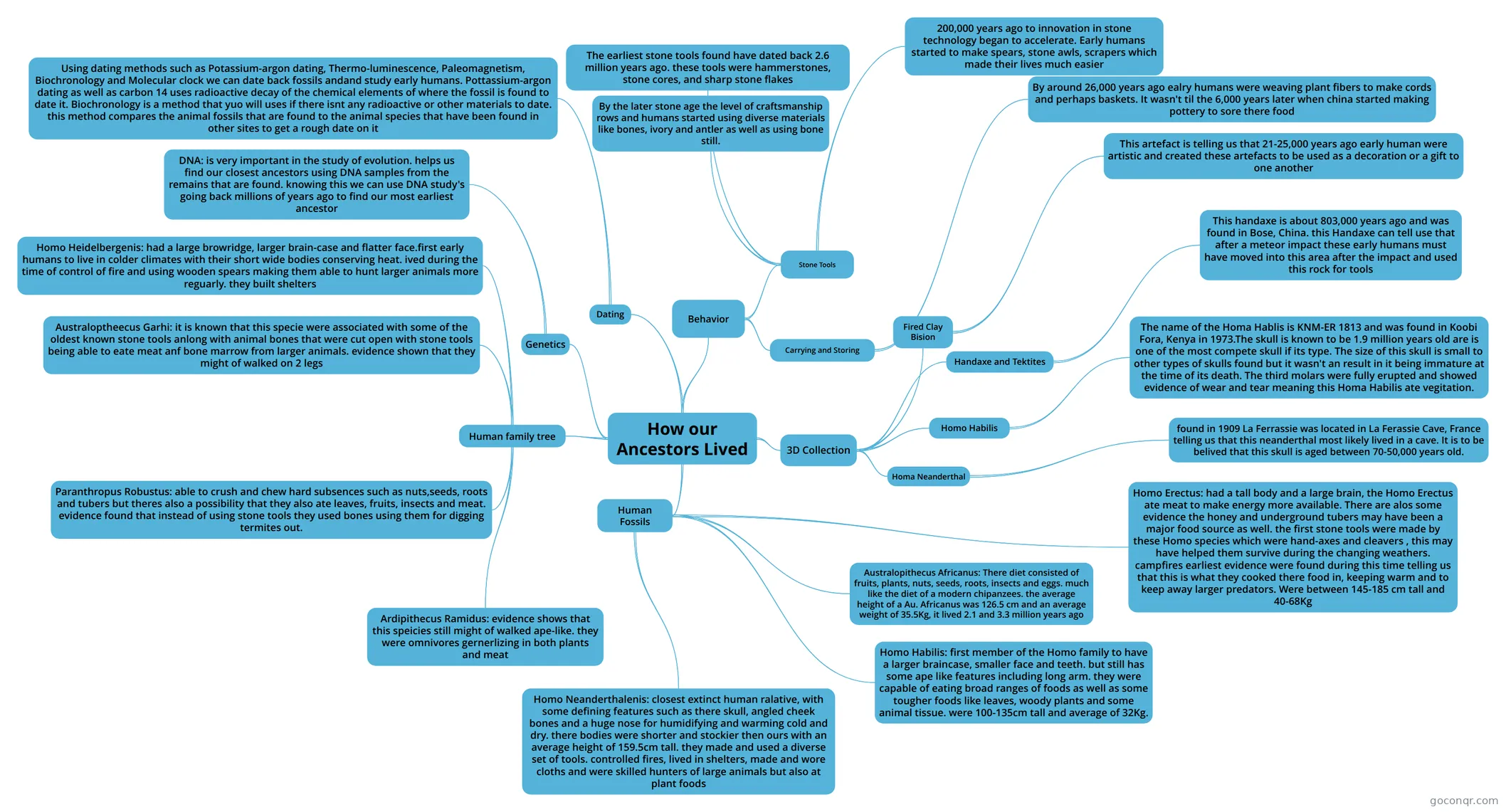
Mind map: How our ancestors lived
Map content
How our Ancestors Lived
Behavior
- Stone Tools
- The earliest stone tools found have dated back 2.6 million years ago. these tools were hammerstones, stone cores, and sharp stone flakes
- 200,000 years ago to innovation in stone technology began to accelerate. Early humans started to make spears, stone awls, scrapers which made their lives much easier
- By the later stone age the level of craftsmanship rows and humans started using diverse materials like bones, ivory and antler as well as using bone still.
- Carrying and Storing
- By around 26,000 years ago ealry humans were weaving plant fibers to make cords and perhaps baskets. It wasn't til the 6,000 years later when china started making pottery to sore there food
- Stone Tools
3D Collection
- Fired Clay Bision
- This artefact is telling us that 21-25,000 years ago early human were artistic and created these artefacts to be used as a decoration or a gift to one another
- Handaxe and Tektites
- This handaxe is about 803,000 years ago and was found in Bose, China. this Handaxe can tell use that after a meteor impact these early humans must have moved into this area after the impact and used this rock for tools
- Homo Habilis
- The name of the Homa Hablis is KNM-ER 1813 and was found in Koobi Fora, Kenya in 1973.The skull is known to be 1.9 million years old are is one of the most compete skull if its type. The size of this skull is small to other types of skulls found but it wasn't an result in it being immature at the time of its death. The third molars were fully erupted and showed evidence of wear and tear meaning this Homa Habilis ate vegitation.
- Homa Neanderthal
- found in 1909 La Ferrassie was located in La Ferassie Cave, France telling us that this neanderthal most likely lived in a cave. It is to be belived that this skull is aged between 70-50,000 years old.
- Fired Clay Bision
Human Fossils
- Australopithecus Africanus: There diet consisted of fruits, plants, nuts, seeds, roots, insects and eggs. much like the diet of a modern chipanzees. the average height of a Au. Africanus was 126.5 cm and an average weight of 35.5Kg, it lived 2.1 and 3.3 million years ago
- Homo Erectus: had a tall body and a large brain, the Homo Erectus ate meat to make energy more available. There are alos some evidence the honey and underground tubers may have been a major food source as well. the first stone tools were made by these Homo species which were hand-axes and cleavers , this may have helped them survive during the changing weathers. campfires earliest evidence were found during this time telling us that this is what they cooked there food in, keeping warm and to keep away larger predators. Were between 145-185 cm tall and 40-68Kg
- Homo Habilis: first member of the Homo family to have a larger braincase, smaller face and teeth. but still has some ape like features including long arm. they were capable of eating broad ranges of foods as well as some tougher foods like leaves, woody plants and some animal tissue. were 100-135cm tall and average of 32Kg.
- Homo Neanderthalenis: closest extinct human ralative, with some defining features such as there skull, angled cheek bones and a huge nose for humidifying and warming cold and dry. there bodies were shorter and stockier then ours with an average height of 159.5cm tall. they made and used a diverse set of tools. controlled fires, lived in shelters, made and wore cloths and were skilled hunters of large animals but also at plant foods
Human family tree
- Ardipithecus Ramidus: evidence shows that this speicies still might of walked ape-like. they were omnivores gernerlizing in both plants and meat
- Australoptheecus Garhi: it is known that this specie were associated with some of the oldest known stone tools anlong with animal bones that were cut open with stone tools being able to eate meat anf bone marrow from larger animals. evidence shown that they might of walked on 2 legs
- Paranthropus Robustus: able to crush and chew hard subsences such as nuts,seeds, roots and tubers but theres also a possibility that they also ate leaves, fruits, insects and meat. evidence found that instead of using stone tools they used bones using them for digging termites out.
- Homo Heidelbergenis: had a large browridge, larger brain-case and flatter face.first early humans to live in colder climates with their short wide bodies conserving heat. ived during the time of control of fire and using wooden spears making them able to hunt larger animals more reguarly. they built shelters
Genetics
- DNA: is very important in the study of evolution. helps us find our closest ancestors using DNA samples from the remains that are found. knowing this we can use DNA study's going back millions of years ago to find our most earliest ancestor
Dating
- Using dating methods such as Potassium-argon dating, Thermo-luminescence, Paleomagnetism, Biochronology and Molecular clock we can date back fossils andand study early humans. Pottassium-argon dating as well as carbon 14 uses radioactive decay of the chemical elements of where the fossil is found to date it. Biochronology is a method that yuo will uses if there isnt any radioactive or other materials to date. this method compares the animal fossils that are found to the animal species that have been found in other sites to get a rough date on it
Information
- Description
- Mind Map on How our Ancestors Lived, created by liam thongkham on 01/09/2015.
- Created by
- liam thongkham
- Views
- 0
- Rating