
Mind map
The CPU
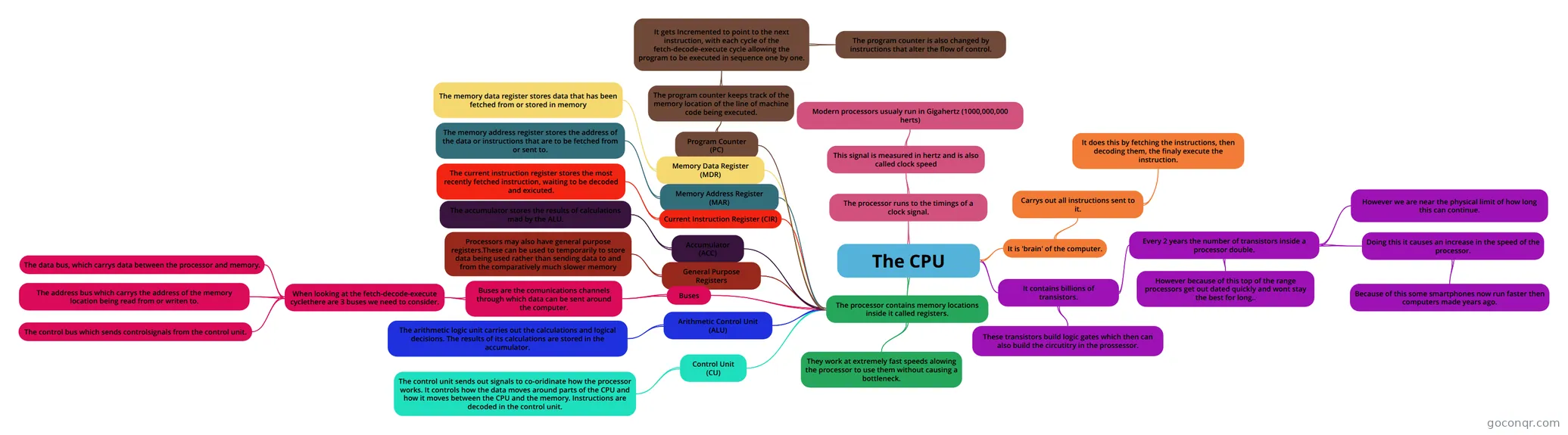
Mind map: The CPU
Map content
The CPU
It is 'brain' of the computer.
- Carrys out all instructions sent to it.
- It does this by fetching the instructions, then decoding them, the finaly execute the instruction.
- Carrys out all instructions sent to it.
It contains billions of transistors.
- These transistors build logic gates which then can also build the circutitry in the prossessor.
- Every 2 years the number of transistors inside a processor double.
- However we are near the physical limit of how long this can continue.
- Doing this it causes an increase in the speed of the processor.
- Because of this some smartphones now run faster then computers made years ago.
- However because of this top of the range processors get out dated quickly and wont stay the best for long..
The processor runs to the timings of a clock signal.
- This signal is measured in hertz and is also called clock speed
- Modern processors usualy run in Gigahertz (1000,000,000 herts)
- This signal is measured in hertz and is also called clock speed
The processor contains memory locations inside it called registers.
- They work at extremely fast speeds alowing the processor to use them without causing a bottleneck.
- Program Counter (PC)
- The program counter keeps track of the memory location of the line of machine code being executed.
- It gets Incremented to point to the next instruction, with each cycle of the fetch-decode-execute cycle allowing the program to be executed in sequence one by one.
- The program counter is also changed by instructions that alter the flow of control.
- It gets Incremented to point to the next instruction, with each cycle of the fetch-decode-execute cycle allowing the program to be executed in sequence one by one.
- The program counter keeps track of the memory location of the line of machine code being executed.
- Memory Data Register (MDR)
- The memory data register stores data that has been fetched from or stored in memory
- Memory Address Register (MAR)
- The memory address register stores the address of the data or instructions that are to be fetched from or sent to.
- Current Instruction Register (CIR)
- The current instruction register stores the most recently fetched instruction, waiting to be decoded and exicuted.
- Accumulator (ACC)
- The accumulator stores the results of calculations mad by the ALU.
- General Purpose Registers
- Processors may also have general purpose registers.These can be used to temporarily to store data being used rather than sending data to and from the comparatively much slower memory
- Buses
- Buses are the comunications channels through which data can be sent around the computer.
- When looking at the fetch-decode-execute cyclethere are 3 buses we need to consider.
- The data bus, which carrys data between the processor and memory.
- The address bus which carrys the address of the memory location being read from or writen to.
- The control bus which sends controlsignals from the control unit.
- When looking at the fetch-decode-execute cyclethere are 3 buses we need to consider.
- Buses are the comunications channels through which data can be sent around the computer.
- Arithmetic Control Unit (ALU)
- The arithmetic logic unit carries out the calculations and logical decisions. The results of its calculations are stored in the accumulator.
- Control Unit (CU)
- The control unit sends out signals to co-oridinate how the processor works. It controls how the data moves around parts of the CPU and how it moves between the CPU and the memory. Instructions are decoded in the control unit.
Information
- Description
- Mind Map on The CPU, created by Harry Rogers on 04/09/2015.
- Created by
- Harry Rogers
- Views
- 0
- Rating