
Mind map
Nadia Burns her Hands
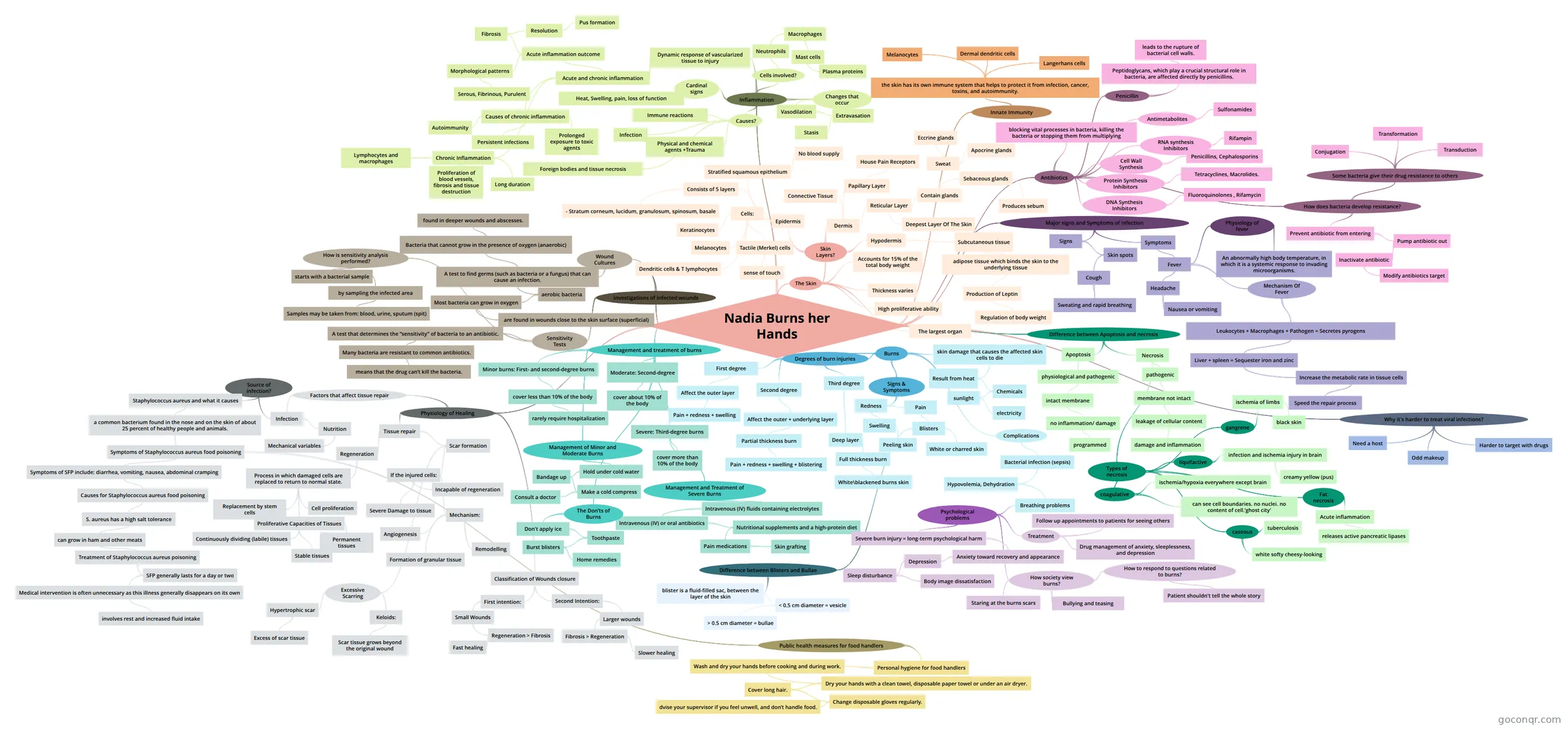
Mind map: Skin, Burns, and Healing Processes
Map content
Nadia Burns her Hands
The Skin
- The largest organ
- Accounts for 15% of the total body weight
- Thickness varies
- High proliferative ability
- Skin Layers?
- Epidermis
- Stratified squamous epithelium
- No blood supply
- Consists of 5 layers
- - Stratum corneum, lucidum, granulosum, spinosum, basale
- Cells:
- Keratinocytes
- Melanocytes
- Tactile (Merkel) cells
- sense of touch
- Dendritic cells & T lymphocytes
- Stratified squamous epithelium
- Dermis
- Connective Tissue
- Papillary Layer
- House Pain Receptors
- Reticular Layer
- Deepest Layer Of The Skin
- Contain glands
- Sweat
- Apocrine glands
- Eccrine glands
- Sebaceous glands
- Produces sebum
- Sweat
- Hypodermis
- Subcutaneous tissue
- adipose tissue which binds the skin to the underlying tissue
- Production of Leptin
- Regulation of body weight
- Production of Leptin
- adipose tissue which binds the skin to the underlying tissue
- Subcutaneous tissue
- Epidermis
Burns
- skin damage that causes the affected skin cells to die
- Result from heat
- Chemicals
- sunlight
- electricity
- sunlight
- Chemicals
- Result from heat
- Signs & Symptoms
- Redness
- Pain
- Blisters
- White or charred skin
- Difference between Blisters and Bullae
- blister is a fluid-filled sac, between the layer of the skin
- < 0.5 cm diameter = vesicle
- > 0.5 cm diameter = bullae
- < 0.5 cm diameter = vesicle
- blister is a fluid-filled sac, between the layer of the skin
- Blisters
- Swelling
- Peeling skin
- Pain
- Redness
- Degrees of burn injuries
- First degree
- Affect the outer layer
- Pain + redness + swelling
- Affect the outer layer
- Second degree
- Affect the outer + underlying layer
- Partial thickness burn
- Pain + redness + swelling + blistering
- Partial thickness burn
- Affect the outer + underlying layer
- Third degree
- Deep layer
- Full thickness burn
- White\blackened burns skin
- Full thickness burn
- Deep layer
- First degree
- Complications
- Bacterial infection (sepsis)
- Hypovolemia, Dehydration
- Breathing problems
- Psychological problems
- Severe burn injury = long-term psychological harm
- Anxiety toward recovery and appearance
- Depression
- Sleep disturbance
- Body image dissatisfaction
- Sleep disturbance
- Depression
- Anxiety toward recovery and appearance
- Treatment
- Follow up appointments to patients for seeing others
- Drug management of anxiety, sleeplessness, and depression
- How society view burns?
- Staring at the burns scars
- Bullying and teasing
- How to respond to questions related to burns?
- Patient shouldn't tell the whole story
- Severe burn injury = long-term psychological harm
- Psychological problems
- Breathing problems
- Hypovolemia, Dehydration
- Bacterial infection (sepsis)
- skin damage that causes the affected skin cells to die
Management and treatment of burns
- Minor burns: First- and second-degree burns
- cover less than 10% of the body
- rarely require hospitalization
- cover less than 10% of the body
- Moderate: Second-degree
- cover about 10% of the body
- Severe: Third-degree burns
- cover more than 10% of the body
- Management and Treatment of Severe Burns
- Intravenous (IV) fluids containing electrolytes
- Intravenous (IV) or oral antibiotics
- Nutritional supplements and a high-protein diet
- Pain medications
- Skin grafting
- Pain medications
- Nutritional supplements and a high-protein diet
- Intravenous (IV) or oral antibiotics
- Intravenous (IV) fluids containing electrolytes
- Management of Minor and Moderate Burns
- Hold under cold water
- Bandage up
- Make a cold compress
- Consult a doctor
- Make a cold compress
- Bandage up
- Hold under cold water
- The Don’ts of Burns
- Don't apply ice
- Toothpaste
- Burst blisters
- Home remedies
- Burst blisters
- Toothpaste
- Don't apply ice
- Minor burns: First- and second-degree burns
Investigations of infected wounds
- Wound Cultures
- A test to find germs (such as bacteria or a fungus) that can cause an infection.
- aerobic bacteria
- Most bacteria can grow in oxygen
- are found in wounds close to the skin surface (superficial)
- Most bacteria can grow in oxygen
- Bacteria that cannot grow in the presence of oxygen (anaerobic)
- found in deeper wounds and abscesses.
- aerobic bacteria
- A test to find germs (such as bacteria or a fungus) that can cause an infection.
- Sensitivity Tests
- A test that determines the “sensitivity” of bacteria to an antibiotic.
- Many bacteria are resistant to common antibiotics.
- means that the drug can’t kill the bacteria.
- Many bacteria are resistant to common antibiotics.
- How is sensitivity analysis performed?
- starts with a bacterial sample
- by sampling the infected area
- Samples may be taken from: blood, urine, sputum (spit)
- by sampling the infected area
- starts with a bacterial sample
- A test that determines the “sensitivity” of bacteria to an antibiotic.
- Wound Cultures
Physiology of Healing
- Tissue repair
- Regeneration
- Process in which damaged cells are replaced to return to normal state.
- Cell proliferation
- Replacement by stem cells
- Proliferative Capacities of Tissues
- Continuously dividing (labile) tissues
- Stable tissues
- Permanent tissues
- Process in which damaged cells are replaced to return to normal state.
- Scar formation
- If the injured cells:
- Incapable of regeneration
- Severe Damage to tissue
- Mechanism:
- Angiogenesis
- Formation of granular tissue
- Remodelling
- Excessive Scarring
- Hypertrophic scar
- Excess of scar tissue
- Keloids:
- Scar tissue grows beyond the original wound
- Hypertrophic scar
- If the injured cells:
- Regeneration
- Classification of Wounds closure
- First intention:
- Small Wounds
- Regeneration > Fibrosis
- Fast healing
- Regeneration > Fibrosis
- Small Wounds
- Second Intention:
- Larger wounds
- Fibrosis > Regeneration
- Slower healing
- Fibrosis > Regeneration
- Larger wounds
- First intention:
- Factors that affect tissue repair
- Infection
- Nutrition
- Mechanical variables
- Source of infection?
- Staphylococcus aureus and what it causes
- a common bacterium found in the nose and on the skin of about 25 percent of healthy people and animals.
- Symptoms of Staphylococcus aureus food poisoning
- Symptoms of SFP include: diarrhea, vomiting, nausea, abdominal cramping
- Causes for Staphylococcus aureus food poisoning
- S. aureus has a high salt tolerance
- can grow in ham and other meats
- Treatment of Staphylococcus aureus poisoning
- SFP generally lasts for a day or two
- Medical intervention is often unnecessary as this illness generally disappears on its own
- involves rest and increased fluid intake
- Medical intervention is often unnecessary as this illness generally disappears on its own
- SFP generally lasts for a day or two
- Treatment of Staphylococcus aureus poisoning
- can grow in ham and other meats
- S. aureus has a high salt tolerance
- Causes for Staphylococcus aureus food poisoning
- Public health measures for food handlers
- Personal hygiene for food handlers
- Wash and dry your hands before cooking and during work.
- Dry your hands with a clean towel, disposable paper towel or under an air dryer.
- Cover long hair.
- Change disposable gloves regularly.
- dvise your supervisor if you feel unwell, and don’t handle food.
- Change disposable gloves regularly.
- Cover long hair.
- Dry your hands with a clean towel, disposable paper towel or under an air dryer.
- Wash and dry your hands before cooking and during work.
- Personal hygiene for food handlers
- Symptoms of SFP include: diarrhea, vomiting, nausea, abdominal cramping
- Symptoms of Staphylococcus aureus food poisoning
- a common bacterium found in the nose and on the skin of about 25 percent of healthy people and animals.
- Staphylococcus aureus and what it causes
- Nutrition
- Infection
- Tissue repair
Difference between Apoptosis and necrosis
- Apoptosis
- physiological and pathogenic
- intact membrane
- no inflammation/ damage
- programmed
- no inflammation/ damage
- intact membrane
- physiological and pathogenic
- Necrosis
- pathogenic
- membrane not intact
- leakage of cellular content
- damage and inflammation
- leakage of cellular content
- membrane not intact
- Types of necrosis
- coagulative
- ischemia/hypoxia everywhere except brain
- can see cell boundaries. no nuclei. no content of cell.’ghost city’
- liquifactive
- infection and ischemia injury in brain
- creamy yellow (pus)
- infection and ischemia injury in brain
- caseous
- tuberculosis
- white softy cheesy-looking
- Fat necrosis
- Acute inflammation
- releases active pancreatic lipases
- Acute inflammation
- gangrene
- ischemia of limbs
- black skin
- ischemia of limbs
- coagulative
- pathogenic
- Apoptosis
Major signs and Symptoms of infection
- Signs
- Skin spots
- Cough
- Sweating and rapid breathing
- Cough
- Skin spots
- Symptoms
- Fever
- Headache
- Nausea or vomiting
- Physiology of fever
- An abnormally high body temperature, in which it is a systemic response to invading microorganisms.
- Mechanism Of Fever
- Leukocytes + Macrophages + Pathogen = Secretes pyrogens
- Liver + spleen = Sequester iron and zinc
- Increase the metabolic rate in tissue cells
- Speed the repair process
- Increase the metabolic rate in tissue cells
- Liver + spleen = Sequester iron and zinc
- Leukocytes + Macrophages + Pathogen = Secretes pyrogens
- Headache
- Fever
- Signs
Inflammation
- Dynamic response of vascularized tissue to injury
- Acute and chronic inflammation
- Acute inflammation outcome
- Fibrosis
- Resolution
- Pus formation
- Resolution
- Morphological patterns
- Serous, Fibrinous, Purulent
- Fibrosis
- Causes of chronic inflammation
- Autoimmunity
- Persistent infections
- Prolonged exposure to toxic agents
- Chronic Inflammation
- Long duration
- Proliferation of blood vessels, fibrosis and tissue destruction
- Lymphocytes and macrophages
- Acute inflammation outcome
- Acute and chronic inflammation
- Causes?
- Immune reactions
- Physical and chemical agents +Trauma
- Infection
- Foreign bodies and tissue necrosis
- Cells involved?
- Neutrophils
- Macrophages
- Mast cells
- Plasma proteins
- Mast cells
- Macrophages
- Neutrophils
- Changes that occur
- Vasodilation
- Extravasation
- Stasis
- Extravasation
- Vasodilation
- Cardinal signs
- Heat, Swelling, pain, loss of function
- Dynamic response of vascularized tissue to injury
Innate Immunity
- the skin has its own immune system that helps to protect it from infection, cancer, toxins, and autoimmunity.
- Melanocytes
- Dermal dendritic cells
- Langerhans cells
- the skin has its own immune system that helps to protect it from infection, cancer, toxins, and autoimmunity.
Antibiotics
- blocking vital processes in bacteria, killing the bacteria or stopping them from multiplying
- Cell Wall Synthesis
- Penicillins, Cephalosporins
- Protein Synthesis Inhibitors
- Tetracyclines, Macrolides.
- DNA Synthesis Inhibitors
- Fluoroquinolones , Rifamycin
- RNA synthesis Inhibitors
- Rifampin
- Antimetabolites
- Sulfonamides
- How does bacteria develop resistance?
- Prevent antibiotic from entering
- Pump antibiotic out
- Inactivate antibiotic
- Modify antibiotics target
- Inactivate antibiotic
- Pump antibiotic out
- Some bacteria give their drug resistance to others
- Conjugation
- Transformation
- Transduction
- Prevent antibiotic from entering
- Penicillin
- Peptidoglycans, which play a crucial structural role in bacteria, are affected directly by penicillins.
- leads to the rupture of bacterial cell walls.
- Peptidoglycans, which play a crucial structural role in bacteria, are affected directly by penicillins.
Why it's harder to treat viral infections?
- Need a host
- Odd makeup
- Harder to target with drugs
Information
- Description
- Mind Map on Nadia Burns her Hands, created by Lelas A on 10/19/2021.
- Created by
- Lelas A
- Views
- 4
- Rating