
Mind map
Psychology - Behavourist approach
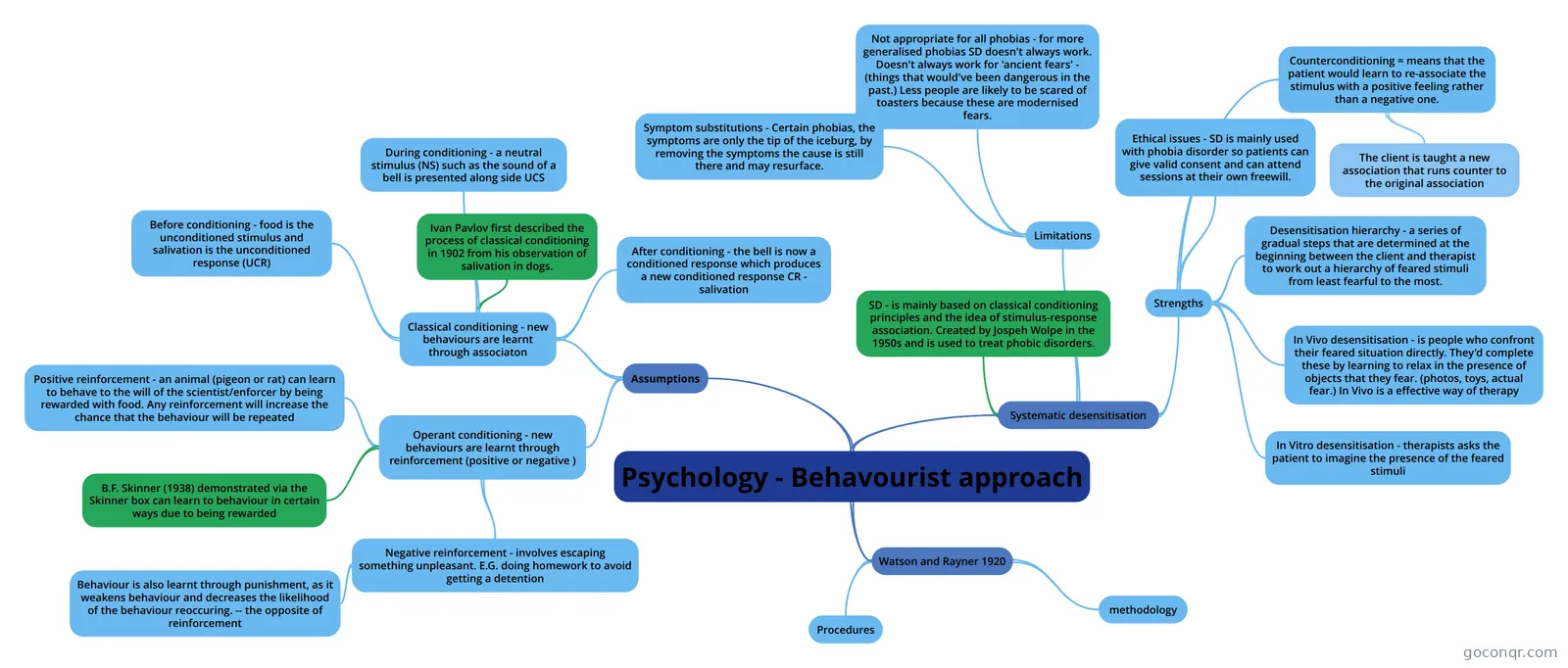
Mind map: behaviourist approach psychology
Map content
Psychology - Behavourist approach
Assumptions
- Classical conditioning - new behaviours are learnt through associaton
- Before conditioning - food is the unconditioned stimulus and salivation is the unconditioned response (UCR)
- During conditioning - a neutral stimulus (NS) such as the sound of a bell is presented along side UCS
- After conditioning - the bell is now a conditioned response which produces a new conditioned response CR - salivation
- Ivan Pavlov first described the process of classical conditioning in 1902 from his observation of salivation in dogs.
- Operant conditioning - new behaviours are learnt through reinforcement (positive or negative )
- B.F. Skinner (1938) demonstrated via the Skinner box can learn to behaviour in certain ways due to being rewarded
- Positive reinforcement - an animal (pigeon or rat) can learn to behave to the will of the scientist/enforcer by being rewarded with food. Any reinforcement will increase the chance that the behaviour will be repeated
- Negative reinforcement - involves escaping something unpleasant. E.G. doing homework to avoid getting a detention
- Behaviour is also learnt through punishment, as it weakens behaviour and decreases the likelihood of the behaviour reoccuring. -- the opposite of reinforcement
- Classical conditioning - new behaviours are learnt through associaton
Systematic desensitisation
- Strengths
- Counterconditioning = means that the patient would learn to re-associate the stimulus with a positive feeling rather than a negative one.
- The client is taught a new association that runs counter to the original association
- Desensitisation hierarchy - a series of gradual steps that are determined at the beginning between the client and therapist to work out a hierarchy of feared stimuli from least fearful to the most.
- In Vivo desensitisation - is people who confront their feared situation directly. They'd complete these by learning to relax in the presence of objects that they fear. (photos, toys, actual fear.) In Vivo is a effective way of therapy
- In Vitro desensitisation - therapists asks the patient to imagine the presence of the feared stimuli
- Ethical issues - SD is mainly used with phobia disorder so patients can give valid consent and can attend sessions at their own freewill.
- Counterconditioning = means that the patient would learn to re-associate the stimulus with a positive feeling rather than a negative one.
- Limitations
- Not appropriate for all phobias - for more generalised phobias SD doesn't always work. Doesn't always work for 'ancient fears' - (things that would've been dangerous in the past.) Less people are likely to be scared of toasters because these are modernised fears.
- Symptom substitutions - Certain phobias, the symptoms are only the tip of the iceburg, by removing the symptoms the cause is still there and may resurface.
- SD - is mainly based on classical conditioning principles and the idea of stimulus-response association. Created by Jospeh Wolpe in the 1950s and is used to treat phobic disorders.
- Strengths
Watson and Rayner 1920
- methodology
- Procedures
Information
- Description
- Mind Map on Psychology - Behavourist approach, created by Emele Rees on 08/12/2021.
- Created by
- Emele Rees
- Views
- 8
- Rating