
Mind map
Working scientifically. (Key stages one and two.)
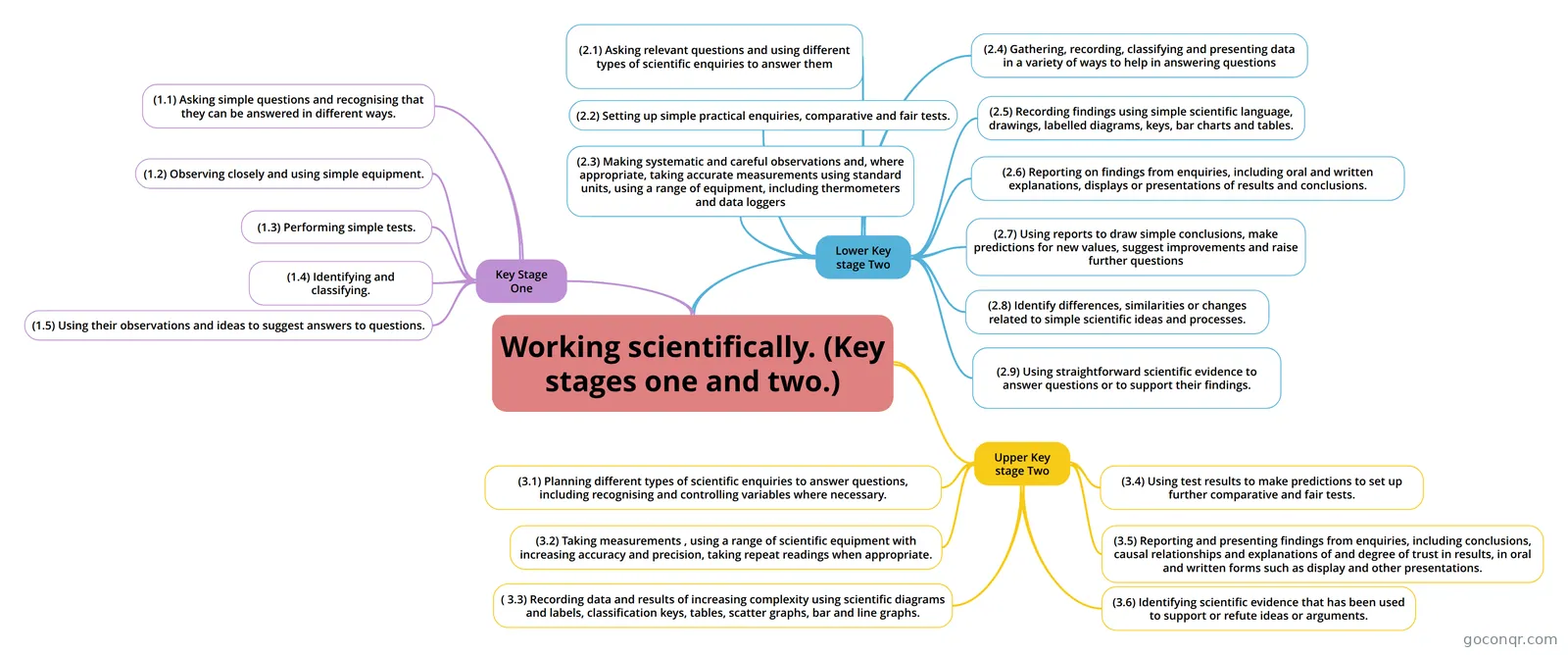
Mind map: Working scientifically key stages one and two
Map content
Working scientifically. (Key stages one and two.)
Key Stage One
- (1.1) Asking simple questions and recognising that they can be answered in different ways.
- (1.2) Observing closely and using simple equipment.
- (1.3) Performing simple tests.
- (1.4) Identifying and classifying.
- (1.5) Using their observations and ideas to suggest answers to questions.
Lower Key stage Two
- (2.1) Asking relevant questions and using different types of scientific enquiries to answer them
- (2.2) Setting up simple practical enquiries, comparative and fair tests.
- (2.3) Making systematic and careful observations and, where appropriate, taking accurate measurements using standard units, using a range of equipment, including thermometers and data loggers
- (2.4) Gathering, recording, classifying and presenting data in a variety of ways to help in answering questions
- (2.5) Recording findings using simple scientific language, drawings, labelled diagrams, keys, bar charts and tables.
- (2.6) Reporting on findings from enquiries, including oral and written explanations, displays or presentations of results and conclusions.
- (2.7) Using reports to draw simple conclusions, make predictions for new values, suggest improvements and raise further questions
- (2.8) Identify differences, similarities or changes related to simple scientific ideas and processes.
- (2.9) Using straightforward scientific evidence to answer questions or to support their findings.
Upper Key stage Two
- (3.1) Planning different types of scientific enquiries to answer questions, including recognising and controlling variables where necessary.
- (3.2) Taking measurements , using a range of scientific equipment with increasing accuracy and precision, taking repeat readings when appropriate.
- ( 3.3) Recording data and results of increasing complexity using scientific diagrams and labels, classification keys, tables, scatter graphs, bar and line graphs.
- (3.4) Using test results to make predictions to set up further comparative and fair tests.
- (3.5) Reporting and presenting findings from enquiries, including conclusions, causal relationships and explanations of and degree of trust in results, in oral and written forms such as display and other presentations.
- (3.6) Identifying scientific evidence that has been used to support or refute ideas or arguments.
Information
- Description
- entry level Science Mind Map on Working scientifically. (Key stages one and two.), created by Matthew Coupe on 24/09/2015.
- Created by
- Matthew Coupe
- Views
- 1
- Rating