
Mind map
Fundamentals of Artificial intelligence
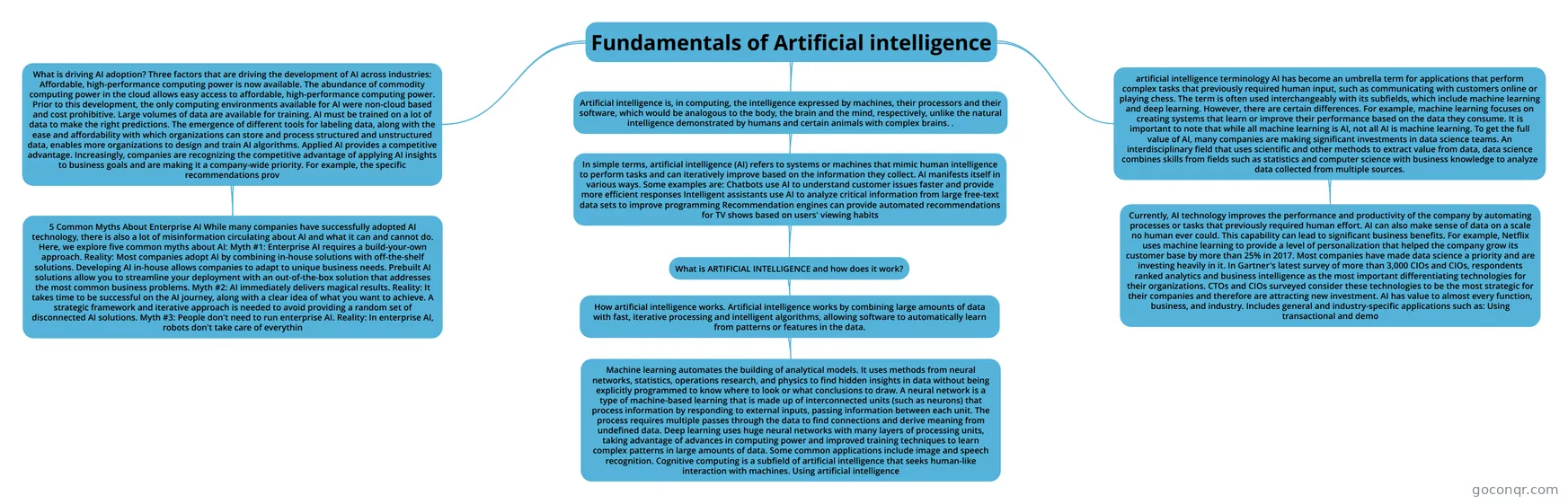
Mind map: Fundamentals of artificial intelligence
Map content
Fundamentals of Artificial intelligence
Artificial intelligence is, in computing, the intelligence expressed by machines, their processors and their software, which would be analogous to the body, the brain and the mind, respectively, unlike the natural intelligence demonstrated by humans and certain animals with complex brains. .
- In simple terms, artificial intelligence (AI) refers to systems or machines that mimic human intelligence to perform tasks and can iteratively improve based on the information they collect. AI manifests itself in various ways. Some examples are: Chatbots use AI to understand customer issues faster and provide more efficient responses Intelligent assistants use AI to analyze critical information from large free-text data sets to improve programming Recommendation engines can provide automated recommendations for TV shows based on users' viewing habits
- What is ARTIFICIAL INTELLIGENCE and how does it work?
- How artificial intelligence works. Artificial intelligence works by combining large amounts of data with fast, iterative processing and intelligent algorithms, allowing software to automatically learn from patterns or features in the data.
- Machine learning automates the building of analytical models. It uses methods from neural networks, statistics, operations research, and physics to find hidden insights in data without being explicitly programmed to know where to look or what conclusions to draw. A neural network is a type of machine-based learning that is made up of interconnected units (such as neurons) that process information by responding to external inputs, passing information between each unit. The process requires multiple passes through the data to find connections and derive meaning from undefined data. Deep learning uses huge neural networks with many layers of processing units, taking advantage of advances in computing power and improved training techniques to learn complex patterns in large amounts of data. Some common applications include image and speech recognition. Cognitive computing is a subfield of artificial intelligence that seeks human-like interaction with machines. Using artificial intelligence
- How artificial intelligence works. Artificial intelligence works by combining large amounts of data with fast, iterative processing and intelligent algorithms, allowing software to automatically learn from patterns or features in the data.
- What is ARTIFICIAL INTELLIGENCE and how does it work?
- In simple terms, artificial intelligence (AI) refers to systems or machines that mimic human intelligence to perform tasks and can iteratively improve based on the information they collect. AI manifests itself in various ways. Some examples are: Chatbots use AI to understand customer issues faster and provide more efficient responses Intelligent assistants use AI to analyze critical information from large free-text data sets to improve programming Recommendation engines can provide automated recommendations for TV shows based on users' viewing habits
artificial intelligence terminology AI has become an umbrella term for applications that perform complex tasks that previously required human input, such as communicating with customers online or playing chess. The term is often used interchangeably with its subfields, which include machine learning and deep learning. However, there are certain differences. For example, machine learning focuses on creating systems that learn or improve their performance based on the data they consume. It is important to note that while all machine learning is AI, not all AI is machine learning. To get the full value of AI, many companies are making significant investments in data science teams. An interdisciplinary field that uses scientific and other methods to extract value from data, data science combines skills from fields such as statistics and computer science with business knowledge to analyze data collected from multiple sources.
- Currently, AI technology improves the performance and productivity of the company by automating processes or tasks that previously required human effort. AI can also make sense of data on a scale no human ever could. This capability can lead to significant business benefits. For example, Netflix uses machine learning to provide a level of personalization that helped the company grow its customer base by more than 25% in 2017. Most companies have made data science a priority and are investing heavily in it. In Gartner's latest survey of more than 3,000 CIOs and CIOs, respondents ranked analytics and business intelligence as the most important differentiating technologies for their organizations. CTOs and CIOs surveyed consider these technologies to be the most strategic for their companies and therefore are attracting new investment. AI has value to almost every function, business, and industry. Includes general and industry-specific applications such as: Using transactional and demo
What is driving AI adoption? Three factors that are driving the development of AI across industries: Affordable, high-performance computing power is now available. The abundance of commodity computing power in the cloud allows easy access to affordable, high-performance computing power. Prior to this development, the only computing environments available for AI were non-cloud based and cost prohibitive. Large volumes of data are available for training. AI must be trained on a lot of data to make the right predictions. The emergence of different tools for labeling data, along with the ease and affordability with which organizations can store and process structured and unstructured data, enables more organizations to design and train AI algorithms. Applied AI provides a competitive advantage. Increasingly, companies are recognizing the competitive advantage of applying AI insights to business goals and are making it a company-wide priority. For example, the specific recommendations prov
- 5 Common Myths About Enterprise AI While many companies have successfully adopted AI technology, there is also a lot of misinformation circulating about AI and what it can and cannot do. Here, we explore five common myths about AI: Myth #1: Enterprise AI requires a build-your-own approach. Reality: Most companies adopt AI by combining in-house solutions with off-the-shelf solutions. Developing AI in-house allows companies to adapt to unique business needs. Prebuilt AI solutions allow you to streamline your deployment with an out-of-the-box solution that addresses the most common business problems. Myth #2: AI immediately delivers magical results. Reality: It takes time to be successful on the AI journey, along with a clear idea of what you want to achieve. A strategic framework and iterative approach is needed to avoid providing a random set of disconnected AI solutions. Myth #3: People don't need to run enterprise AI. Reality: In enterprise AI, robots don't take care of everythin
Information
- Description
- Mind Map on Fundamentals of Artificial intelligence, created by Alejandro Caballero on 09/03/2022.
- Created by
- Alejandro Caballero
- Views
- 6
- Rating