
Mind map
Applications of Derivatives
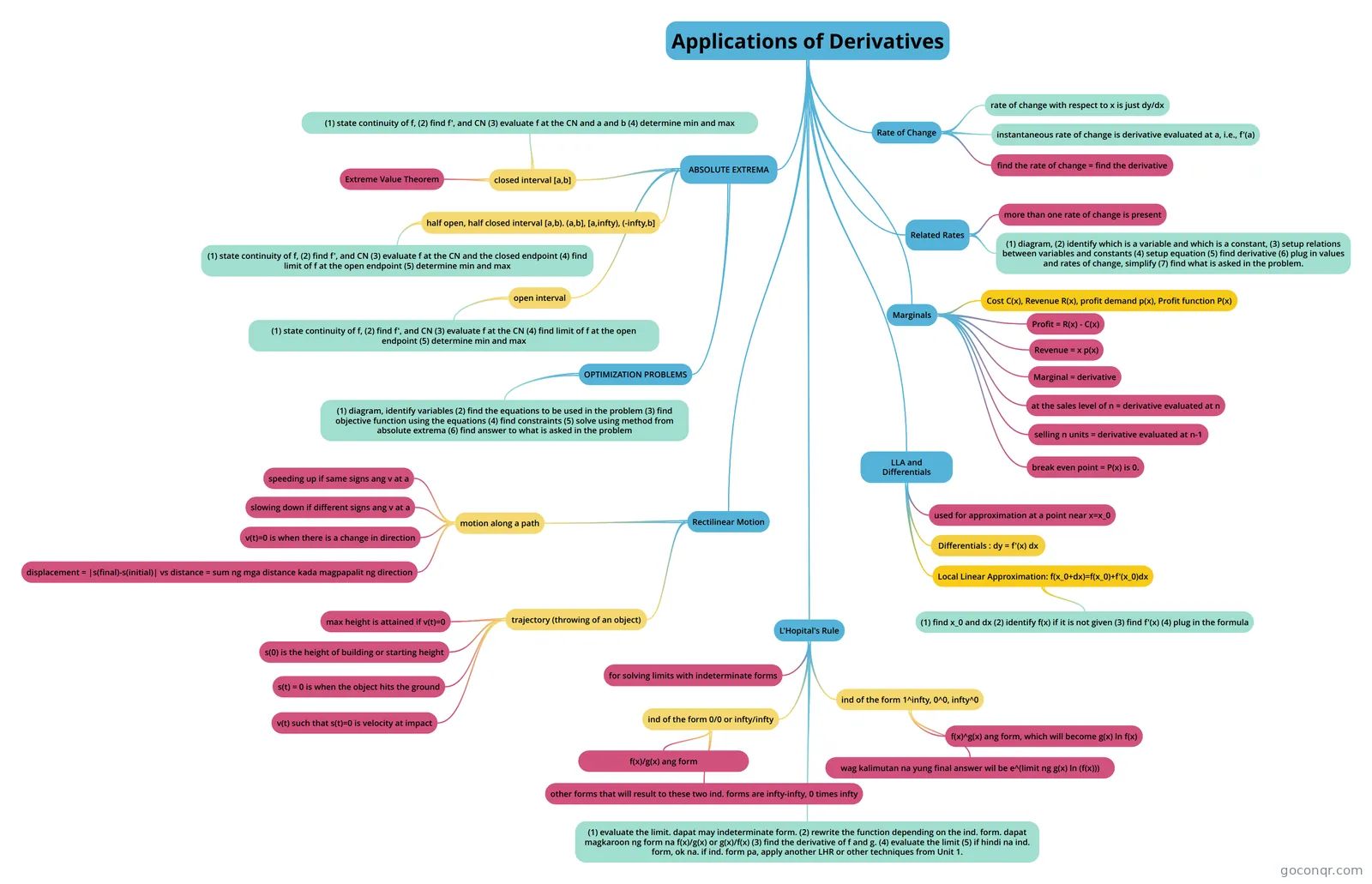
Mind map: Applications of derivatives
Map content
Applications of Derivatives
ABSOLUTE EXTREMA
- OPTIMIZATION PROBLEMS
- (1) diagram, identify variables (2) find the equations to be used in the problem (3) find objective function using the equations (4) find constraints (5) solve using method from absolute extrema (6) find answer to what is asked in the problem
- closed interval [a,b]
- Extreme Value Theorem
- States that the absolute minimum and maximum exists for closed intervals, provided that f is continuous on the interval
- (1) state continuity of f, (2) find f', and CN (3) evaluate f at the CN and a and b (4) determine min and max
- Extreme Value Theorem
- half open, half closed interval [a,b). (a,b], [a,infty), (-infty,b]
- (1) state continuity of f, (2) find f', and CN (3) evaluate f at the CN and the closed endpoint (4) find limit of f at the open endpoint (5) determine min and max
- open interval
- (1) state continuity of f, (2) find f', and CN (3) evaluate f at the CN (4) find limit of f at the open endpoint (5) determine min and max
- OPTIMIZATION PROBLEMS
Rectilinear Motion
- motion along a path
- speeding up if same signs ang v at a
- slowing down if different signs ang v at a
- v(t)=0 is when there is a change in direction
- displacement = |s(final)-s(initial)| vs distance = sum ng mga distance kada magpapalit ng direction
- trajectory (throwing of an object)
- max height is attained if v(t)=0
- s(0) is the height of building or starting height
- s(t) = 0 is when the object hits the ground
- v(t) such that s(t)=0 is velocity at impact
- motion along a path
Rate of Change
- rate of change with respect to x is just dy/dx
- instantaneous rate of change is derivative evaluated at a, i.e., f'(a)
- find the rate of change = find the derivative
Related Rates
- more than one rate of change is present
- (1) diagram, (2) identify which is a variable and which is a constant, (3) setup relations between variables and constants (4) setup equation (5) find derivative (6) plug in values and rates of change, simplify (7) find what is asked in the problem.
LLA and Differentials
- used for approximation at a point near x=x_0
- dapat mas madali macompute yung LLA a kaysa sa specific na pinapahanap na value. Ex. sec(1.98) yung pinapahanap. We can solve this function by solving f(x)= sec(x), where x=2+dx.
- Differentials : dy = f'(x) dx
- Local Linear Approximation: f(x_0+dx)=f(x_0)+f'(x_0)dx
- (1) find x_0 and dx (2) identify f(x) if it is not given (3) find f'(x) (4) plug in the formula
- used for approximation at a point near x=x_0
Marginals
- Cost C(x), Revenue R(x), profit demand p(x), Profit function P(x)
- Revenue = x p(x)
- Profit = R(x) - C(x)
- Marginal = derivative
- at the sales level of n = derivative evaluated at n
- selling n units = derivative evaluated at n-1
- break even point = P(x) is 0.
L'Hopital's Rule
- ind of the form 0/0 or infty/infty
- f(x)/g(x) ang form
- other forms that will result to these two ind. forms are infty-infty, 0 times infty
- for solving limits with indeterminate forms
- ind of the form 1^infty, 0^0, infty^0
- f(x)^g(x) ang form, which will become g(x) ln f(x)
- wag kalimutan na yung final answer wil be e^(limit ng g(x) ln (f(x)))
- (1) evaluate the limit. dapat may indeterminate form. (2) rewrite the function depending on the ind. form. dapat magkaroon ng form na f(x)/g(x) or g(x)/f(x) (3) find the derivative of f and g. (4) evaluate the limit (5) if hindi na ind. form, ok na. if ind. form pa, apply another LHR or other techniques from Unit 1.
- ind of the form 0/0 or infty/infty
Information
- Description
- Mind Map on Applications of Derivatives, created by Cristeta Jamilla on 14/03/2022.
- Created by
- Cristeta Jamilla
- Views
- 7
- Rating