
Mind map
REST APIs
Map content
REST APIs
Example
- Star Wars API (SWAPI)
- URL
- https://swapi.dev/
- Data Interface
- Usability Principles
- Learnability, utility, accessibility, effectiveness and safety
- Elements of Design
- Space, line, colour, shape, texture, tone, form, proportion and scale
- Principles of Design
- Balance, contrast, proximity, harmony, alignment, repetition and heirarchy
- Raw JSON output
- <pre>{{result}}</pre>
- <pre> tag preserves style of JSON text
- <pre>{{result}}</pre>
- Usability Principles
- Data Structure
- JSON
- Curly braces around objects
- {}
- Key and value pairs
- Separated by colons
- :
- Separated by colons
- Square brackets around arrays
- []
- Quotes enclosing character data elements
- ""
- Commas separating pieces of data
- ,
- Heirarchical
- URI values
- Curly braces around objects
- JSON
- Data Specifications
- Data Structure
- JSON Schema
- Data Definition
- URI
- URL
- https://swapi.dev/api/
- URN
- people/1/
- Data categorised in six resources
- Planets, Spaceships, Vehicles, People, Films and Species
- Each record in a category has a unique number
- URL
- URI
- Dataset Name
- SWAPI
- Data Validation
- None
- Data Security
- Rate limiting
- Done via IP address
- 10000 API requests per day
- Authentication
- None
- Encoding
- JSON
- Wookiee
- Rate limiting
- Data Structure
- URL
- Star Wars API (SWAPI)
REST Principles
- Uniform Interface
- Information is transferred in a standard form.
- Requested resources identifiable and separate from the representations sent to the client.
- Request
- Endpoints
- The URL/URI where the API/service can be accessed by a client application
- https://mysite.com/api/users
- GET, POST
- https://mysite.com/api/users/[http method]/1
- GET, PUT, DELETE
- https://mysite.com/api/users/1
- GET, PUT, DELETE
- The same URI/URL can be used with different methods
- https://mysite.com/api/users
- The URL/URI where the API/service can be accessed by a client application
- HTTP Methods
- OPTIONS
- Returns the supported HTTP methods
- HEAD
- Same as GET, but does not return a body.
- PATCH
- Update partial resources
- DELETE
- Deletes a specified resource
- GET
- URI also used to get HTML webpages
- Retrieve data from a specified resource
- POST
- Submit data to be processed to a specified resource
- Also used by HTML forms
- PUT
- Update a specified resource
- Only works with code
- OPTIONS
- Endpoints
- Response
- Codes
- 200s
- Success
- 400s
- Input error
- 500s
- Server error
- 200s
- Data
- JSON
- XML
- HTML
- Codes
- Information is transferred in a standard form.
- Stateless
- No client information is stored between get requests and each request is separate and unconnected.
- Specify pagination in URI
- Authenticate using URI
- No client information is stored between get requests and each request is separate and unconnected.
- Cacheable
- Streamlines client-server interactions.
- An HTTP response stored to be retrieved and used later, saving a new request to the server.
- Streamlines client-server interactions.
- Client-server
- Architecture made up of clients, servers, and resources, with requests managed through HTTP.
- Rate limits
- Authentication
- API keys
- Require a token to use the API service.
- Can be free or paid.
- -H "Authorisation: token OAUTH-TOKEN" https://api.mysite.com
- Sending token inside of HTTP header
- https://api.mysite.com/? access_token=OAUTH-TOKEN
- Sending token as parameter in URI
- Send token with requests
- 'https://api.mysite.com/users/whatever ?client_id=xxxx&client_secret=yyyy'
- Sending a generated client ID and secret as a parameter to the request instead of a token
- Basic
- Architecture made up of clients, servers, and resources, with requests managed through HTTP.
- Layered
- Each type of server involved in retrieval organised into hierarchies.
- Can include URIS to other APIs
- Each type of server involved in retrieval organised into hierarchies.
- Code-on-demand
- Sending executable code to the client when requested.
- Not Applicable
- Sending executable code to the client when requested.
- Uniform Interface
Definitions
- REST
- Representational State Transfer
- Architecture Style
- Treats server objects as resources that can be created or destroyed.
- Can be used by virtually any programming language.
- Relies on a stateless, client-server protocol.
- Representational State Transfer
- API
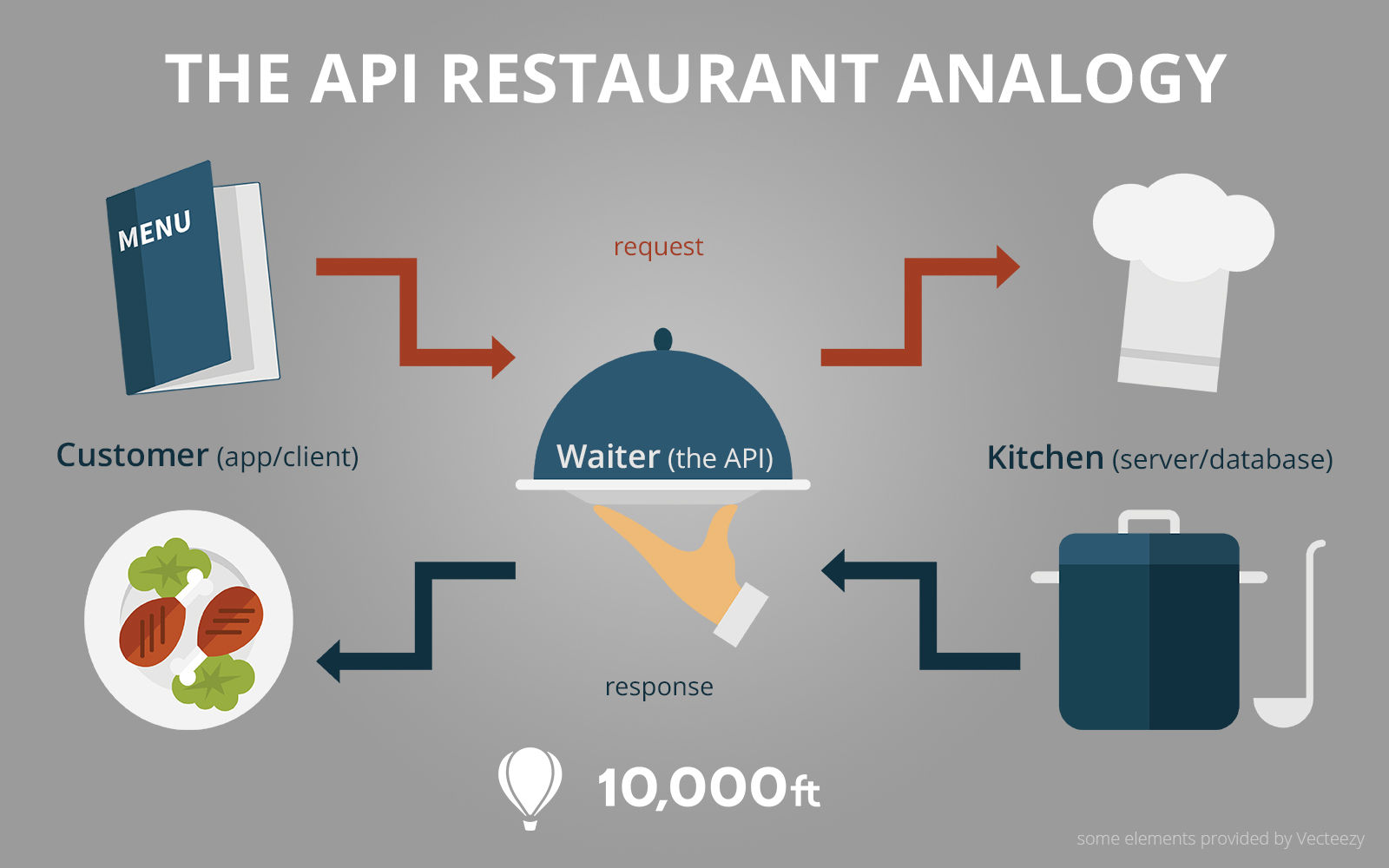
- Analogy
- Restaurant
- Kitchen is the server
- Customers are clients
- Waiter is the API
- Restaurant
- Application Program Interface
- Contract provided by one piece of software to another
- Structured request and response
- Analogy
- REST
Images and files in the map
Information
- Description
- Year 11 Digital Solutions Mind Map on REST APIs, created by Julia de Beer on 27/04/2022.
- Created by
- Julia de Beer
- Views
- 7
- Rating