
Mind map
Arab-Israeli Conflict
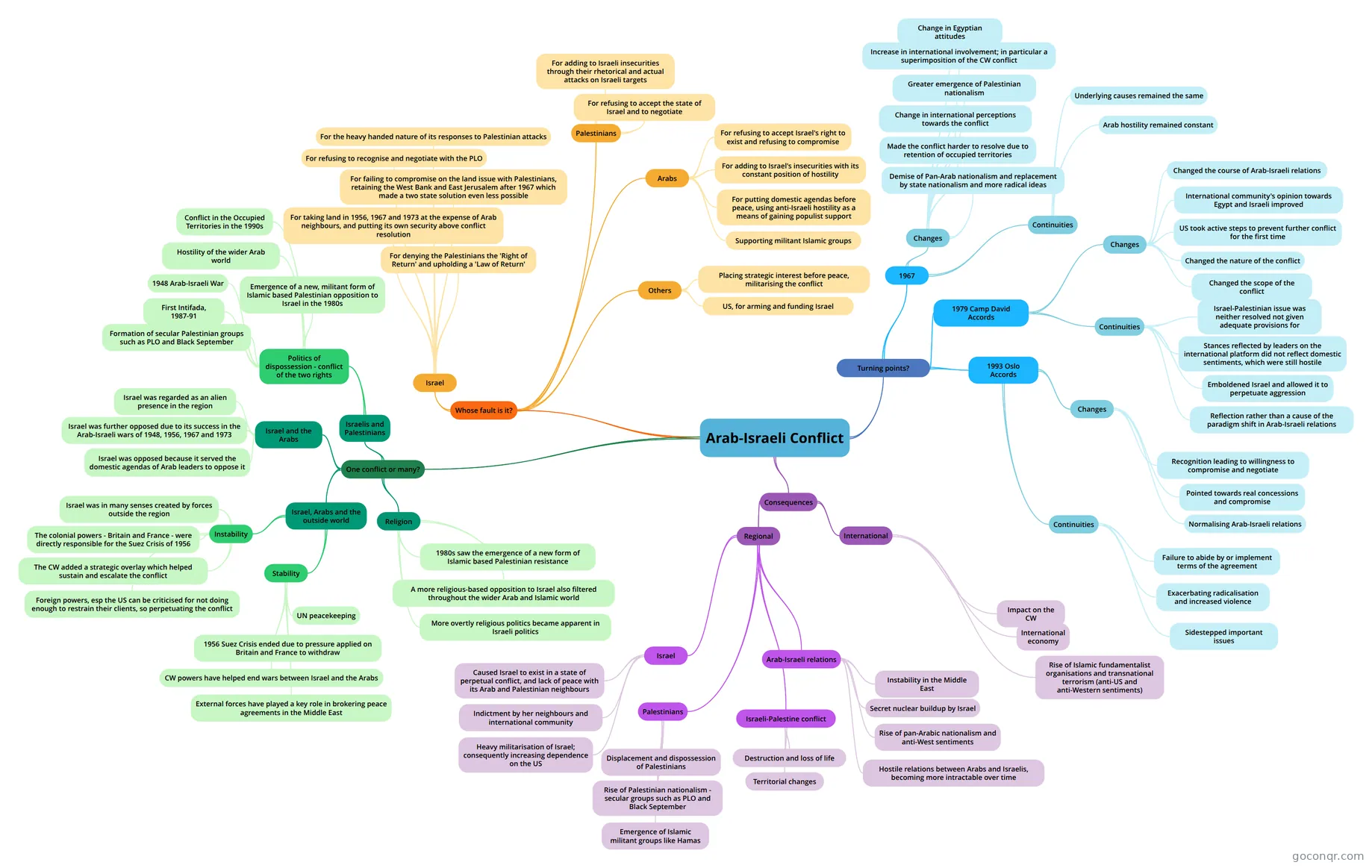
Mind map: Arab-Israeli conflict
Map content
Arab-Israeli Conflict
One conflict or many?
- Israelis and Palestinians
- Politics of dispossession - conflict of the two rights
- 1948 Arab-Israeli War
- Formation of secular Palestinian groups such as PLO and Black September
- First Intifada, 1987-91
- Conflict in the Occupied Territories in the 1990s
- Hostility of the wider Arab world
- Emergence of a new, militant form of Islamic based Palestinian opposition to Israel in the 1980s
- Politics of dispossession - conflict of the two rights
- Israel and the Arabs
- Israel was regarded as an alien presence in the region
- Israel was further opposed due to its success in the Arab-Israeli wars of 1948, 1956, 1967 and 1973
- Israel was opposed because it served the domestic agendas of Arab leaders to oppose it
- Israel, Arabs and the outside world
- Instability
- Israel was in many senses created by forces outside the region
- The colonial powers - Britain and France - were directly responsible for the Suez Crisis of 1956
- The CW added a strategic overlay which helped sustain and escalate the conflict
- Foreign powers, esp the US can be criticised for not doing enough to restrain their clients, so perpetuating the conflict
- Stability
- 1956 Suez Crisis ended due to pressure applied on Britain and France to withdraw
- UN peacekeeping
- CW powers have helped end wars between Israel and the Arabs
- External forces have played a key role in brokering peace agreements in the Middle East
- Instability
- Religion
- 1980s saw the emergence of a new form of Islamic based Palestinian resistance
- A more religious-based opposition to Israel also filtered throughout the wider Arab and Islamic world
- More overtly religious politics became apparent in Israeli politics
- Israelis and Palestinians
Whose fault is it?
- Israel
- For denying the Palestinians the 'Right of Return' and upholding a 'Law of Return'
- For taking land in 1956, 1967 and 1973 at the expense of Arab neighbours, and putting its own security above conflict resolution
- For failing to compromise on the land issue with Palestinians, retaining the West Bank and East Jerusalem after 1967 which made a two state solution even less possible
- For refusing to recognise and negotiate with the PLO
- For the heavy handed nature of its responses to Palestinian attacks
- Palestinians
- For refusing to accept the state of Israel and to negotiate
- For adding to Israeli insecurities through their rhetorical and actual attacks on Israeli targets
- Arabs
- For refusing to accept Israel's right to exist and refusing to compromise
- For adding to Israel's insecurities with its constant position of hostility
- For putting domestic agendas before peace, using anti-Israeli hostility as a means of gaining populist support
- Supporting militant Islamic groups
- Others
- Placing strategic interest before peace, militarising the conflict
- US, for arming and funding Israel
- Israel
Turning points?
- 1967
- Changes
- Demise of Pan-Arab nationalism and replacement by state nationalism and more radical ideas
- Made the conflict harder to resolve due to retention of occupied territories
- Change in international perceptions towards the conflict
- Greater emergence of Palestinian nationalism
- Increase in international involvement; in particular a superimposition of the CW conflict
- Change in Egyptian attitudes
- Continuities
- Underlying causes remained the same
- Arab hostility remained constant
- Changes
- 1979 Camp David Accords
- Changes
- Changed the course of Arab-Israeli relations
- International community's opinion towards Egypt and Israeli improved
- US took active steps to prevent further conflict for the first time
- Changed the nature of the conflict
- Changed the scope of the conflict
- Continuities
- Israel-Palestinian issue was neither resolved not given adequate provisions for
- Stances reflected by leaders on the international platform did not reflect domestic sentiments, which were still hostile
- Emboldened Israel and allowed it to perpetuate aggression
- Reflection rather than a cause of the paradigm shift in Arab-Israeli relations
- Changes
- 1993 Oslo Accords
- Changes
- Recognition leading to willingness to compromise and negotiate
- Pointed towards real concessions and compromise
- Normalising Arab-Israeli relations
- Continuities
- Failure to abide by or implement terms of the agreement
- Exacerbating radicalisation and increased violence
- Sidestepped important issues
- Changes
- 1967
Consequences
- Regional
- Israel
- Caused Israel to exist in a state of perpetual conflict, and lack of peace with its Arab and Palestinian neighbours
- Indictment by her neighbours and international community
- Heavy militarisation of Israel; consequently increasing dependence on the US
- Palestinians
- Displacement and dispossession of Palestinians
- Rise of Palestinian nationalism - secular groups such as PLO and Black September
- Emergence of Islamic militant groups like Hamas
- Israeli-Palestine conflict
- Destruction and loss of life
- Territorial changes
- Arab-Israeli relations
- Instability in the Middle East
- Secret nuclear buildup by Israel
- Rise of pan-Arabic nationalism and anti-West sentiments
- Hostile relations between Arabs and Israelis, becoming more intractable over time
- Israel
- International
- International economy
- Impact on the CW
- Rise of Islamic fundamentalist organisations and transnational terrorism (anti-US and anti-Western sentiments)
- Regional
Information
- Description
- Mind Map on Arab-Israeli Conflict, created by Tan Wei Xin on 10/04/2015.
- Created by
- Tan Wei Xin
- Views
- 31
- Rating
More on Arab-Israeli and Israeli-Palestinian Conflict