
Mind map
bowlby's monotropic theory
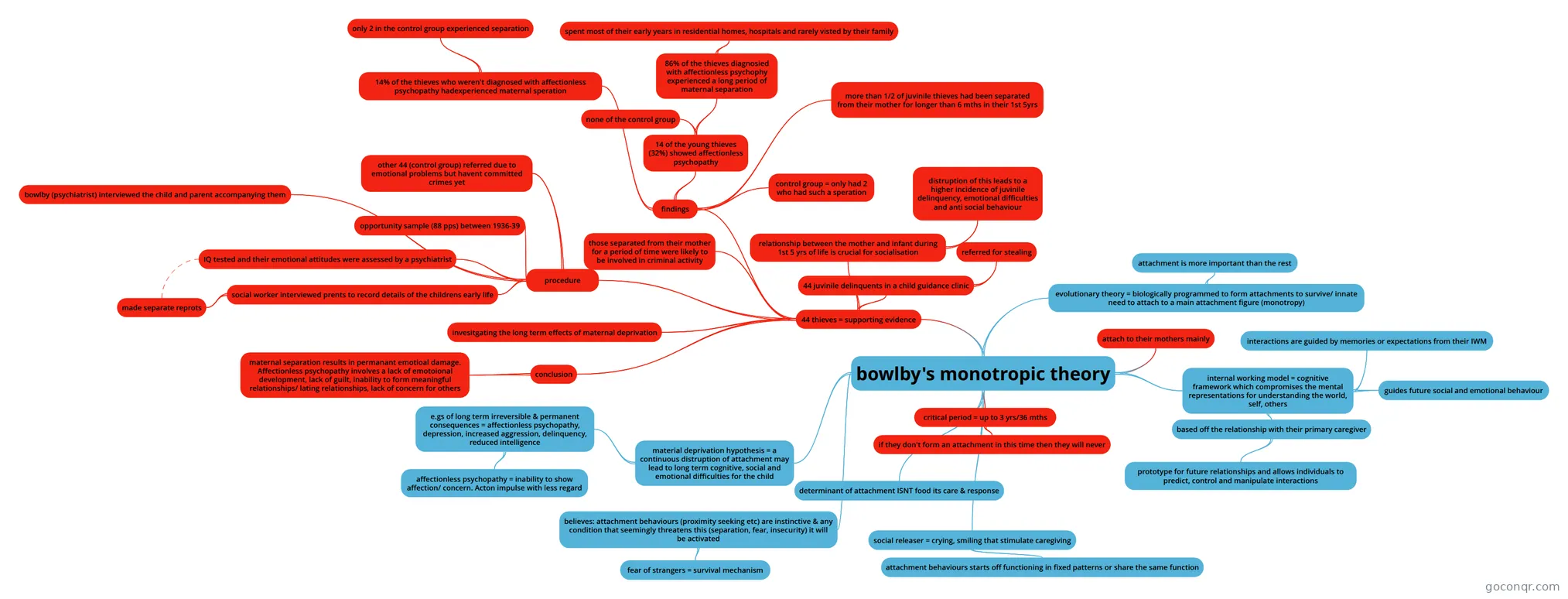
Mind map: Bowlby's monotropic theory
Map content
bowlby's monotropic theory
critical period = up to 3 yrs/36 mths
- if they don't form an attachment in this time then they will never
attach to their mothers mainly
44 thieves = supporting evidence
- 44 juvinile delinquents in a child guidance clinic
- referred for stealing
- those separated from their mother for a period of time were likely to be involved in criminal activity
- relationship between the mother and infant during 1st 5 yrs of life is crucial for socialisation
- distruption of this leads to a higher incidence of juvinile delinquency, emotional difficulties and anti social behaviour
- invesitgating the long term effects of maternal deprivation
- procedure
- other 44 (control group) referred due to emotional problems but havent committed crimes yet
- opportunity sample (88 pps) between 1936-39
- IQ tested and their emotional attitudes were assessed by a psychiatrist
- social worker interviewed prents to record details of the childrens early life
- made separate reprots
- bowlby (psychiatrist) interviewed the child and parent accompanying them
- findings
- more than 1/2 of juvinile thieves had been separated from their mother for longer than 6 mths in their 1st 5yrs
- control group = only had 2 who had such a speration
- 14 of the young thieves (32%) showed affectionless psychopathy
- none of the control group
- 86% of the thieves diagnosied with affectionless psychophy experienced a long period of maternal separation
- spent most of their early years in residential homes, hospitals and rarely visted by their family
- 14% of the thieves who weren't diagnosed with affectionless psychopathy hadexperienced maternal speration
- only 2 in the control group experienced separation
- conclusion
- maternal separation results in permanant emotioal damage. Affectionless psychopathy involves a lack of emotoional development, lack of guilt, inability to form meaningful relationships/ lating relationships, lack of concern for others
- 44 juvinile delinquents in a child guidance clinic
evolutionary theory = biologically programmed to form attachments to survive/ innate need to attach to a main attachment figure (monotropy)
- attachment is more important than the rest
material deprivation hypothesis = a continuous distruption of attachment may lead to long term cognitive, social and emotional difficulties for the child
- e.gs of long term irreversible & permanent consequences = affectionless psychopathy, depression, increased aggression, delinquency, reduced intelligence
- affectionless psychopathy = inability to show affection/ concern. Acton impulse with less regard
- e.gs of long term irreversible & permanent consequences = affectionless psychopathy, depression, increased aggression, delinquency, reduced intelligence
internal working model = cognitive framework which compromises the mental representations for understanding the world, self, others
- based off the relationship with their primary caregiver
- prototype for future relationships and allows individuals to predict, control and manipulate interactions
- interactions are guided by memories or expectations from their IWM
- guides future social and emotional behaviour
- based off the relationship with their primary caregiver
believes: attachment behaviours (proximity seeking etc) are instinctive & any condition that seemingly threatens this (separation, fear, insecurity) it will be activated
- fear of strangers = survival mechanism
social releaser = crying, smiling that stimulate caregiving
- attachment behaviours starts off functioning in fixed patterns or share the same function
determinant of attachment ISNT food its care & response
Information
- Description
- Mind Map on bowlby's monotropic theory, created by Millie Walker on 29/05/2022.
- Created by
- Millie Walker
- Views
- 0
- Rating
More on Bowlby's monotropic theory