
Mind map
Analogy and Aquinas
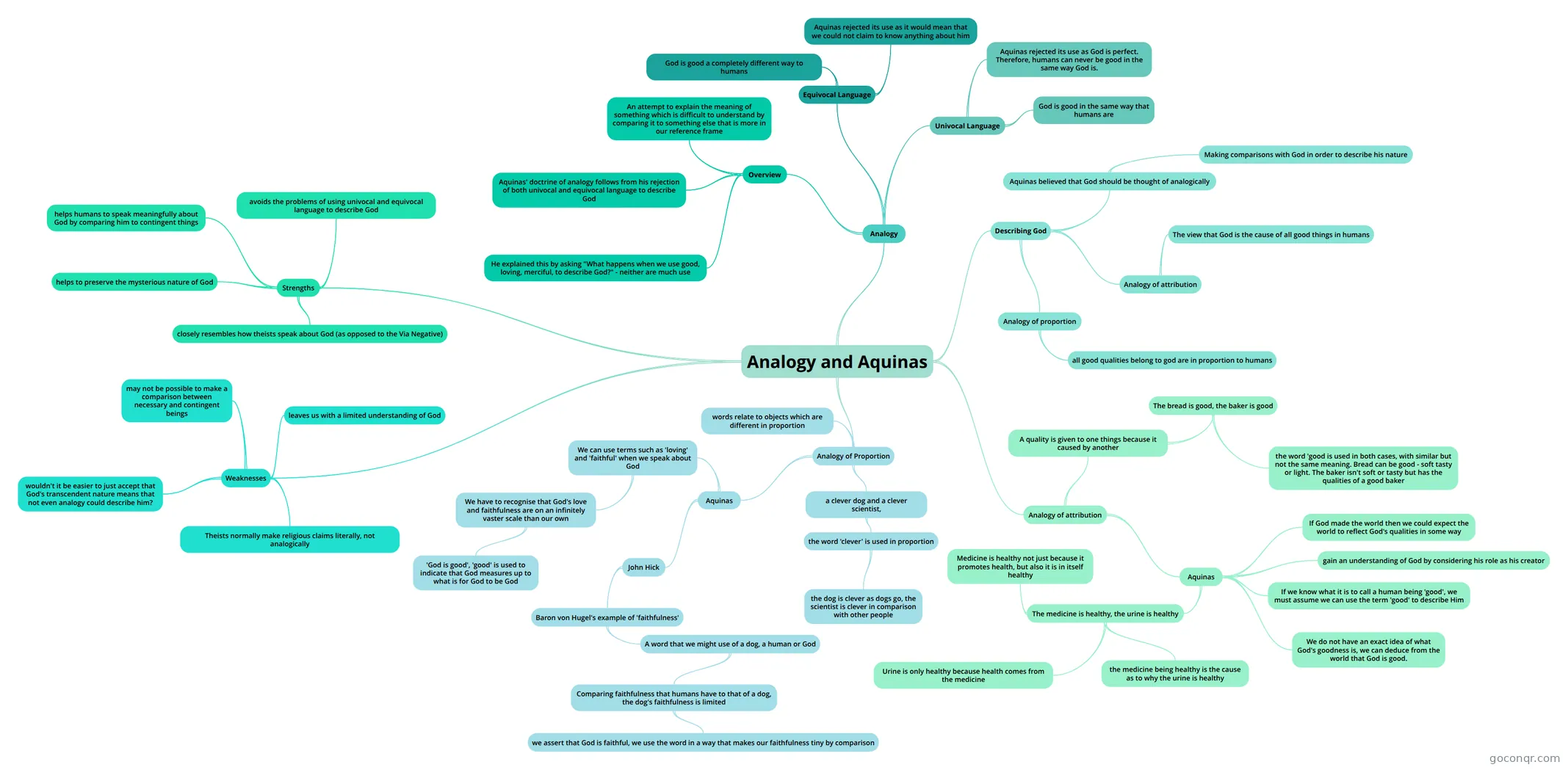
Mind map: Analogy and Aquinas
Map content
Analogy and Aquinas
Analogy
- Univocal Language
- God is good in the same way that humans are
- Aquinas rejected its use as God is perfect. Therefore, humans can never be good in the same way God is.
- Equivocal Language
- God is good a completely different way to humans
- Aquinas rejected its use as it would mean that we could not claim to know anything about him
- Overview
- An attempt to explain the meaning of something which is difficult to understand by comparing it to something else that is more in our reference frame
- Aquinas' doctrine of analogy follows from his rejection of both univocal and equivocal language to describe God
- He explained this by asking "What happens when we use good, loving, merciful, to describe God?" - neither are much use
- Univocal Language
Describing God
- Aquinas believed that God should be thought of analogically
- Making comparisons with God in order to describe his nature
- Analogy of attribution
- The view that God is the cause of all good things in humans
- Analogy of proportion
- all good qualities belong to god are in proportion to humans
- Aquinas believed that God should be thought of analogically
Analogy of attribution
- A quality is given to one things because it caused by another
- The bread is good, the baker is good
- the word 'good is used in both cases, with similar but not the same meaning. Bread can be good - soft tasty or light. The baker isn't soft or tasty but has the qualities of a good baker
- The bread is good, the baker is good
- Aquinas
- gain an understanding of God by considering his role as his creator
- If God made the world then we could expect the world to reflect God's qualities in some way
- If we know what it is to call a human being 'good', we must assume we can use the term 'good' to describe Him
- We do not have an exact idea of what God's goodness is, we can deduce from the world that God is good.
- The medicine is healthy, the urine is healthy
- the medicine being healthy is the cause as to why the urine is healthy
- Urine is only healthy because health comes from the medicine
- Medicine is healthy not just because it promotes health, but also it is in itself healthy
- A quality is given to one things because it caused by another
Analogy of Proportion
- words relate to objects which are different in proportion
- a clever dog and a clever scientist,
- the word 'clever' is used in proportion
- the dog is clever as dogs go, the scientist is clever in comparison with other people
- the word 'clever' is used in proportion
- Aquinas
- We can use terms such as 'loving' and 'faithful' when we speak about God
- We have to recognise that God's love and faithfulness are on an infinitely vaster scale than our own
- 'God is good', 'good' is used to indicate that God measures up to what is for God to be God
- We have to recognise that God's love and faithfulness are on an infinitely vaster scale than our own
- John Hick
- Baron von Hugel's example of 'faithfulness'
- A word that we might use of a dog, a human or God
- Comparing faithfulness that humans have to that of a dog, the dog's faithfulness is limited
- we assert that God is faithful, we use the word in a way that makes our faithfulness tiny by comparison
- Comparing faithfulness that humans have to that of a dog, the dog's faithfulness is limited
- A word that we might use of a dog, a human or God
- Baron von Hugel's example of 'faithfulness'
- We can use terms such as 'loving' and 'faithful' when we speak about God
Strengths
- avoids the problems of using univocal and equivocal language to describe God
- helps humans to speak meaningfully about God by comparing him to contingent things
- helps to preserve the mysterious nature of God
- closely resembles how theists speak about God (as opposed to the Via Negative)
Weaknesses
- leaves us with a limited understanding of God
- may not be possible to make a comparison between necessary and contingent beings
- wouldn't it be easier to just accept that God's transcendent nature means that not even analogy could describe him?
- Theists normally make religious claims literally, not analogically
Information
- Description
- A level Philosophy (Religious Language) Mind Map on Analogy and Aquinas, created by Scarlett Swift on 20/06/2022.
- Created by
- Scarlett Swift
- Views
- 0
- Rating