
Mind map
Introduction into Insurance
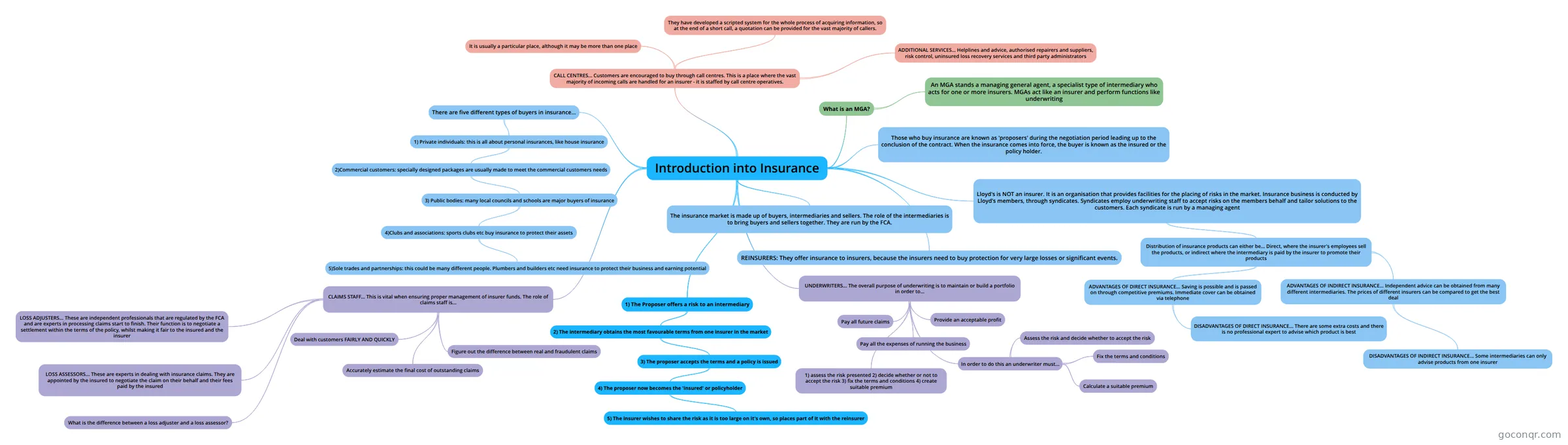
Mind map: Insurance Market Structure and Roles
Map content
Introduction into Insurance
The insurance market is made up of buyers, intermediaries and sellers. The role of the intermediaries is to bring buyers and sellers together. They are run by the FCA.
Those who buy insurance are known as 'proposers' during the negotiation period leading up to the conclusion of the contract. When the insurance comes into force, the buyer is known as the insured or the policy holder.
There are five different types of buyers in insurance...
- 1) Private individuals: this is all about personal insurances, like house insurance
- 2)Commercial customers: specially designed packages are usually made to meet the commercial customers needs
- 3) Public bodies: many local councils and schools are major buyers of insurance
- 4)Clubs and associations: sports clubs etc buy insurance to protect their assets
- 5)Sole trades and partnerships: this could be many different people. Plumbers and builders etc need insurance to protect their business and earning potential
- 4)Clubs and associations: sports clubs etc buy insurance to protect their assets
- 3) Public bodies: many local councils and schools are major buyers of insurance
- 2)Commercial customers: specially designed packages are usually made to meet the commercial customers needs
- 1) Private individuals: this is all about personal insurances, like house insurance
Lloyd's is NOT an insurer. It is an organisation that provides facilities for the placing of risks in the market. Insurance business is conducted by Lloyd's members, through syndicates. Syndicates employ underwriting staff to accept risks on the members behalf and tailor solutions to the customers. Each syndicate is run by a managing agent
- Distribution of insurance products can either be... Direct, where the insurer's employees sell the products, or indirect where the intermediary is paid by the insurer to promote their products
- ADVANTAGES OF DIRECT INSURANCE... Saving is possible and is passed on through competitive premiums. Immediate cover can be obtained via telephone
- DISADVANTAGES OF DIRECT INSURANCE... There are some extra costs and there is no professional expert to advise which product is best
- ADVANTAGES OF INDIRECT INSURANCE... Independent advice can be obtained from many different intermediaries. The prices of different insurers can be compared to get the best deal
- DISADVANTAGES OF INDIRECT INSURANCE... Some intermediaries can only advise products from one insurer
- ADVANTAGES OF DIRECT INSURANCE... Saving is possible and is passed on through competitive premiums. Immediate cover can be obtained via telephone
- Distribution of insurance products can either be... Direct, where the insurer's employees sell the products, or indirect where the intermediary is paid by the insurer to promote their products
REINSURERS: They offer insurance to insurers, because the insurers need to buy protection for very large losses or significant events.
1) The Proposer offers a risk to an intermediary
- 2) The intermediary obtains the most favourable terms from one insurer in the market
- 3) The proposer accepts the terms and a policy is issued
- 4) The proposer now becomes the 'insured' or policyholder
- 5) The insurer wishes to share the risk as it is too large on it's own, so places part of it with the reinsurer
- 4) The proposer now becomes the 'insured' or policyholder
- 3) The proposer accepts the terms and a policy is issued
- 2) The intermediary obtains the most favourable terms from one insurer in the market
What is an MGA?
- An MGA stands a managing general agent, a specialist type of intermediary who acts for one or more insurers. MGAs act like an insurer and perform functions like underwriting
UNDERWRITERS... The overall purpose of underwriting is to maintain or build a portfolio in order to...
- Pay all future claims
- Pay all the expenses of running the business
- Provide an acceptable profit
- In order to do this an underwriter must...
- Assess the risk and decide whether to accept the risk
- Fix the terms and conditions
- Calculate a suitable premium
- 1) assess the risk presented 2) decide whether or not to accept the risk 3) fix the terms and conditions 4) create suitable premium
CLAIMS STAFF... This is vital when ensuring proper management of insurer funds. The role of claims staff is...
- Deal with customers FAIRLY AND QUICKLY
- Figure out the difference between real and fraudulent claims
- Accurately estimate the final cost of outstanding claims
- LOSS ADJUSTERS... These are independent professionals that are regulated by the FCA and are experts in processing claims start to finish. Their function is to negotiate a settlement within the terms of the policy, whilst making it fair to the insured and the insurer
- LOSS ASSESSORS... These are experts in dealing with insurance claims. They are appointed by the insured to negotiate the claim on their behalf and their fees paid by the insured
- What is the difference between a loss adjuster and a loss assessor?
CALL CENTRES... Customers are encouraged to buy through call centres. This is a place where the vast majority of incoming calls are handled for an insurer - it is staffed by call centre operatives.
- They have developed a scripted system for the whole process of acquiring information, so at the end of a short call, a quotation can be provided for the vast majority of callers.
- It is usually a particular place, although it may be more than one place
- ADDITIONAL SERVICES... Helplines and advice, authorised repairers and suppliers, risk control, uninsured loss recovery services and third party administrators