
Mind map
Old and new species
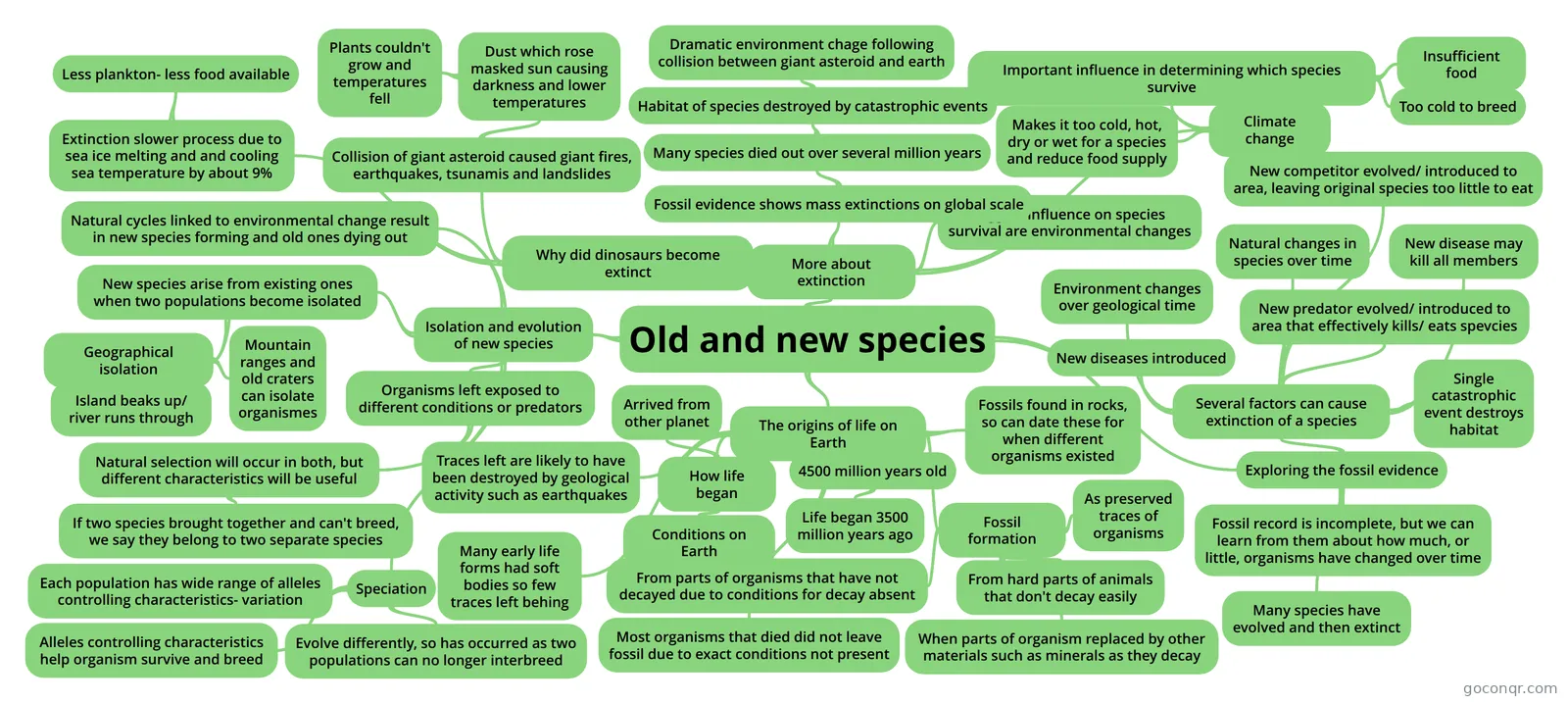
Mind map: Old and new species
Map content
Old and new species
The origins of life on Earth
- 4500 million years old
- Life began 3500 million years ago
- How life began
- Conditions on Earth
- Arrived from other planet
- Fossils found in rocks, so can date these for when different organisms existed
- Fossil formation
- From hard parts of animals that don't decay easily
- From parts of organisms that have not decayed due to conditions for decay absent
- When parts of organism replaced by other materials such as minerals as they decay
- As preserved traces of organisms
- Most organisms that died did not leave fossil due to exact conditions not present
- Many early life forms had soft bodies so few traces left behing
- Traces left are likely to have been destroyed by geological activity such as earthquakes
- 4500 million years old
Exploring the fossil evidence
- Fossil record is incomplete, but we can learn from them about how much, or little, organisms have changed over time
- Many species have evolved and then extinct
- Several factors can cause extinction of a species
- New disease may kill all members
- Environment changes over geological time
- New diseases introduced
- New predator evolved/ introduced to area that effectively kills/ eats spevcies
- Natural changes in species over time
- New competitor evolved/ introduced to area, leaving original species too little to eat
- Single catastrophic event destroys habitat
More about extinction
- Biggest influence on species survival are environmental changes
- Climate change
- Important influence in determining which species survive
- Insufficient food
- Too cold to breed
- Makes it too cold, hot, dry or wet for a species and reduce food supply
- Important influence in determining which species survive
- Fossil evidence shows mass extinctions on global scale
- Many species died out over several million years
- Habitat of species destroyed by catastrophic events
- Dramatic environment chage following collision between giant asteroid and earth
- Habitat of species destroyed by catastrophic events
- Many species died out over several million years
- Why did dinosaurs become extinct
- Collision of giant asteroid caused giant fires, earthquakes, tsunamis and landslides
- Dust which rose masked sun causing darkness and lower temperatures
- Plants couldn't grow and temperatures fell
- Dust which rose masked sun causing darkness and lower temperatures
- Extinction slower process due to sea ice melting and and cooling sea temperature by about 9%
- Less plankton- less food available
- Collision of giant asteroid caused giant fires, earthquakes, tsunamis and landslides
Isolation and evolution of new species
- Natural cycles linked to environmental change result in new species forming and old ones dying out
- New species arise from existing ones when two populations become isolated
- Geographical isolation
- Mountain ranges and old craters can isolate organismes
- Island beaks up/ river runs through
- Geographical isolation
- Organisms left exposed to different conditions or predators
- Natural selection will occur in both, but different characteristics will be useful
- If two species brought together and can't breed, we say they belong to two separate species
- Natural selection will occur in both, but different characteristics will be useful
- Speciation
- Each population has wide range of alleles controlling characteristics- variation
- Alleles controlling characteristics help organism survive and breed
- Evolve differently, so has occurred as two populations can no longer interbreed
Information
- Description
- Mind Map on Old and new species, created by Patrick Mackie on 16/10/2015.
- Created by
- Patrick Mackie
- Views
- 0
- Rating
More on History of Life and Extinction