
Mind map
HOMEOSTASIS and CONTROLLING BODY TEMP
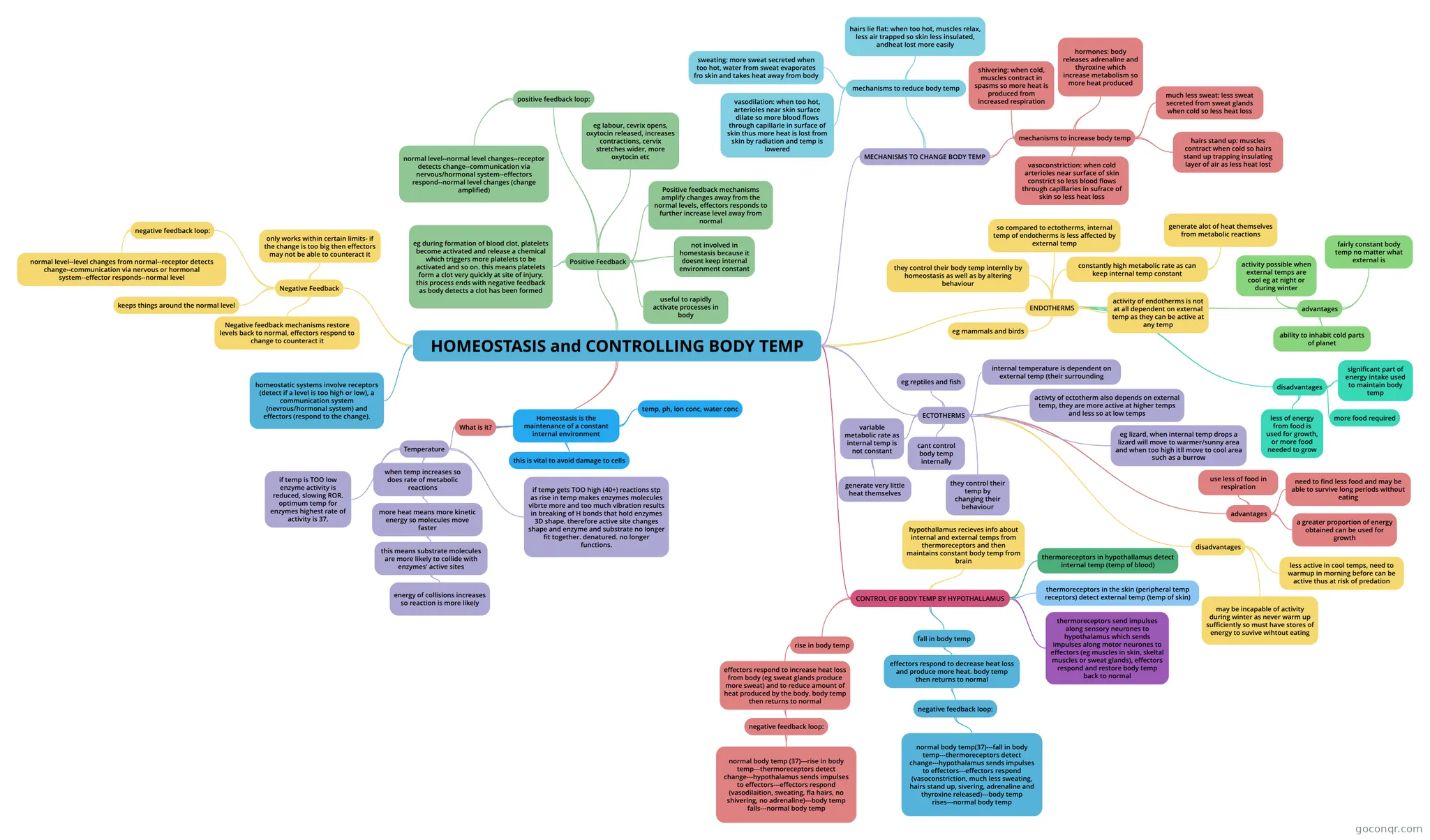
Mind map: Homeostasis and body temperature control
Map content
HOMEOSTASIS and CONTROLLING BODY TEMP
What is it?
- Temperature
- when temp increases so does rate of metabolic reactions
- more heat means more kinetic energy so molecules move faster
- this means substrate molecules are more likely to collide with enzymes' active sites
- energy of collisions increases so reaction is more likely
- this means substrate molecules are more likely to collide with enzymes' active sites
- more heat means more kinetic energy so molecules move faster
- if temp gets TOO high (40+) reactions stp as rise in temp makes enzymes molecules vibrte more and too much vibration results in breaking of H bonds that hold enzymes 3D shape. therefore active site changes shape and enzyme and substrate no longer fit together. denatured. no longer functions.
- if temp is TOO low enzyme activity is reduced, slowing ROR. optimum temp for enzymes highest rate of activity is 37.
- when temp increases so does rate of metabolic reactions
- Homeostasis is the maintenance of a constant internal environment
- this is vital to avoid damage to cells
- temp, ph, ion conc, water conc
- Temperature
Negative Feedback
- Negative feedback mechanisms restore levels back to normal, effectors respond to change to counteract it
- negative feedback loop:
- normal level--level changes from normal--receptor detects change--communication via nervous or hormonal system--effector responds--normal level
- keeps things around the normal level
- only works within certain limits- if the change is too big then effectors may not be able to counteract it
Positive Feedback
- Positive feedback mechanisms amplify changes away from the normal levels, effectors responds to further increase level away from normal
- positive feedback loop:
- normal level--normal level changes--receptor detects change--communication via nervous/hormonal system--effectors respond--normal level changes (change amplified)
- not involved in homestasis because it doesnt keep internal environment constant
- useful to rapidly activate processes in body
- eg during formation of blood clot, platelets become activated and release a chemical which triggers more platelets to be activated and so on. this means platelets form a clot very quickly at site of injury. this process ends with negative feedback as body detects a clot has been formed
- eg labour, cevrix opens, oxytocin released, increases contractions, cervix stretches wider, more oxytocin etc
ECTOTHERMS
- eg reptiles and fish
- cant control body temp internally
- they control their temp by changing their behaviour
- internal temperature is dependent on external temp (their surrounding
- activty of ectotherm also depends on external temp, they are more active at higher temps and less so at low temps
- eg lizard, when internal temp drops a lizard will move to warmer/sunny area and when too high itll move to cool area such as a burrow
- variable metabolic rate as internal temp is not constant
- generate very little heat themselves
- advantages
- use less of food in respiration
- need to find less food and may be able to survive long periods without eating
- a greater proportion of energy obtained can be used for growth
- disadvantages
- less active in cool temps, need to warmup in morning before can be active thus at risk of predation
- may be incapable of activity during winter as never warm up sufficiently so must have stores of energy to suvive wihtout eating
ENDOTHERMS
- eg mammals and birds
- they control their body temp internlly by homeostasis as well as by altering behaviour
- so compared to ectotherms, internal temp of endotherms is less affected by external temp
- constantly high metabolic rate as can keep internal temp constant
- generate alot of heat themselves from metabolic reactions
- activity of endotherms is not at all dependent on external temp as they can be active at any temp
- advantages
- fairly constant body temp no matter what external is
- activity possible when external temps are cool eg at night or during winter
- ability to inhabit cold parts of planet
- disadvantages
- significant part of energy intake used to maintain body temp
- more food required
- less of energy from food is used for growth, or more food needed to grow
MECHANISMS TO CHANGE BODY TEMP
- mechanisms to reduce body temp
- sweating: more sweat secreted when too hot, water from sweat evaporates fro skin and takes heat away from body
- hairs lie flat: when too hot, muscles relax, less air trapped so skin less insulated, andheat lost more easily
- vasodilation: when too hot, arterioles near skin surface dilate so more blood flows through capillarie in surface of skin thus more heat is lost from skin by radiation and temp is lowered
- mechanisms to increase body temp
- shivering: when cold, muscles contract in spasms so more heat is produced from increased respiration
- hormones: body releases adrenaline and thyroxine which increase metabolism so more heat produced
- much less sweat: less sweat secreted from sweat glands when cold so less heat loss
- hairs stand up: muscles contract when cold so hairs stand up trapping insulating layer of air as less heat lost
- vasoconstriction: when cold arterioles near surface of skin constrict so less blood flows through capillaries in sufrace of skin so less heat loss
- mechanisms to reduce body temp
CONTROL OF BODY TEMP BY HYPOTHALLAMUS
- hypothallamus recieves info about internal and external temps from thermoreceptors and then maintains constant body temp from brain
- thermoreceptors in hypothallamus detect internal temp (temp of blood)
- thermoreceptors in the skin (peripheral temp receptors) detect external temp (temp of skin)
- thermoreceptors send impulses along sensory neurones to hypothalamus which sends impulses along motor neurones to effectors (eg muscles in skin, skeltal muscles or sweat glands), effectors respond and restore body temp back to normal
- rise in body temp
- effectors respond to increase heat loss from body (eg sweat glands produce more sweat) and to reduce amount of heat produced by the body. body temp then returns to normal
- negative feedback loop:
- normal body temp (37)---rise in body temp---thermoreceptors detect change---hypothalamus sends impulses to effectors---effectors respond (vasodilaition, sweating, fla hairs, no shivering, no adrenaline)---body temp falls---normal body temp
- negative feedback loop:
- effectors respond to increase heat loss from body (eg sweat glands produce more sweat) and to reduce amount of heat produced by the body. body temp then returns to normal
- fall in body temp
- effectors respond to decrease heat loss and produce more heat. body temp then returns to normal
- negative feedback loop:
- normal body temp(37)---fall in body temp---thermoreceptors detect change---hypothalamus sends impulses to effectors---effectors respond (vasoconstriction, much less sweating, hairs stand up, sivering, adrenaline and thyroxine released)---body temp rises---normal body temp
- negative feedback loop:
- effectors respond to decrease heat loss and produce more heat. body temp then returns to normal
homeostatic systems involve receptors (detect if a level is too high or low), a communication system (nevrous/hormonal system) and effectors (respond to the change).
Information
- Description
- Mind Map on HOMEOSTASIS and CONTROLLING BODY TEMP, created by shannon.kelly4 on 18/10/2015.
- Created by
- shannon.kelly4
- Views
- 6
- Rating