
Mind map
BRANCHES OF QUALITY
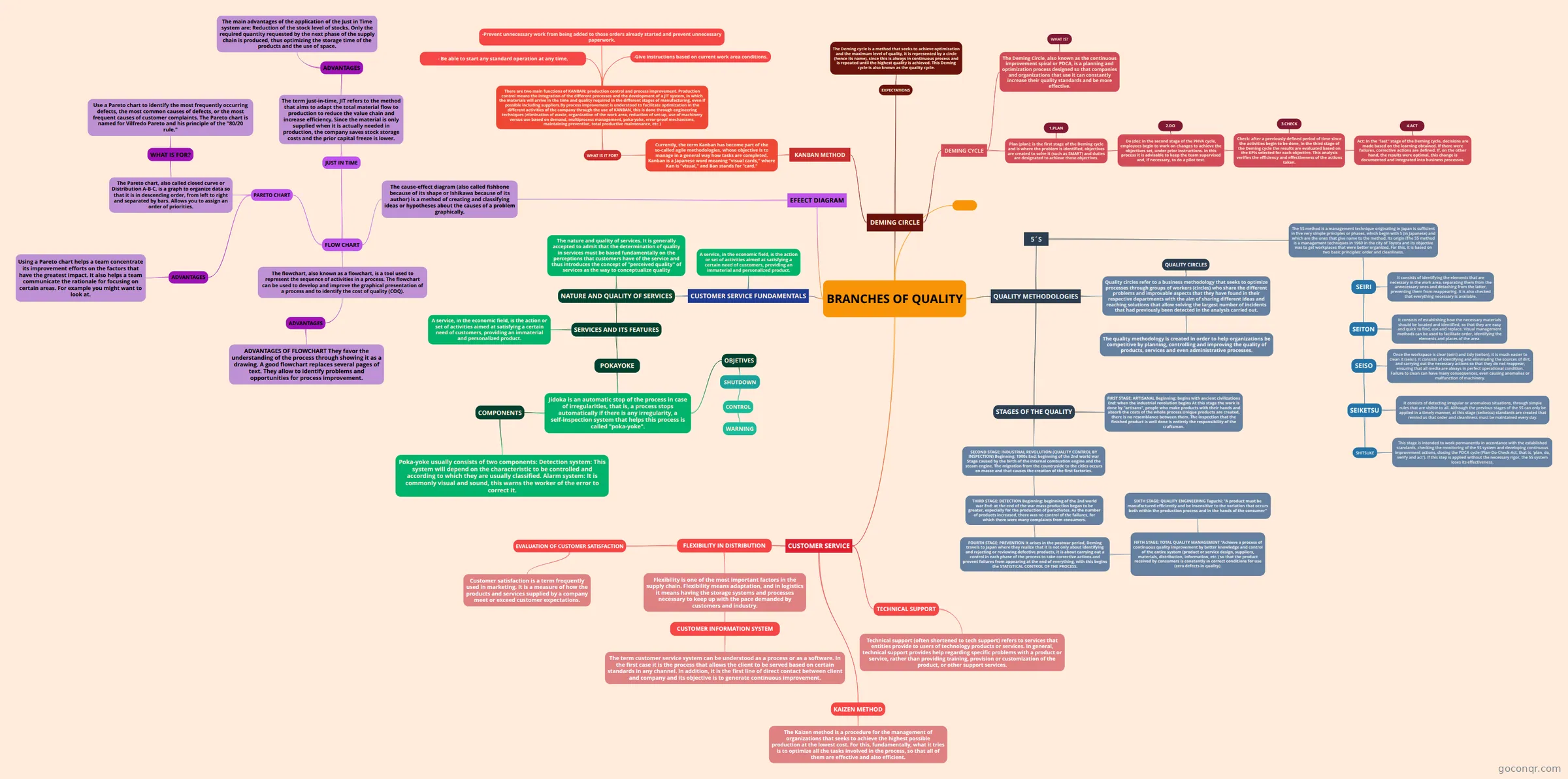
Mind map: Branches of quality
Map content
BRANCHES OF QUALITY
DEMING CIRCLE
- DEMING CYCLE
- Plan (plan): is the first stage of the Deming cycle and is where the problem is identified, objectives are created to solve it (such as SMART) and duties are designated to achieve those objectives.
- 1.PLAN
- Do (do): in the second stage of the PHVA cycle, employees begin to work on changes to achieve the objectives set, under prior instructions. In this process it is advisable to keep the team supervised and, if necessary, to do a pilot test.
- 2.DO
- Check: after a previously defined period of time since the activities begin to be done, in the third stage of the Deming cycle the results are evaluated based on the KPIs selected for each objective. This analysis verifies the efficiency and effectiveness of the actions taken.
- 3.CHECK
- Act: In the "last" stage of the Deming cycle, decisions are made based on the learning obtained. If there were failures, corrective actions are defined. If, on the other hand, the results were optimal, this change is documented and integrated into business processes.
- 4.ACT
- The Deming Circle, also known as the continuous improvement spiral or PDCA, is a planning and optimization process designed so that companies and organizations that use it can constantly increase their quality standards and be more effective.
- WHAT IS?
- Plan (plan): is the first stage of the Deming cycle and is where the problem is identified, objectives are created to solve it (such as SMART) and duties are designated to achieve those objectives.
- KANBAN METHOD
- Currently, the term Kanban has become part of the so-called agile methodologies, whose objective is to manage in a general way how tasks are completed. Kanban is a Japanese word meaning "visual cards," where Kan is "visual," and Ban stands for "card."
- WHAT IS IT FOR?
- There are two main functions of KANBAN: production control and process improvement. Production control means the integration of the different processes and the development of a JIT system, in which the materials will arrive in the time and quality required in the different stages of manufacturing, even if possible including suppliers.By process improvement is understood to facilitate optimization in the different activities of the company through the use of KANBAN, this is done through engineering techniques (elimination of waste, organization of the work area, reduction of set-up, use of machinery versus use based on demand, multiprocess management, poka-yoke, error-proof mechanisms, maintaining preventive, total productive maintenance, etc.)
- - Be able to start any standard operation at any time.
- -Prevent unnecessary work from being added to those orders already started and prevent unnecessary paperwork.
- -Give instructions based on current work area conditions.
- There are two main functions of KANBAN: production control and process improvement. Production control means the integration of the different processes and the development of a JIT system, in which the materials will arrive in the time and quality required in the different stages of manufacturing, even if possible including suppliers.By process improvement is understood to facilitate optimization in the different activities of the company through the use of KANBAN, this is done through engineering techniques (elimination of waste, organization of the work area, reduction of set-up, use of machinery versus use based on demand, multiprocess management, poka-yoke, error-proof mechanisms, maintaining preventive, total productive maintenance, etc.)
- WHAT IS IT FOR?
- Currently, the term Kanban has become part of the so-called agile methodologies, whose objective is to manage in a general way how tasks are completed. Kanban is a Japanese word meaning "visual cards," where Kan is "visual," and Ban stands for "card."
- EXPECTATIONS
- The Deming cycle is a method that seeks to achieve optimization and the maximum level of quality, it is represented by a circle (hence its name), since this is always in continuous process and is repeated until the highest quality is achieved. This Deming cycle is also known as the quality cycle.
- DEMING CYCLE
QUALITY METHODOLOGIES
- Quality circles refer to a business methodology that seeks to optimize processes through groups of workers (circles) who share the different problems and improvable aspects that they have found in their respective departments with the aim of sharing different ideas and reaching solutions that allow solving the largest number of incidents that had previously been detected in the analysis carried out.
- QUALITY CIRCLES
- The quality methodology is created in order to help organizations be competitive by planning, controlling and improving the quality of products, services and even administrative processes.
- STAGES OF THE QUALITY
- FIRST STAGE: ARTISANAL Beginning: begins with ancient civilizations End: when the industrial revolution begins At this stage the work is done by "artisans", people who make products with their hands and absorb the costs of the whole process.Unique products are created, there is no resemblance between them. The inspection that the finished product is well done is entirely the responsibility of the craftsman.
- SECOND STAGE: INDUSTRIAL REVOLUTION (QUALITY CONTROL BY INSPECTION) Beginning: 1900s End: beginning of the 2nd world war Stage caused by the birth of the internal combustion engine and the steam engine. The migration from the countryside to the cities occurs en masse and that causes the creation of the first factories.
- THIRD STAGE: DETECTION Beginning: beginning of the 2nd world war End: at the end of the war mass production began to be greater, especially for the production of parachutes. As the number of products increased, there was no control of the failures, for which there were many complaints from consumers.
- FOURTH STAGE: PREVENTION It arises in the postwar period, Deming travels to Japan where they realize that it is not only about identifying and rejecting or reviewing defective products, it is about carrying out a control in each phase of the process to take corrective actions and prevent failures from appearing at the end of everything, with this begins the STATISTICAL CONTROL OF THE PROCESS.
- FIFTH STAGE: TOTAL QUALITY MANAGEMENT "Achieve a process of continuous quality improvement by better knowledge and control of the entire system (product or service design, suppliers, materials, distribution, information, etc.) so that the product received by consumers is constantly in correct conditions for use (zero defects in quality).
- SIXTH STAGE: QUALITY ENGINEERING Taguchi: "A product must be manufactured efficiently and be insensitive to the variation that occurs both within the production process and in the hands of the consumer"
- FIFTH STAGE: TOTAL QUALITY MANAGEMENT "Achieve a process of continuous quality improvement by better knowledge and control of the entire system (product or service design, suppliers, materials, distribution, information, etc.) so that the product received by consumers is constantly in correct conditions for use (zero defects in quality).
- FOURTH STAGE: PREVENTION It arises in the postwar period, Deming travels to Japan where they realize that it is not only about identifying and rejecting or reviewing defective products, it is about carrying out a control in each phase of the process to take corrective actions and prevent failures from appearing at the end of everything, with this begins the STATISTICAL CONTROL OF THE PROCESS.
- THIRD STAGE: DETECTION Beginning: beginning of the 2nd world war End: at the end of the war mass production began to be greater, especially for the production of parachutes. As the number of products increased, there was no control of the failures, for which there were many complaints from consumers.
- 5´S
- The 5S method is a management technique originating in Japan is sufficient in five very simple principles or phases, which begin with S (in Japanese) and which are the ones that give name to the method. Its origin iThe 5S method is a management techniques in 1960 in the city of Toyota and its objective was to get workplaces that were better organized. For this, it is based on two basic principles: order and cleanliness.
- SEIRI
- It consists of identifying the elements that are necessary in the work area, separating them from the unnecessary ones and detaching from the latter, preventing them from reappearing. It is also checked that everything necessary is available.
- SEITON
- It consists of establishing how the necessary materials should be located and identified, so that they are easy and quick to find, use and replace. Visual management methods can be used to facilitate order, identifying the elements and places of the area.
- SEISO
- Once the workspace is clear (seiri) and tidy (seiton), it is much easier to clean it (seisō). It consists of identifying and eliminating the sources of dirt, and carrying out the necessary actions so that they do not reappear, ensuring that all media are always in perfect operational condition. Failure to clean can have many consequences, even causing anomalies or malfunction of machinery.
- SEIKETSU
- It consists of detecting irregular or anomalous situations, through simple rules that are visible to all. Although the previous stages of the 5S can only be applied in a timely manner, at this stage (seiketsu) standards are created that remind us that order and cleanliness must be maintained every day.
- SHITSUKE
- This stage is intended to work permanently in accordance with the established standards, checking the monitoring of the 5S system and developing continuous improvement actions, closing the PDCA cycle (Plan-Do-Check-Act, that is, 'plan, do, verify and act'). If this step is applied without the necessary rigor, the 5S system loses its effectiveness.
- SEIRI
- The 5S method is a management technique originating in Japan is sufficient in five very simple principles or phases, which begin with S (in Japanese) and which are the ones that give name to the method. Its origin iThe 5S method is a management techniques in 1960 in the city of Toyota and its objective was to get workplaces that were better organized. For this, it is based on two basic principles: order and cleanliness.
- Quality circles refer to a business methodology that seeks to optimize processes through groups of workers (circles) who share the different problems and improvable aspects that they have found in their respective departments with the aim of sharing different ideas and reaching solutions that allow solving the largest number of incidents that had previously been detected in the analysis carried out.
CUSTOMER SERVICE FUNDAMENTALS
- A service, in the economic field, is the action or set of activities aimed at satisfying a certain need of customers, providing an immaterial and personalized product.
- NATURE AND QUALITY OF SERVICES
- The nature and quality of services. It is generally accepted to admit that the determination of quality in services must be based fundamentally on the perceptions that customers have of the service and thus introduces the concept of "perceived quality" of services as the way to conceptualize quality
- SERVICES AND ITS FEATURES
- A service, in the economic field, is the action or set of activities aimed at satisfying a certain need of customers, providing an immaterial and personalized product.
- POKAYOKE
- Jidoka is an automatic stop of the process in case of irregularities, that is, a process stops automatically if there is any irregularity, a self-inspection system that helps this process is called "poka-yoke".
- OBJETIVES
- SHUTDOWN
- CONTROL
- WARNING
- CONTROL
- SHUTDOWN
- COMPONENTS
- Poka-yoke usually consists of two components: Detection system: This system will depend on the characteristic to be controlled and according to which they are usually classified. Alarm system: It is commonly visual and sound, this warns the worker of the error to correct it.
- OBJETIVES
- Jidoka is an automatic stop of the process in case of irregularities, that is, a process stops automatically if there is any irregularity, a self-inspection system that helps this process is called "poka-yoke".
CUSTOMER SERVICE
- FLEXIBILITY IN DISTRIBUTION
- Flexibility is one of the most important factors in the supply chain. Flexibility means adaptation, and in logistics it means having the storage systems and processes necessary to keep up with the pace demanded by customers and industry.
- CUSTOMER INFORMATION SYSTEM
- The term customer service system can be understood as a process or as a software. In the first case it is the process that allows the client to be served based on certain standards in any channel. In addition, it is the first line of direct contact between client and company and its objective is to generate continuous improvement.
- CUSTOMER INFORMATION SYSTEM
- EVALUATION OF CUSTOMER SATISFACTION
- Customer satisfaction is a term frequently used in marketing. It is a measure of how the products and services supplied by a company meet or exceed customer expectations.
- Flexibility is one of the most important factors in the supply chain. Flexibility means adaptation, and in logistics it means having the storage systems and processes necessary to keep up with the pace demanded by customers and industry.
- TECHNICAL SUPPORT
- Technical support (often shortened to tech support) refers to services that entities provide to users of technology products or services. In general, technical support provides help regarding specific problems with a product or service, rather than providing training, provision or customization of the product, or other support services.
- KAIZEN METHOD
- The Kaizen method is a procedure for the management of organizations that seeks to achieve the highest possible production at the lowest cost. For this, fundamentally, what it tries is to optimize all the tasks involved in the process, so that all of them are effective and also efficient.
- FLEXIBILITY IN DISTRIBUTION
EFEECT DIAGRAM
- The cause-effect diagram (also called fishbone because of its shape or Ishikawa because of its author) is a method of creating and classifying ideas or hypotheses about the causes of a problem graphically.
- FLOW CHART
- The flowchart, also known as a flowchart, is a tool used to represent the sequence of activities in a process. The flowchart can be used to develop and improve the graphical presentation of a process and to identify the cost of quality (COQ).
- ADVANTAGES
- ADVANTAGES OF FLOWCHART They favor the understanding of the process through showing it as a drawing. A good flowchart replaces several pages of text. They allow to identify problems and opportunities for process improvement.
- ADVANTAGES
- JUST IN TIME
- The term just-in-time, JIT refers to the method that aims to adapt the total material flow to production to reduce the value chain and increase efficiency. Since the material is only supplied when it is actually needed in production, the company saves stock storage costs and the prior capital freeze is lower.
- ADVANTAGES
- The main advantages of the application of the Just in Time system are: Reduction of the stock level of stocks. Only the required quantity requested by the next phase of the supply chain is produced, thus optimizing the storage time of the products and the use of space.
- ADVANTAGES
- The term just-in-time, JIT refers to the method that aims to adapt the total material flow to production to reduce the value chain and increase efficiency. Since the material is only supplied when it is actually needed in production, the company saves stock storage costs and the prior capital freeze is lower.
- PARETO CHART
- The Pareto chart, also called closed curve or Distribution A-B-C, is a graph to organize data so that it is in descending order, from left to right and separated by bars. Allows you to assign an order of priorities.
- WHAT IS FOR?
- Use a Pareto chart to identify the most frequently occurring defects, the most common causes of defects, or the most frequent causes of customer complaints. The Pareto chart is named for Vilfredo Pareto and his principle of the "80/20 rule."
- WHAT IS FOR?
- ADVANTAGES
- Using a Pareto chart helps a team concentrate its improvement efforts on the factors that have the greatest impact. It also helps a team communicate the rationale for focusing on certain areas. For example you might want to look at.
- The Pareto chart, also called closed curve or Distribution A-B-C, is a graph to organize data so that it is in descending order, from left to right and separated by bars. Allows you to assign an order of priorities.
- The flowchart, also known as a flowchart, is a tool used to represent the sequence of activities in a process. The flowchart can be used to develop and improve the graphical presentation of a process and to identify the cost of quality (COQ).
- FLOW CHART
- The cause-effect diagram (also called fishbone because of its shape or Ishikawa because of its author) is a method of creating and classifying ideas or hypotheses about the causes of a problem graphically.
Information
- Description
- Mind Map on BRANCHES OF QUALITY, created by oscar villarreal on 17/11/2022.
- Created by
- oscar villarreal
- Views
- 3
- Rating
More on Continuous Improvement and Lean