
Mind map
Classic evidence: Bowlby (1944)
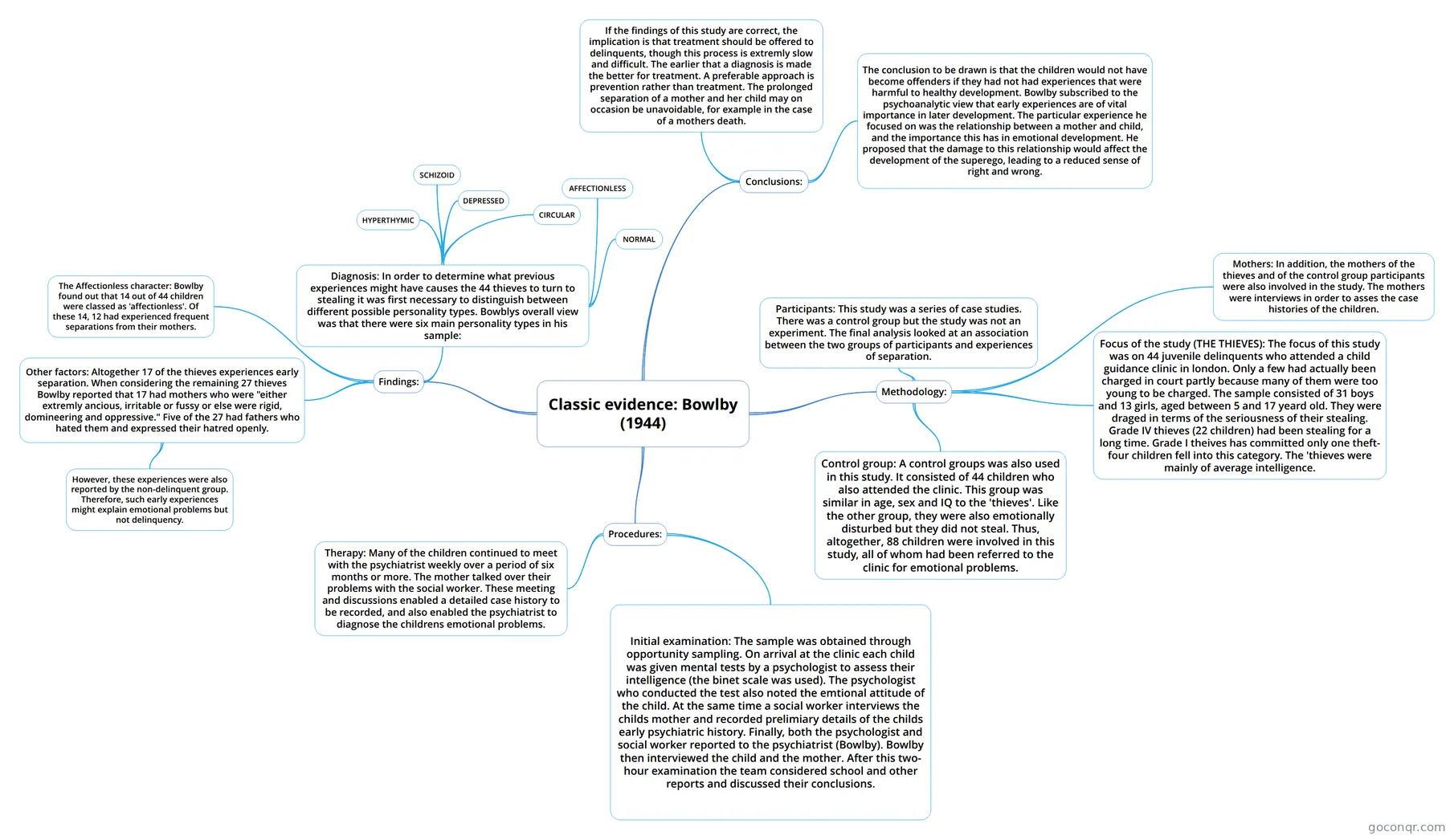
Mind map: Bowlby 1944 study
Map content
Classic evidence: Bowlby (1944)
Methodology:
- Participants: This study was a series of case studies. There was a control group but the study was not an experiment. The final analysis looked at an association between the two groups of participants and experiences of separation.
- Focus of the study (THE THIEVES): The focus of this study was on 44 juvenile delinquents who attended a child guidance clinic in london. Only a few had actually been charged in court partly because many of them were too young to be charged. The sample consisted of 31 boys and 13 girls, aged between 5 and 17 yeard old. They were draged in terms of the seriousness of their stealing. Grade IV thieves (22 children) had been stealing for a long time. Grade I theives has committed only one theft- four children fell into this category. The 'thieves were mainly of average intelligence.
- Control group: A control groups was also used in this study. It consisted of 44 children who also attended the clinic. This group was similar in age, sex and IQ to the 'thieves'. Like the other group, they were also emotionally disturbed but they did not steal. Thus, altogether, 88 children were involved in this study, all of whom had been referred to the clinic for emotional problems.
- Mothers: In addition, the mothers of the thieves and of the control group participants were also involved in the study. The mothers were interviews in order to asses the case histories of the children.
Procedures:
- Initial examination: The sample was obtained through opportunity sampling. On arrival at the clinic each child was given mental tests by a psychologist to assess their intelligence (the binet scale was used). The psychologist who conducted the test also noted the emtional attitude of the child. At the same time a social worker interviews the childs mother and recorded prelimiary details of the childs early psychiatric history. Finally, both the psychologist and social worker reported to the psychiatrist (Bowlby). Bowlby then interviewed the child and the mother. After this two- hour examination the team considered school and other reports and discussed their conclusions.
- Therapy: Many of the children continued to meet with the psychiatrist weekly over a period of six months or more. The mother talked over their problems with the social worker. These meeting and discussions enabled a detailed case history to be recorded, and also enabled the psychiatrist to diagnose the childrens emotional problems.
Findings:
- Diagnosis: In order to determine what previous experiences might have causes the 44 thieves to turn to stealing it was first necessary to distinguish between different possible personality types. Bowblys overall view was that there were six main personality types in his sample:
- NORMAL
- DEPRESSED
- CIRCULAR
- HYPERTHYMIC
- AFFECTIONLESS
- SCHIZOID
- The Affectionless character: Bowlby found out that 14 out of 44 children were classed as 'affectionless'. Of these 14, 12 had experienced frequent separations from their mothers.
- Other factors: Altogether 17 of the thieves experiences early separation. When considering the remaining 27 thieves Bowlby reported that 17 had mothers who were "either extremly ancious, irritable or fussy or else were rigid, domineering and oppressive." Five of the 27 had fathers who hated them and expressed their hatred openly.
- However, these experiences were also reported by the non-delinquent group. Therefore, such early experiences might explain emotional problems but not delinquency.
- Diagnosis: In order to determine what previous experiences might have causes the 44 thieves to turn to stealing it was first necessary to distinguish between different possible personality types. Bowblys overall view was that there were six main personality types in his sample:
Conclusions:
- The conclusion to be drawn is that the children would not have become offenders if they had not had experiences that were harmful to healthy development. Bowlby subscribed to the psychoanalytic view that early experiences are of vital importance in later development. The particular experience he focused on was the relationship between a mother and child, and the importance this has in emotional development. He proposed that the damage to this relationship would affect the development of the superego, leading to a reduced sense of right and wrong.
- If the findings of this study are correct, the implication is that treatment should be offered to delinquents, though this process is extremly slow and difficult. The earlier that a diagnosis is made the better for treatment. A preferable approach is prevention rather than treatment. The prolonged separation of a mother and her child may on occasion be unavoidable, for example in the case of a mothers death.
Information
- Description
- Mind Map on Classic evidence: Bowlby (1944), created by beth__ on 27/10/2015.
- Created by
- beth__
- Views
- 13
- Rating