
Mind map
Identity mindmap
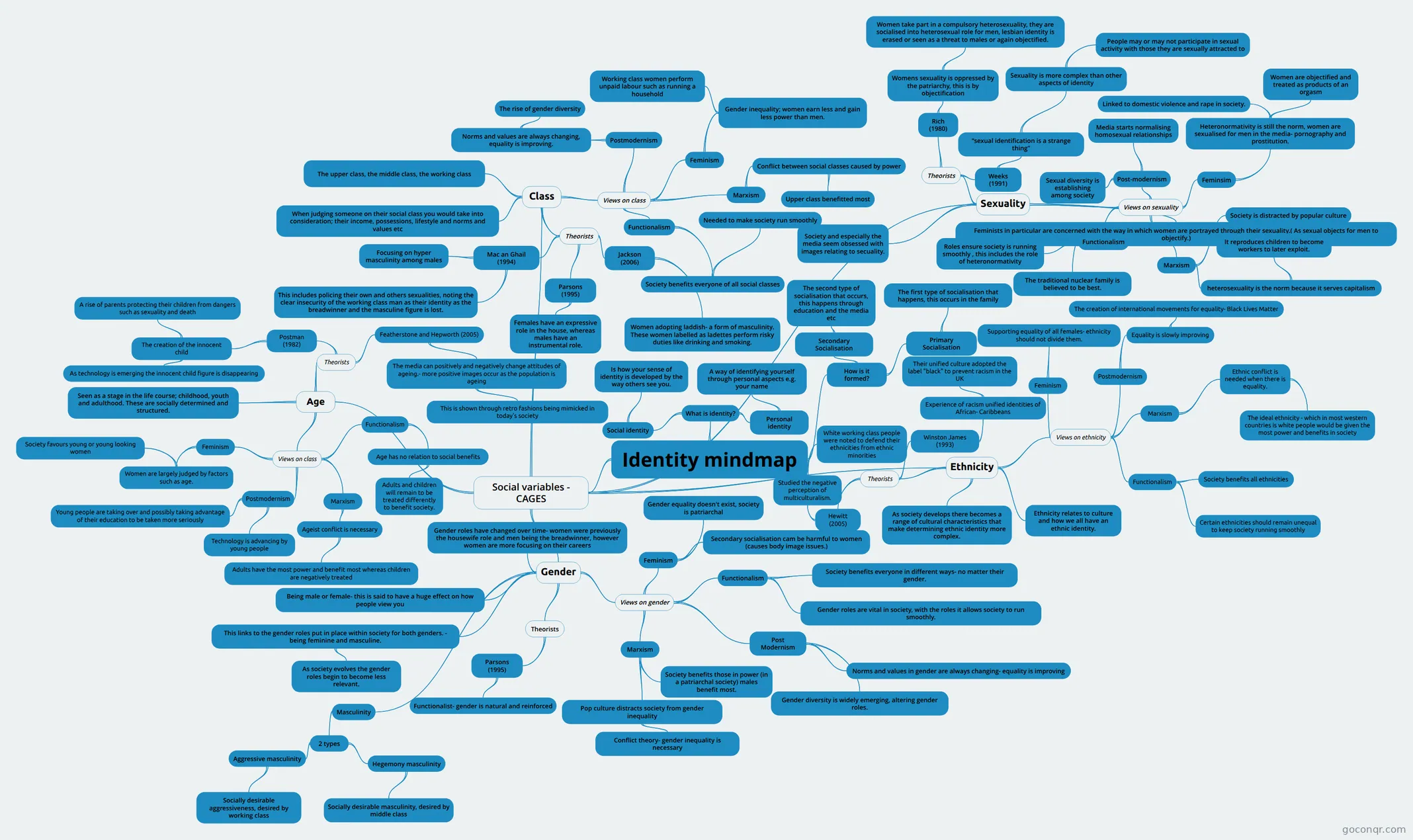
Mind map: Identity mindmap
Map content
Identity mindmap
What is identity?
- Personal identity
- A way of identifying yourself through personal aspects e.g. your name
- Social identity
- Is how your sense of identity is developed by the way others see you.
- Personal identity
How is it formed?
- Primary Socialisation
- The first type of socialisation that happens, this occurs in the family
- Secondary Socialisation
- The second type of socialisation that occurs, this happens through education and the media etc
- Primary Socialisation
Social variables - CAGES
- Class
- The upper class, the middle class, the working class
- When judging someone on their social class you would take into consideration; their income, possessions, lifestyle and norms and values etc
- Views on class
- Feminism
- Gender inequality; women earn less and gain less power than men.
- Working class women perform unpaid labour such as running a household
- Gender inequality; women earn less and gain less power than men.
- Marxism
- Conflict between social classes caused by power
- Upper class benefitted most
- Conflict between social classes caused by power
- Functionalism
- Society benefits everyone of all social classes
- Needed to make society run smoothly
- Society benefits everyone of all social classes
- Postmodernism
- Norms and values are always changing, equality is improving.
- The rise of gender diversity
- Norms and values are always changing, equality is improving.
- Feminism
- Theorists
- Parsons (1995)
- Females have an expressive role in the house, whereas males have an instrumental role.
- Mac an Ghail (1994)
- Focusing on hyper masculinity among males
- This includes policing their own and others sexualities, noting the clear insecurity of the working class man as their identity as the breadwinner and the masculine figure is lost.
- Jackson (2006)
- Women adopting laddish- a form of masculinity. These women labelled as ladettes perform risky duties like drinking and smoking.
- Parsons (1995)
- Age
- Seen as a stage in the life course; childhood, youth and adulthood. These are socially determined and structured.
- Views on class
- Feminism
- Women are largely judged by factors such as age.
- Society favours young or young looking women
- Women are largely judged by factors such as age.
- Marxism
- Ageist conflict is necessary
- Adults have the most power and benefit most whereas children are negatively treated
- Ageist conflict is necessary
- Functionalism
- Age has no relation to social benefits
- Adults and children will remain to be treated differently to benefit society.
- Age has no relation to social benefits
- Postmodernism
- Young people are taking over and possibly taking advantage of their education to be taken more seriously
- Technology is advancing by young people
- Feminism
- Theorists
- Postman (1982)
- The creation of the innocent child
- A rise of parents protecting their children from dangers such as sexuality and death
- As technology is emerging the innocent child figure is disappearing
- The creation of the innocent child
- Featherstone and Hepworth (2005)
- The media can positively and negatively change attitudes of ageing.- more positive images occur as the population is ageing
- This is shown through retro fashions being mimicked in today's society
- The media can positively and negatively change attitudes of ageing.- more positive images occur as the population is ageing
- Postman (1982)
- Gender
- Being male or female- this is said to have a huge effect on how people view you
- This links to the gender roles put in place within society for both genders. - being feminine and masculine.
- As society evolves the gender roles begin to become less relevant.
- Gender roles have changed over time- women were previously the housewife role and men being the breadwinner, however women are more focusing on their careers
- Views on gender
- Feminism
- Gender equality doesn't exist, society is patriarchal
- Secondary socialisation cam be harmful to women (causes body image issues.)
- Marxism
- Pop culture distracts society from gender inequality
- Conflict theory- gender inequality is necessary
- Society benefits those in power (in a patriarchal society) males benefit most.
- Pop culture distracts society from gender inequality
- Functionalism
- Society benefits everyone in different ways- no matter their gender.
- Gender roles are vital in society, with the roles it allows society to run smoothly.
- Post Modernism
- Norms and values in gender are always changing- equality is improving
- Gender diversity is widely emerging, altering gender roles.
- Feminism
- Masculinity
- 2 types
- Aggressive masculinity
- Socially desirable aggressiveness, desired by working class
- Hegemony masculinity
- Socially desirable masculinity, desired by middle class
- Aggressive masculinity
- 2 types
- Theorists
- Parsons (1995)
- Functionalist- gender is natural and reinforced
- Parsons (1995)
- Ethnicity
- Ethnicity relates to culture and how we all have an ethnic identity.
- As society develops there becomes a range of cultural characteristics that make determining ethnic identity more complex.
- Views on ethnicity
- Feminism
- Supporting equality of all females- ethnicity should not divide them.
- Marxism
- Ethnic conflict is needed when there is equality.
- The ideal ethnicity - which in most western countries is white people would be given the most power and benefits in society
- Ethnic conflict is needed when there is equality.
- Functionalism
- Society benefits all ethnicities
- Certain ethnicities should remain unequal to keep society running smoothly
- Postmodernism
- Equality is slowly improving
- The creation of international movements for equality- Black Lives Matter
- Equality is slowly improving
- Feminism
- Theorists
- Hewitt (2005)
- Studied the negative perception of multiculturalism.
- White working class people were noted to defend their ethnicities from ethnic minorities
- Studied the negative perception of multiculturalism.
- Winston James (1993)
- Experience of racism unified identities of African- Caribbeans
- Their unified culture adopted the label "black" to prevent racism in the UK
- Experience of racism unified identities of African- Caribbeans
- Hewitt (2005)
- Sexuality
- Society and especially the media seem obsessed with images relating to secuality.
- Feminists in particular are concerned with the way in which women are portrayed through their sexuality.( As sexual objects for men to objectify.)
- Views on sexuality
- Feminsim
- Heteronormativity is still the norm, women are sexualised for men in the media- pornography and prostitution.
- Linked to domestic violence and rape in society.
- Women are objectified and treated as products of an orgasm
- Heteronormativity is still the norm, women are sexualised for men in the media- pornography and prostitution.
- Marxism
- heterosexuality is the norm because it serves capitalism
- It reproduces children to become workers to later exploit.
- Society is distracted by popular culture
- heterosexuality is the norm because it serves capitalism
- Functionalism
- Roles ensure society is running smoothly , this includes the role of heteronormativity
- The traditional nuclear family is believed to be best.
- Post-modernism
- Sexual diversity is establishing among society
- Media starts normalising homosexual relationships
- Feminsim
- Theorists
- Rich (1980)
- Womens sexuality is oppressed by the patriarchy, this is by objectification
- Women take part in a compulsory heterosexuality, they are socialised into heterosexual role for men, lesbian identity is erased or seen as a threat to males or again objectified.
- Womens sexuality is oppressed by the patriarchy, this is by objectification
- Weeks (1991)
- "sexual identification is a strange thing"
- Sexuality is more complex than other aspects of identity
- People may or may not participate in sexual activity with those they are sexually attracted to
- Sexuality is more complex than other aspects of identity
- "sexual identification is a strange thing"
- Rich (1980)
- Class
Information
- Description
- Mindmap for sociology on identity
- Created by
- aebannister
- Views
- 13
- Tags
- Rating
More on Personal and Social Identity