
Mind map
Trade union militancy 1917-27
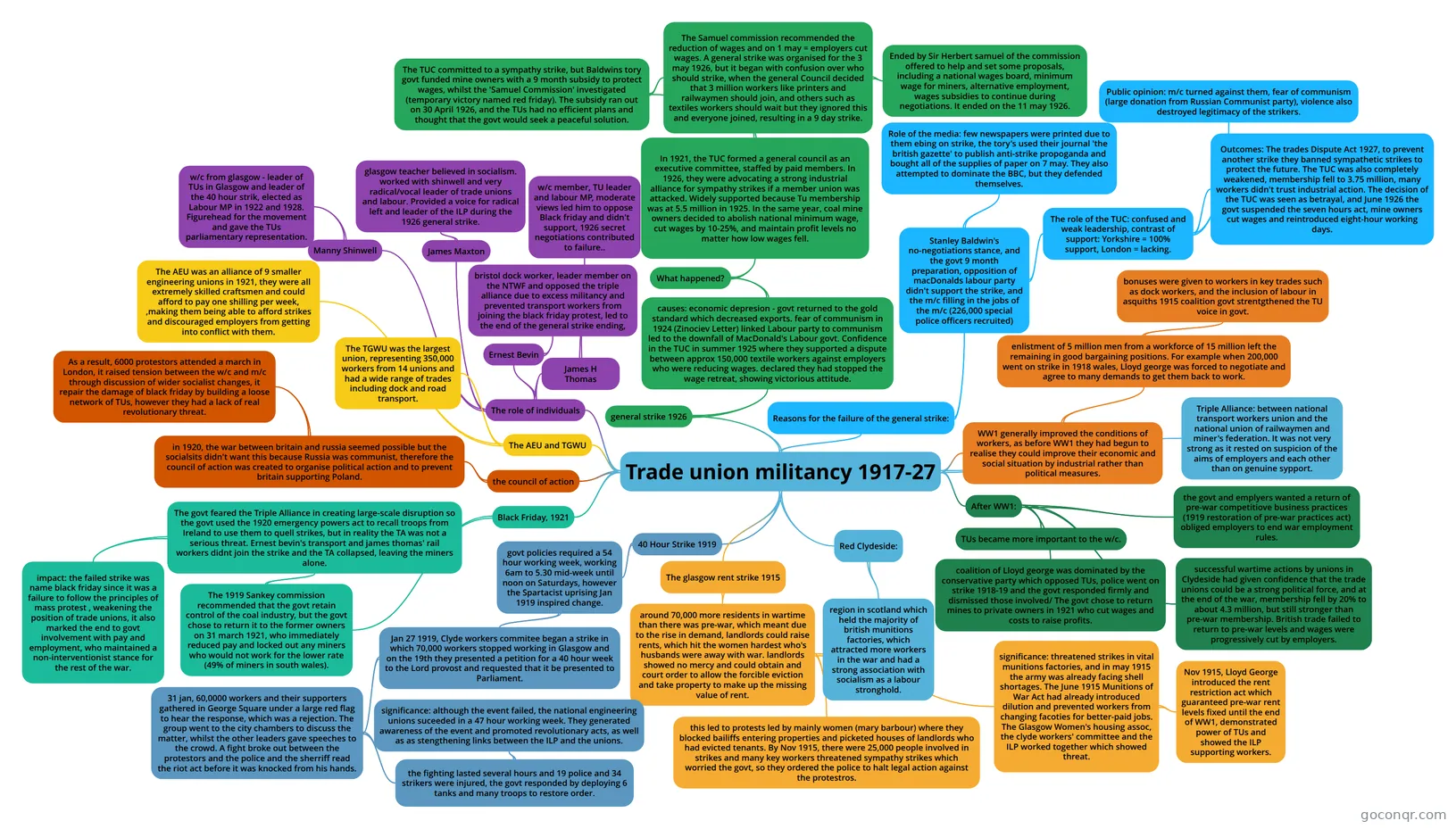
Mind map: Trade union militancy 1917-27
Map content
Trade union militancy 1917-27
WW1 generally improved the conditions of workers, as before WW1 they had begun to realise they could improve their economic and social situation by industrial rather than political measures.
- enlistment of 5 million men from a workforce of 15 million left the remaining in good bargaining positions. For example when 200,000 went on strike in 1918 wales, Lloyd george was forced to negotiate and agree to many demands to get them back to work.
- bonuses were given to workers in key trades such as dock workers, and the inclusion of labour in asquiths 1915 coalition govt strentgthened the TU voice in govt.
- enlistment of 5 million men from a workforce of 15 million left the remaining in good bargaining positions. For example when 200,000 went on strike in 1918 wales, Lloyd george was forced to negotiate and agree to many demands to get them back to work.
Triple Alliance: between national transport workers union and the national union of railwaymen and miner's federation. It was not very strong as it rested on suspicion of the aims of employers and each other than on genuine sypport.
After WW1:
- the govt and emplyers wanted a return of pre-war competitiove business practices (1919 restoration of pre-war practices act) obliged employers to end war employment rules.
- successful wartime actions by unions in Clydeside had given confidence that the trade unions could be a strong political force, and at the end of the war, membership fell by 20% to about 4.3 million, but still stronger than pre-war membership. British trade failed to return to pre-war levels and wages were progressively cut by employers.
- coalition of Lloyd george was dominated by the conservative party which opposed TUs, police went on strike 1918-19 and the govt responded firmly and dismissed those involved/ The govt chose to return mines to private owners in 1921 who cut wages and costs to raise profits.
- TUs became more important to the w/c.
Red Clydeside:
- region in scotland which held the majority of british munitions factories, which attracted more workers in the war and had a strong association with socialism as a labour stronghold.
The glasgow rent strike 1915
- around 70,000 more residents in wartime than there was pre-war, which meant due to the rise in demand, landlords could raise rents, which hit the women hardest who's husbands were away with war. landlords showed no mercy and could obtain and court order to allow the forcible eviction and take property to make up the missing value of rent.
- significance: threatened strikes in vital munitions factories, and in may 1915 the army was already facing shell shortages. The June 1915 Munitions of War Act had already introduced dilution and prevented workers from changing facoties for better-paid jobs. The Glasgow Women's housing assoc, the clyde workers' committee and the ILP worked together which showed threat.
- Nov 1915, Lloyd George introduced the rent restriction act which guaranteed pre-war rent levels fixed until the end of WW1, demonstrated power of TUs and showed the ILP supporting workers.
- this led to protests led by mainly women (mary barbour) where they blocked bailiffs entering properties and picketed houses of landlords who had evicted tenants. By Nov 1915, there were 25,000 people involved in strikes and many key workers threatened sympathy strikes which worried the govt, so they ordered the police to halt legal action against the protestros.
- significance: threatened strikes in vital munitions factories, and in may 1915 the army was already facing shell shortages. The June 1915 Munitions of War Act had already introduced dilution and prevented workers from changing facoties for better-paid jobs. The Glasgow Women's housing assoc, the clyde workers' committee and the ILP worked together which showed threat.
- around 70,000 more residents in wartime than there was pre-war, which meant due to the rise in demand, landlords could raise rents, which hit the women hardest who's husbands were away with war. landlords showed no mercy and could obtain and court order to allow the forcible eviction and take property to make up the missing value of rent.
40 Hour Strike 1919
- govt policies required a 54 hour working week, working 6am to 5.30 mid-week until noon on Saturdays, however the Spartacist uprising Jan 1919 inspired change.
- Jan 27 1919, Clyde workers commitee began a strike in which 70,000 workers stopped working in Glasgow and on the 19th they presented a petition for a 40 hour week to the Lord provost and requested that it be presented to Parliament.
- 31 jan, 60,0000 workers and their supporters gathered in George Square under a large red flag to hear the response, which was a rejection. The group went to the city chambers to discuss the matter, whilst the other leaders gave speeches to the crowd. A fight broke out between the protestors and the police and the sherriff read the riot act before it was knocked from his hands.
- the fighting lasted several hours and 19 police and 34 strikers were injured, the govt responded by deploying 6 tanks and many troops to restore order.
- significance: although the event failed, the national engineering unions suceeded in a 47 hour working week. They generated awareness of the event and promoted revolutionary acts, as well as as stengthening links between the ILP and the unions.
- the fighting lasted several hours and 19 police and 34 strikers were injured, the govt responded by deploying 6 tanks and many troops to restore order.
- 31 jan, 60,0000 workers and their supporters gathered in George Square under a large red flag to hear the response, which was a rejection. The group went to the city chambers to discuss the matter, whilst the other leaders gave speeches to the crowd. A fight broke out between the protestors and the police and the sherriff read the riot act before it was knocked from his hands.
- Jan 27 1919, Clyde workers commitee began a strike in which 70,000 workers stopped working in Glasgow and on the 19th they presented a petition for a 40 hour week to the Lord provost and requested that it be presented to Parliament.
- govt policies required a 54 hour working week, working 6am to 5.30 mid-week until noon on Saturdays, however the Spartacist uprising Jan 1919 inspired change.
Black Friday, 1921
- The 1919 Sankey commission recommended that the govt retain control of the coal industry, but the govt chose to return it to the former owners on 31 march 1921, who immediately reduced pay and locked out any miners who would not work for the lower rate (49% of miners in south wales).
- The govt feared the Triple Alliance in creating large-scale disruption so the govt used the 1920 emergency powers act to recall troops from Ireland to use them to quell strikes, but in reality the TA was not a serious threat. Ernest bevin's transport and james thomas' rail workers didnt join the strike and the TA collapsed, leaving the miners alone.
- impact: the failed strike was name black friday since it was a failure to follow the principles of mass protest , weakening the position of trade unions, it also marked the end to govt involvement with pay and employment, who maintained a non-interventionist stance for the rest of the war.
- The govt feared the Triple Alliance in creating large-scale disruption so the govt used the 1920 emergency powers act to recall troops from Ireland to use them to quell strikes, but in reality the TA was not a serious threat. Ernest bevin's transport and james thomas' rail workers didnt join the strike and the TA collapsed, leaving the miners alone.
- The 1919 Sankey commission recommended that the govt retain control of the coal industry, but the govt chose to return it to the former owners on 31 march 1921, who immediately reduced pay and locked out any miners who would not work for the lower rate (49% of miners in south wales).
the council of action
- in 1920, the war between britain and russia seemed possible but the socialsits didn't want this because Russia was communist, therefore the council of action was created to organise political action and to prevent britain supporting Poland.
- As a result, 6000 protestors attended a march in London, it raised tension between the w/c and m/c through discussion of wider socialist changes, it repair the damage of black friday by building a loose network of TUs, however they had a lack of real revolutionary threat.
- in 1920, the war between britain and russia seemed possible but the socialsits didn't want this because Russia was communist, therefore the council of action was created to organise political action and to prevent britain supporting Poland.
The AEU and TGWU
- The AEU was an alliance of 9 smaller engineering unions in 1921, they were all extremely skilled craftsmen and could afford to pay one shilling per week, ,making them being able to afford strikes and discouraged employers from getting into conflict with them.
- The TGWU was the largest union, representing 350,000 workers from 14 unions and had a wide range of trades including dock and road transport.
The role of individuals
- Manny Shinwell
- w/c from glasgow - leader of TUs in Glasgow and leader of the 40 hour strik, elected as Labour MP in 1922 and 1928. Figurehead for the movement and gave the TUs parliamentary representation.
- James Maxton
- glasgow teacher believed in socialism. worked with shinwell and very radical/vocal leader of trade unions and labour. Provided a voice for radical left and leader of the ILP during the 1926 general strike.
- Ernest Bevin
- bristol dock worker, leader member on the NTWF and opposed the triple alliance due to excess militancy and prevented transport workers from joining the black friday protest, led to the end of the general strike ending,
- James H Thomas
- w/c member, TU leader and labour MP, moderate views led him to oppose Black friday and didn't support, 1926 secret negotiations contributed to failure..
- Manny Shinwell
general strike 1926
- causes: economic depresion - govt returned to the gold standard which decreased exports. fear of communism in 1924 (Zinociev Letter) linked Labour party to communism led to the downfall of MacDonald's Labour govt. Confidence in the TUC in summer 1925 where they supported a dispute between approx 150,000 textile workers against employers who were reducing wages. declared they had stopped the wage retreat, showing victorious attitude.
- What happened?
- In 1921, the TUC formed a general council as an executive committee, staffed by paid members. In 1926, they were advocating a strong industrial alliance for sympathy strikes if a member union was attacked. Widely supported because Tu membership was at 5.5 million in 1925. In the same year, coal mine owners decided to abolish national minimum wage, cut wages by 10-25%, and maintain profit levels no matter how low wages fell.
- The TUC committed to a sympathy strike, but Baldwins tory govt funded mine owners with a 9 month subsidy to protect wages, whilst the 'Samuel Commission' investigated (temporary victory named red friday). The subsidy ran out on 30 April 1926, and the TUs had no efficient plans and thought that the govt would seek a peaceful solution.
- The Samuel commission recommended the reduction of wages and on 1 may = employers cut wages. A general strike was organised for the 3 may 1926, but it began with confusion over who should strike, when the general Council decided that 3 million workers like printers and railwaymen should join, and others such as textiles workers should wait but they ignored this and everyone joined, resulting in a 9 day strike.
- Ended by Sir Herbert samuel of the commission offered to help and set some proposals, including a national wages board, minimum wage for miners, alternative employment, wages subsidies to continue during negotiations. It ended on the 11 may 1926.
- The Samuel commission recommended the reduction of wages and on 1 may = employers cut wages. A general strike was organised for the 3 may 1926, but it began with confusion over who should strike, when the general Council decided that 3 million workers like printers and railwaymen should join, and others such as textiles workers should wait but they ignored this and everyone joined, resulting in a 9 day strike.
- The TUC committed to a sympathy strike, but Baldwins tory govt funded mine owners with a 9 month subsidy to protect wages, whilst the 'Samuel Commission' investigated (temporary victory named red friday). The subsidy ran out on 30 April 1926, and the TUs had no efficient plans and thought that the govt would seek a peaceful solution.
- In 1921, the TUC formed a general council as an executive committee, staffed by paid members. In 1926, they were advocating a strong industrial alliance for sympathy strikes if a member union was attacked. Widely supported because Tu membership was at 5.5 million in 1925. In the same year, coal mine owners decided to abolish national minimum wage, cut wages by 10-25%, and maintain profit levels no matter how low wages fell.
- What happened?
- causes: economic depresion - govt returned to the gold standard which decreased exports. fear of communism in 1924 (Zinociev Letter) linked Labour party to communism led to the downfall of MacDonald's Labour govt. Confidence in the TUC in summer 1925 where they supported a dispute between approx 150,000 textile workers against employers who were reducing wages. declared they had stopped the wage retreat, showing victorious attitude.
Reasons for the failure of the general strike:
- Stanley Baldwin's no-negotiations stance, and the govt 9 month preparation, opposition of macDonalds labour party didn't support the strike, and the m/c filling in the jobs of the m/c (226,000 special police officers recruited)
- Role of the media: few newspapers were printed due to them ebing on strike, the tory's used their journal 'the british gazette' to publish anti-strike propoganda and bought all of the supplies of paper on 7 may. They also attempted to dominate the BBC, but they defended themselves.
- The role of the TUC: confused and weak leadership, contrast of support: Yorkshire = 100% support, London = lacking.
- Public opinion: m/c turned against them, fear of communism (large donation from Russian Communist party), violence also destroyed legitimacy of the strikers.
- Outcomes: The trades Dispute Act 1927, to prevent another strike they banned sympathetic strikes to protect the future. The TUC was also completely weakened, membership fell to 3.75 million, many workers didn't trust industrial action. The decision of the TUC was seen as betrayal, and June 1926 the govt suspended the seven hours act, mine owners cut wages and reintroduced eight-hour working days.
- Stanley Baldwin's no-negotiations stance, and the govt 9 month preparation, opposition of macDonalds labour party didn't support the strike, and the m/c filling in the jobs of the m/c (226,000 special police officers recruited)
Information
- Description
- Mind Map on Trade union militancy 1917-27, created by Joely Mayes on 10/06/2024.
- Created by
- Joely Mayes
- Views
- 0
- Rating