
Mind map
6. Fiduciary Obligations
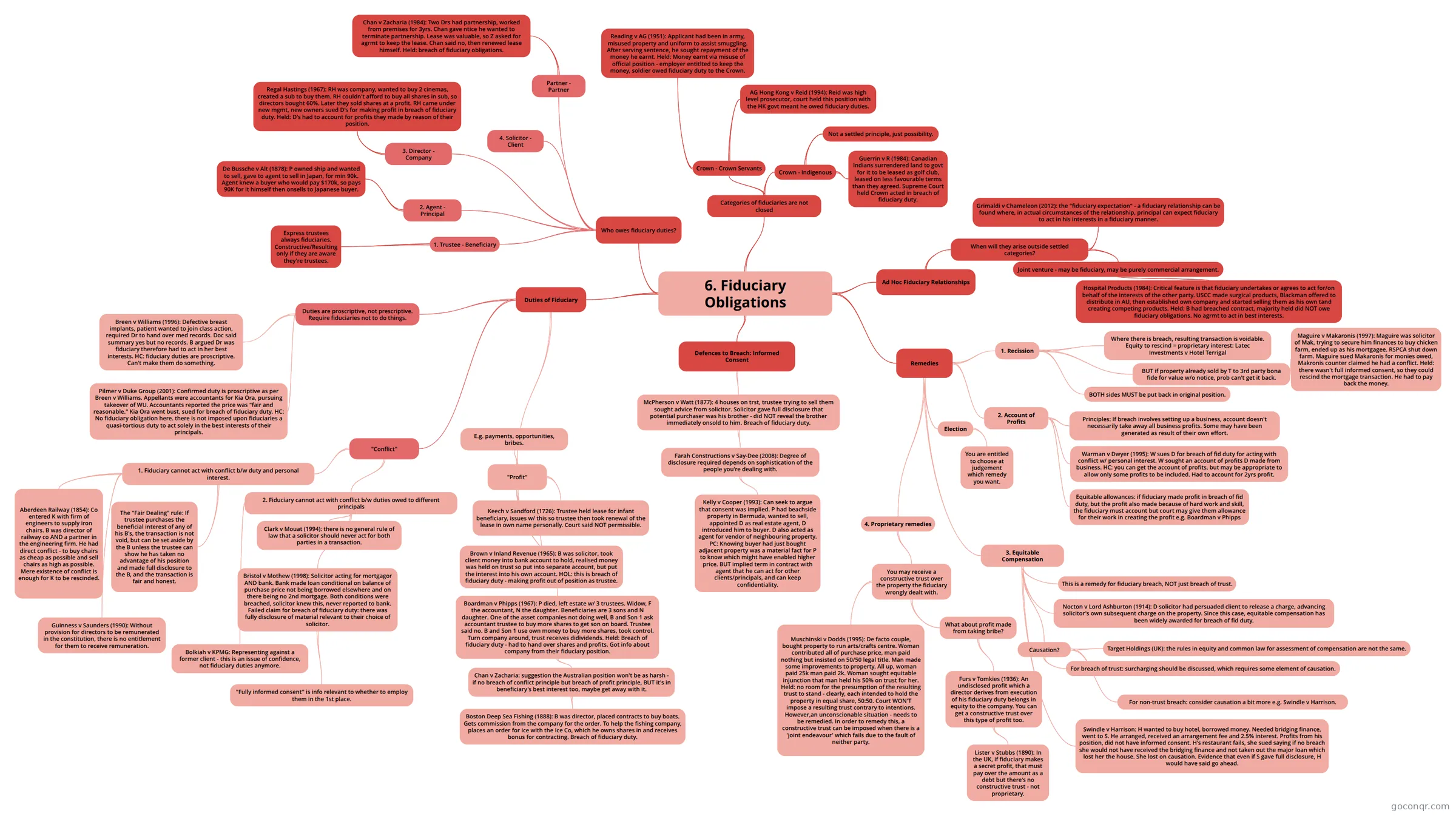
Mind map: Fiduciary obligations
Map content
6. Fiduciary Obligations
Who owes fiduciary duties?
- 1. Trustee - Beneficiary
- Express trustees always fiduciaries. Constructive/Resulting only if they are aware they're trustees.
- 2. Agent - Principal
- De Bussche v Alt (1878): P owned ship and wanted to sell, gave to agent to sell in Japan, for min 90k. Agent knew a buyer who would pay $170k, so pays 90K for it himself then onsells to Japanese buyer.
- 3. Director - Company
- Regal Hastings (1967): RH was company, wanted to buy 2 cinemas, created a sub to buy them. RH couldn't afford to buy all shares in sub, so directors bought 60%. Later they sold shares at a profit. RH came under new mgmt, new owners sued D's for making profit in breach of fiduciary duty. Held: D's had to account for profits they made by reason of their position.
- 4. Solicitor - Client
- Partner - Partner
- Chan v Zacharia (1984): Two Drs had partnership, worked from premises for 3yrs. Chan gave ntice he wanted to terminate partnership. Lease was valuable, so Z asked for agrmt to keep the lease. Chan said no, then renewed lease himself. Held: breach of fiduciary obligations.
- 1. Trustee - Beneficiary
Categories of fiduciaries are not closed
- Crown - Crown Servants
- Reading v AG (1951): Applicant had been in army, misused property and uniform to assist smuggling. After serving sentence, he sought repayment of the money he earnt. Held: Money earnt via misuse of official position - employer entitlted to keep the money, soldier owed fiduciary duty to the Crown.
- AG Hong Kong v Reid (1994): Reid was high level prosecutor, court held this position with the HK govt meant he owed fiduciary duties.
- Crown - Indigenous
- Not a settled principle, just possibility.
- Guerrin v R (1984): Canadian Indians surrendered land to govt for it to be leased as golf club, leased on less favourable terms than they agreed. Supreme Court held Crown acted in breach of fiduciary duty.
- Crown - Crown Servants
Ad Hoc Fiduciary Relationships
- When will they arise outside settled categories?
- Grimaldi v Chameleon (2012): the "fiduciary expectation" - a fiduciary relationship can be found where, in actual circumstances of the relationship, principal can expect fiduciary to act in his interests in a fiduciary manner.
- Joint venture - may be fiduciary, may be purely commercial arrangement.
- Hospital Products (1984): Critical feature is that fiduciary undertakes or agrees to act for/on behalf of the interests of the other party. USCC made surgical products, Blackman offered to distribute in AU, then established own company and started selling them as his own tand creating competing products. Held: B had breached contract, majority held did NOT owe fiduciary obligations. No agrmt to act in best interests.
- When will they arise outside settled categories?
Duties of Fiduciary
- "Profit"
- E.g. payments, opportunities, bribes.
- Keech v Sandford (1726): Trustee held lease for infant beneficiary, issues w/ this so trustee then took renewal of the lease in own name personally. Court said NOT permissible.
- Brown v Inland Revenue (1965): B was solicitor, took client money into bank account to hold, realised money was held on trust so put into separate account, but put the interest into his own account. HOL: this is breach of fiduciary duty - making profit out of position as trustee.
- Boardman v Phipps (1967): P died, left estate w/ 3 trustees. Widow, F the accountant, N the daughter. Beneficiaries are 3 sons and N daughter. One of the asset companies not doing well, B and Son 1 ask accountant trustee to buy more shares to get son on board. Trustee said no. B and Son 1 use own money to buy more shares, took control. Turn company around, trust receives didividends. Held: Breach of fiduciary duty - had to hand over shares and profits. Got info about company from their fiduciary position.
- Chan v Zacharia: suggestion the Australian position won't be as harsh - if no breach of conflict principle but breach of profit principle, BUT it's in beneficiary's best interest too, maybe get away with it.
- Boston Deep Sea Fishing (1888): B was director, placed contracts to buy boats. Gets commission from the company for the order. To help the fishing company, places an order for ice with the Ice Co, which he owns shares in and receives bonus for contracting. Breach of fiduciary duty.
- Chan v Zacharia: suggestion the Australian position won't be as harsh - if no breach of conflict principle but breach of profit principle, BUT it's in beneficiary's best interest too, maybe get away with it.
- "Conflict"
- 1. Fiduciary cannot act with conflict b/w duty and personal interest.
- Aberdeen Railway (1854): Co entered K with firm of engineers to supply iron chairs. B was director of railway co AND a partner in the engineering firm. He had direct conflict - to buy chairs as cheap as possible and sell chairs as high as possible. Mere existence of conflict is enough for K to be rescinded.
- The "Fair Dealing" rule: If trustee purchases the beneficial interest of any of his B's, the transaction is not void, but can be set aside by the B unless the trustee can show he has taken no advantage of his position and made full disclosure to the B, and the transaction is fair and honest.
- Guinness v Saunders (1990): Without provision for directors to be remunerated in the constitution, there is no entitlement for them to receive remuneration.
- 2. Fiduciary cannot act with conflict b/w duties owed to different principals
- Clark v Mouat (1994): there is no general rule of law that a solicitor should never act for both parties in a transaction.
- Bristol v Mothew (1998): Solicitor acting for mortgagor AND bank. Bank made loan conditional on balance of purchase price not being borrowed elsewhere and on there being no 2nd mortgage. Both conditions were breached, solicitor knew this, never reported to bank. Failed claim for breach of fiduciary duty: there was fully disclosure of material relevant to their choice of solicitor.
- "Fully informed consent" is info relevant to whether to employ them in the 1st place.
- Bolkiah v KPMG: Representing against a former client - this is an issue of confidence, not fiduciary duties anymore.
- 1. Fiduciary cannot act with conflict b/w duty and personal interest.
- Duties are proscriptive, not prescriptive. Require fiduciaries not to do things.
- Breen v Williams (1996): Defective breast implants, patient wanted to join class action, required Dr to hand over med records. Doc said summary yes but no records. B argued Dr was fiduciary therefore had to act in her best interests. HC: fiduciary duties are proscriptive. Can't make them do something.
- Pilmer v Duke Group (2001): Confirmed duty is proscriptive as per Breen v Williams. Appellants were accountants for Kia Ora, pursuing takeover of WU. Accountants reported the price was "fair and reasonable." Kia Ora went bust, sued for breach of fiduciary duty. HC: No fiduciary obligation here. there is not imposed upon fiduciaries a quasi-tortious duty to act solely in the best interests of their principals.
- "Profit"
Defences to Breach: Informed Consent
- McPherson v Watt (1877): 4 houses on trst, trustee trying to sell them sought advice from solicitor. Solicitor gave full disclosure that potential purchaser was his brother - did NOT reveal the brother immediately onsold to him. Breach of fiduciary duty.
- Farah Constructions v Say-Dee (2008): Degree of disclosure required depends on sophistication of the people you're dealing with.
- Kelly v Cooper (1993): Can seek to argue that consent was implied. P had beachside property in Bermuda, wanted to sell, appointed D as real estate agent, D introduced him to buyer. D also acted as agent for vendor of neighbouring property. PC: Knowing buyer had just bought adjacent property was a material fact for P to know which might have enabled higher price. BUT implied term in contract with agent that he can act for other clients/principals, and can keep confidentiality.
- Farah Constructions v Say-Dee (2008): Degree of disclosure required depends on sophistication of the people you're dealing with.
- McPherson v Watt (1877): 4 houses on trst, trustee trying to sell them sought advice from solicitor. Solicitor gave full disclosure that potential purchaser was his brother - did NOT reveal the brother immediately onsold to him. Breach of fiduciary duty.
Remedies
- 1. Recission
- Where there is breach, resulting transaction is voidable. Equity to rescind = proprietary interest: Latec Investments v Hotel Terrigal
- BUT if property already sold by T to 3rd party bona fide for value w/o notice, prob can't get it back.
- Maguire v Makaronis (1997): Maguire was solicitor of Mak, trying to secure him finances to buy chicken farm, ended up as his mortgagee. RSPCA shut down farm. Maguire sued Makaronis for monies owed, Makronis counter claimed he had a conflict. Held: there wasn't full informed consent, so they could rescind the mortgage transaction. He had to pay back the money.
- BOTH sides MUST be put back in original position.
- 2. Account of Profits
- Principles: If breach involves setting up a business, account doesn't necessarily take away all business profits. Some may have been generated as result of their own effort.
- Warman v Dwyer (1995): W sues D for breach of fid duty for acting with conflict w/ personal interest. W sought an account of profits D made from business. HC: you can get the account of profits, but may be appropriate to allow only some profits to be included. Had to account for 2yrs profit.
- Equitable allowances: if fiduciary made profit in breach of fid duty, but the profit also made because of hard work and skill, the fiduciary must account but court may give them allowance for their work in creating the profit e.g. Boardman v Phipps
- 3. Equitable Compensation
- This is a remedy for fiduciary breach, NOT just breach of trust.
- Nocton v Lord Ashburton (1914): D solicitor had persuaded client to release a charge, advancing solicitor's own subsequent charge on the property. Since this case, equitable compensation has been widely awarded for breach of fid duty.
- Causation?
- Target Holdings (UK): the rules in equity and common law for assessment of compensation are not the same.
- For breach of trust: surcharging should be discussed, which requires some element of causation.
- For non-trust breach: consider causation a bit more e.g. Swindle v Harrison.
- Swindle v Harrison: H wanted to buy hotel, borrowed money. Needed bridging finance, went to S. He arranged, received an arrangement fee and 2.5% interest. Profits from his position, did not have informed consent. H's restaurant fails, she sued saying if no breach she would not have received the bridging finance and not taken out the major loan which lost her the house. She lost on causation. Evidence that even if S gave full disclosure, H would have said go ahead.
- Election
- You are entitled to choose at judgement which remedy you want.
- 4. Proprietary remedies
- You may receive a constructive trust over the property the fiduciary wrongly dealt with.
- Muschinski v Dodds (1995): De facto couple, bought property to run arts/crafts centre. Woman contributed all of purchase price, man paid nothing but insisted on 50/50 legal title. Man made some improvements to property. All up, woman paid 25k man paid 2k. Woman sought equitable injunction that man held his 50% on trust for her. Held: no room for the presumption of the resulting trust to stand - clearly, each intended to hold the property in equal share, 50:50. Court WON'T impose a resulting trust contrary to intentions. However,an unconscionable situation - needs to be remedied. In order to remedy this, a constructive trust can be imposed when there is a 'joint endeavour' which fails due to the fault of neither party.
- What about profit made from taking bribe?
- Furs v Tomkies (1936): An undisclosed profit which a director derives from execution of his fiduciary duty belongs in equity to the company. You can get a constructive trust over this type of profit too.
- Lister v Stubbs (1890): In the UK, if fiduciary makes a secret profit, that must pay over the amount as a debt but there's no constructive trust - not proprietary.
- Furs v Tomkies (1936): An undisclosed profit which a director derives from execution of his fiduciary duty belongs in equity to the company. You can get a constructive trust over this type of profit too.
- You may receive a constructive trust over the property the fiduciary wrongly dealt with.
- 1. Recission
Information
- Description
- Universität EQUITY Mind Map on 6. Fiduciary Obligations, created by georgiafeltis on 07/11/2015.
- Created by
- georgiafeltis
- Views
- 3
- Rating