
Mind map
GCSE Digital Technology UNIT 4
Map content
GCSE Digital Technology UNIT 4
Contemporary trends in software development
- • describe the following programming paradigms: – procedural programming; and – object-oriented programming;
- Procedural Programming: Programmer sets out, step by step, what the computer needs to do. These instructions are written in source code. A procedural langauge is imperative (gives orders/instructions), also is sequential (instructions carried out one after each other).
- Object Oriented Programming: Uses concept of self-contained objects, contain both program routines and data being processed. Is designed as a collection of objects whih interect by sending messages to each other.
- An object is an element of a program that can perform actions and interact with other elements of the program. They are considered first when designing a program/application, they are defined formally during the design process.
- Once all objects have been designed the building of the application can begin. Objects occur in the real world; e.g. a human could be described as an object, the person would have certain attributes such as age, hair colour, height, eye colour etc... In OOP these attributes are called properties.
- An object can perform actions, these actions are called methods. Methods allow the objects to do things and allow the properties of the object to be manipulated.
- Object classes may be used in other programs. These programs are more reliable because the objects are self-contained, simple and so easier to program
- An object can perform actions, these actions are called methods. Methods allow the objects to do things and allow the properties of the object to be manipulated.
- Once all objects have been designed the building of the application can begin. Objects occur in the real world; e.g. a human could be described as an object, the person would have certain attributes such as age, hair colour, height, eye colour etc... In OOP these attributes are called properties.
- An object is an element of a program that can perform actions and interact with other elements of the program. They are considered first when designing a program/application, they are defined formally during the design process.
- • explain the significance of the following aspects of software development environments: – editing features; and – high-level code translation and execution;
- Program code can be created using a text/code editor. The source code is then translated into machine code. Source code cannot be executed by the computer until it has been translated into machine code.
- If a text editor is used, the program will have to be compiled using program software. More advanced software is known as An Integrated Development Environment (IDE) provides programmers with all of the facilities required to complete the development of an application from coding to testing. This means that an application can be developed fully within one application.
- Editing features: Clipboard, Code outlining, Intellisense, Line Numbering and Syntax error assistant.
- Compiler: Translates the whole program into machine code before the program is run. All bugs are reported at the end (difficult to test individual lines of code). All errors must be removed before the code is fully compiled.Compilation is slow but machine code can be executed quickly. E.g. Java and C ++
- Interpreter: Translates code line by line. Errors are displayed as soon as they are found, easier to debug. Slower to run than compiled code
- If a text editor is used, the program will have to be compiled using program software. More advanced software is known as An Integrated Development Environment (IDE) provides programmers with all of the facilities required to complete the development of an application from coding to testing. This means that an application can be developed fully within one application.
- Program code can be created using a text/code editor. The source code is then translated into machine code. Source code cannot be executed by the computer until it has been translated into machine code.
- • describe the following programming paradigms: – procedural programming; and – object-oriented programming;
DIGITAL DATA
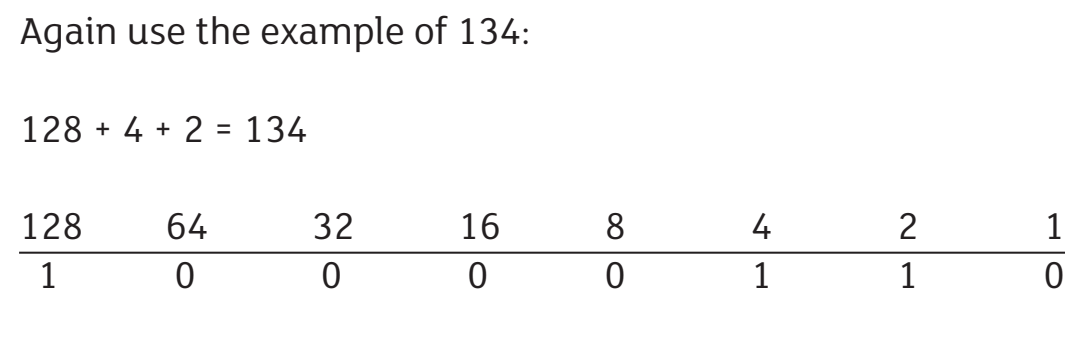
- Describe how a number is converted into a binary pattern for storage in a computer
- In all modern computers memory can either be ON or OFF (1 or 0). Data is stored character by character with each character being represented by a code. The code will consist of a string of 1’s and 0’s. Each 1 or 0 is called a bit – Binary digIT.
- Demonstrate understanding of the following units of data:
- Bit - The word bit stands for Binary Digit. It is a single digit in a binary number. It will either be 0 or 1. Bits are the smallest unit of storage on a computer. All data is stored as binary.
- Byte - This is a group of 8 bits, which is made up of a series of 0's and 1's. Each byte represents a single character. The storage capacity of all computers is measured in multiples of bytes.
- Nibble - A nibble is half a byte, only consisting of 4 binary digits. It can be represented by one hexadecimal digit.
- Kilobyte (KB) - Larger than a byte. = 1024 bytes
- Megabyte (MB) - Larger than a kb = 1024 kb
- Gigabyte (GB) - Larger than a megabyte = 1024 mb
- Terabyte - Larger than a gb = 1024 gb
- Describe how a number is converted into a binary pattern for storage in a computer
Images and files in the map
Information
- Description
- GCSE Digital Technology Mind Map on GCSE Digital Technology UNIT 4, created by Jack Reville on 01/10/2024.
- Created by
- Jack Reville
- Views
- 1
- Rating