
Mind map
Steps for factoring quadratic expressions
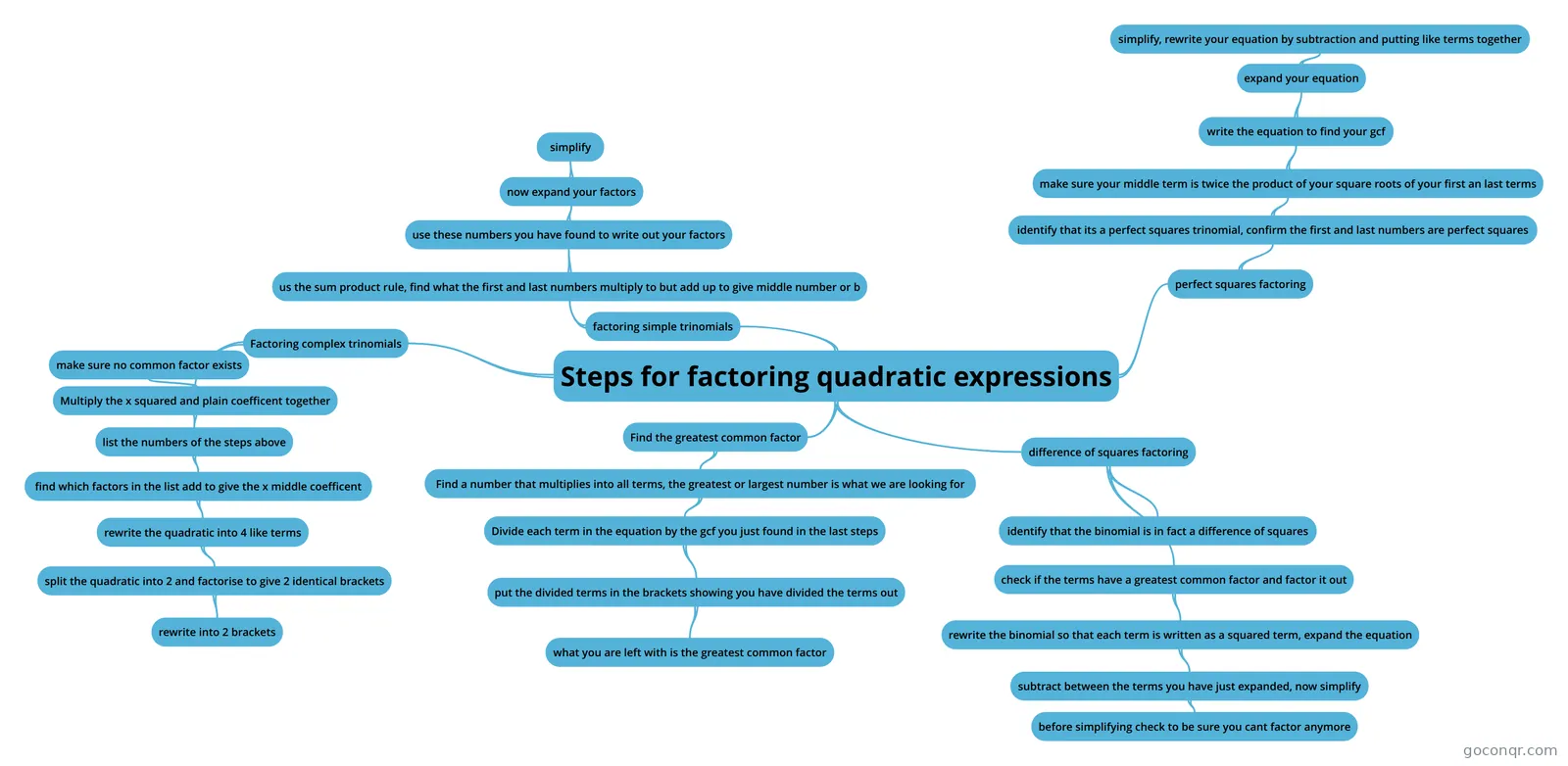
Mind map: Steps for factoring quadratic expressions
Map content
Steps for factoring quadratic expressions
Find the greatest common factor
- Find a number that multiplies into all terms, the greatest or largest number is what we are looking for
- Divide each term in the equation by the gcf you just found in the last steps
- put the divided terms in the brackets showing you have divided the terms out
- what you are left with is the greatest common factor
- put the divided terms in the brackets showing you have divided the terms out
- Divide each term in the equation by the gcf you just found in the last steps
- Find a number that multiplies into all terms, the greatest or largest number is what we are looking for
difference of squares factoring
- check if the terms have a greatest common factor and factor it out
- rewrite the binomial so that each term is written as a squared term, expand the equation
- subtract between the terms you have just expanded, now simplify
- before simplifying check to be sure you cant factor anymore
- subtract between the terms you have just expanded, now simplify
- rewrite the binomial so that each term is written as a squared term, expand the equation
- identify that the binomial is in fact a difference of squares
- check if the terms have a greatest common factor and factor it out
perfect squares factoring
- identify that its a perfect squares trinomial, confirm the first and last numbers are perfect squares
- make sure your middle term is twice the product of your square roots of your first an last terms
- write the equation to find your gcf
- expand your equation
- simplify, rewrite your equation by subtraction and putting like terms together
- expand your equation
- write the equation to find your gcf
- make sure your middle term is twice the product of your square roots of your first an last terms
- identify that its a perfect squares trinomial, confirm the first and last numbers are perfect squares
factoring simple trinomials
- us the sum product rule, find what the first and last numbers multiply to but add up to give middle number or b
- use these numbers you have found to write out your factors
- now expand your factors
- simplify
- now expand your factors
- use these numbers you have found to write out your factors
- us the sum product rule, find what the first and last numbers multiply to but add up to give middle number or b
Factoring complex trinomials
- Multiply the x squared and plain coefficent together
- list the numbers of the steps above
- find which factors in the list add to give the x middle coefficent
- rewrite the quadratic into 4 like terms
- split the quadratic into 2 and factorise to give 2 identical brackets
- rewrite into 2 brackets
- split the quadratic into 2 and factorise to give 2 identical brackets
- rewrite the quadratic into 4 like terms
- find which factors in the list add to give the x middle coefficent
- make sure no common factor exists
- list the numbers of the steps above
- Multiply the x squared and plain coefficent together