
39970447
Description
Mind Map by William Shakesphere, updated more than 1 year ago
|
|
Created by William Shakesphere
over 1 year ago
|
|
Metamorphic Rocks (Chp 7)
- Metamorphic Rock: protolith undergo changes in
texture and mineralogy
- protolith: parent rock
- index mineral: helps determine the
pressure and temp combination
under which a rock recrystallized,
and can help estimate the
conditions present during
metamorphism.
- Andalusite: P and T were relatively low
- Kyanite: high P, but a higher
T requires a higher P to
form Kyanite
- Sillimanite: high T,
found in contact rocks
near intrusions and
deep regional rocks
- Andalusite: P and T were relatively low
- a parent rock may recrystallize
into many different rocks
depending on P and T during
metamorphism
- Basalt can turn into Greenschist (low T and P, schistose,
contains chlorite, actinolite, and sodium rich plagioclase)
or Greenstone (similar minerals, but not foliated, not
strong tectonic forces) or Amphibolite (hornblende,
plagioclase feldspar, garnet)
- Basalt can turn into Greenschist (low T and P, schistose,
contains chlorite, actinolite, and sodium rich plagioclase)
or Greenstone (similar minerals, but not foliated, not
strong tectonic forces) or Amphibolite (hornblende,
plagioclase feldspar, garnet)
- protolith: parent rock
- Types of metamorphism
- Regional Metamorphism: metamorphism occurring over
large regional extent and considerable depth in crust
- associated with mountain
building (orogenic belts) at
convergent plate margins
- almost always foliated,
indicating differential stress
during recrystallization
- differetial stress based on
tectonism; constant movement and
squeezing of crust during mountain
building
- differetial stress based on
tectonism; constant movement and
squeezing of crust during mountain
building
- 300 C to 800 C
based on
geothermal
gradient of region.
subduction zones
will have steeper
gradients
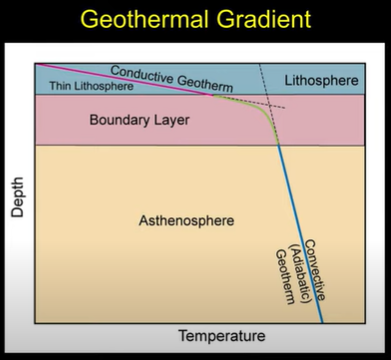
- geothermal gradient: profile of increasing
temperature with increasing depth
- geothermal gradient: profile of increasing
temperature with increasing depth
- Basalt -> Amphibolite
(Hornblende, plagioclase,
garnet); Shale -> Mica schist
(biotite, muscovite, quartz,
garnet); Quartz sandstone ->
Quartzite (quartz);
Limestone or dolomite ->
Marble (calcite or dolomite)
- associated with mountain
building (orogenic belts) at
convergent plate margins
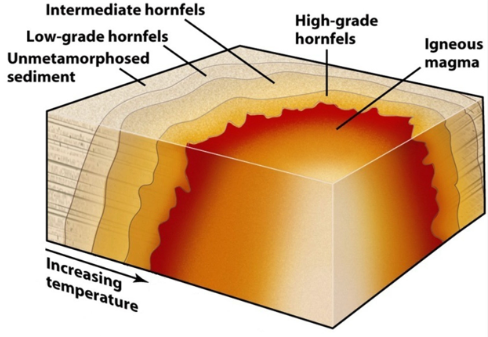
- Contact metamorphism: occurs from thermal effects of a nearby
igneous intrusive body. Associated with high temperature.
- Grade decreases as distance increases from contact aureole (zone of contact)
- Pressure and Differential Stress is rarely
significant because most contact occurs close to
surface (10 km)
- Most rocks will be nonfoliated
- Most rocks will be nonfoliated
- Grade decreases as distance increases from contact aureole (zone of contact)
- Metasomatism:
- Regional Metamorphism: metamorphism occurring over
large regional extent and considerable depth in crust
Media attachments
Want to create your own Mind Maps for free with GoConqr? Learn more.