
Mind map
phrasal verbs
Map content
phrasal verbs
look
- 1. Look after Meaning: To take care of someone or something. Example: Can you look after my cat while I’m on vacation? 2. Look at Meaning: To direct your eyes toward something or someone; to consider or examine something. Example: Look at that beautiful sunset!We need to look at the facts before making a decision. 3. Look forward to Meaning: To feel excited or happy about something that will happen in the future. Example: I’m looking forward to the party next weekend. She looks forward to meeting her friends again.
what are they?
- Phrasal verbs are made by combining a main verb with a small word like a preposition or an adverb. Together, they create a new meaning that is often different from the original verb. For example, the verb “take” means to grab or hold something. But when you add “off” (take off), it means to remove something (like clothes) or for a plane to leave the ground. Phrasal verbs are very common in everyday English, especially in speaking. That’s why it’s important to learn them to understand and speak English more naturally.
how do you use them?
- Phrasal verbs are made up of a main verb plus a small word called a particle (which can be an adverb or a preposition). Together, they form a new meaning that is often different from the original verb. Some phrasal verbs are separable, meaning you can put the object between the verb and the particle, especially if the object is a pronoun. For example: “She turned the lights off.” “She turned them off.” Other phrasal verbs are inseparable, so the verb and particle must stay together. For example: “He looked after the kids.” (not “He looked the kids after.”) Knowing whether a phrasal verb is separable or inseparable helps you use them correctly in sentences.
break
- ‘The thieves broke into the bank and stole the money. ‘Some couples break up after many years of relationship.’‘The car brakes won’t break down because I repaired them.’
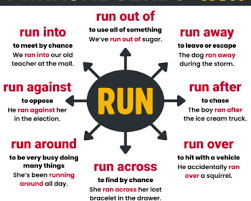
run
- run across: To find or meet something/someone by chance. run out of: To use all of something so there is none left. run into: To meet someone or something unexpectedly. run over: To hit someone or something with a vehicle.
come
- come across: To find or meet someone or something by chance. come up with: To think of an idea, plan, or solution. come back: To return to a place. come out: To appear or become known, or to be published. come down with: To become sick with an illness. Look
Images and files in the map

Information
- Description
- Mind Map on phrasal verbs, created by Ulloa Jonathan Diaz on 08/09/2025.
- Created by
- Ulloa Jonathan Diaz
- Views
- 0
- Rating